Federal judge blocks termination of Haitian TPS, keeps protections from ending Tuesday
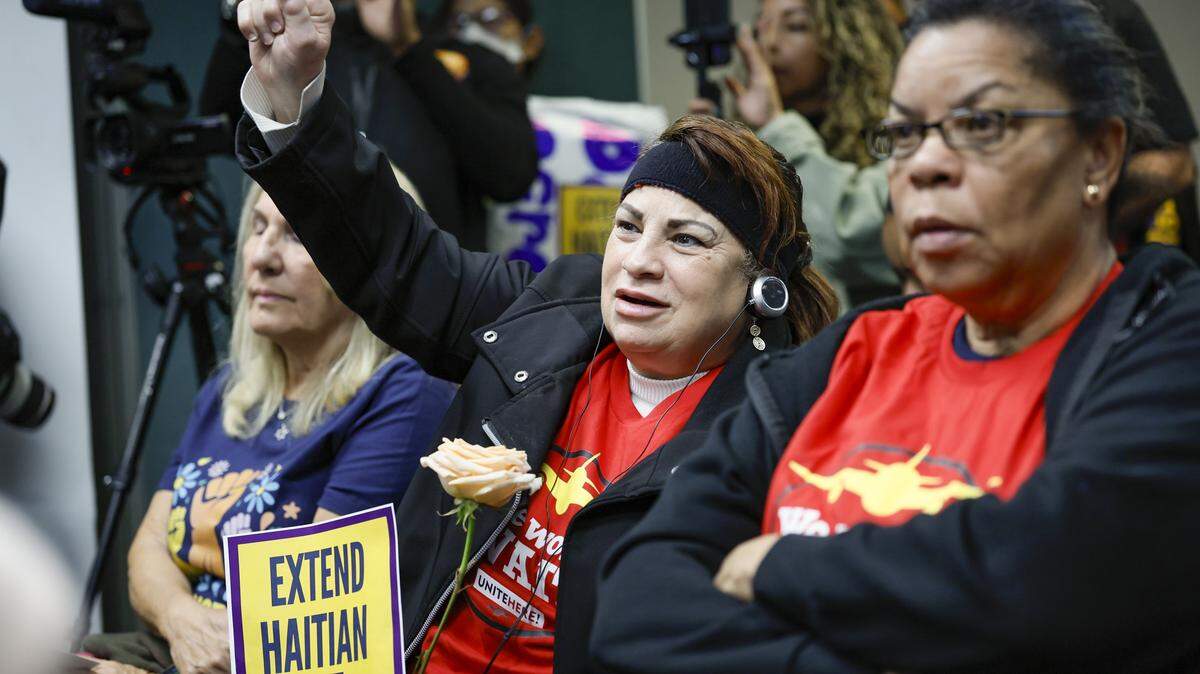
In a pointed rebuke of the Trump administration’s push to make hundreds of thousands of Haitian immigrants suddenly deportable from the United States, a federal judge in Washington blocked the Department of Homeland Security on Monday night from ending temporary immigration protections for Haitians, many of them in South Florida.
The decision halts, for now, the termination of Haiti’s Temporary Protected Status designation, which was set to end at 11:59 p.m. Tuesday. The pending order of termination from DHS Secretary Kristi Noem had triggered a wave of fear among the more than 300,000 Haitians who benefit from the status, because it put them at risk of being detained and deported back to their violence-torn homeland.
In her closely watched decision, U.S. District Judge Ana C. Reyes granted a motion to keep the administration from ending TPS for Haitians. Her decision means that, for the moment, Haitians who benefit from TPS will continue to have protections from deportations and will continue to have valid work authorizations.
The judge noted in her 83-page ruling that Haitians would face irreparable harm if sent back to Haiti, a country the administration’s own State Department says is overrun by criminal “terrorists gangs” and for which it has issued a “Do Not Travel” warning for U.S. citizens. A Biden appointee, Reyes saved her harshest criticism for Noem, whom she paints as someone prejudiced toward Haitians who did not base her termination decision on the law.
Reyes noted that Noem had referred to Haiti as “one of those (her word) ‘damn’ countries.” The DHS secretary, the judge said, ignored Congress’s requirement that she “review the conditions” in Haiti only “after” consulting “with appropriate agencies,” and added: “Indeed, she did not consult other agencies at all.”
Reyes also noted that Noem ignored the billions of dollars that Haitian TPS holders contribute to the economy. That “substantial revenue,” the judge said, generates $5.2 billion in taxes annually.
“Secretary Noem complains of strains unlawful immigrants place on our immigration-enforcement system. Her answer? Turn 352,959 lawful immigrants into unlawful immigrants overnight,” Reyes said. “She complains of strains to our economy. Her answer? Turn employed lawful immigrants who contribute billions in taxes into the legally unemployable. She complains of strains to our healthcare system. Her answer? Turn the insured into the uninsured. This approach is many things — in the public interest is not one of them.”
DHS lawyers argued that Noem’s decision to end TPS was not reviewable by the court. They argued that it was Congress’ intention when they created the law in 1990, not to give individuals the right to challenge the secretary’s decision, and asked for the case to be dismissed. “Yes, the statute does grant her some discretion,” Reyes wrote in the order about Noem. “But not unbounded discretion.”
“To the contrary, Congress passed the TPS statute to standardize the then ad hoc temporary protection system—to replace executive whim with statutory predictability,” Reyes said.
The judge countered Noem’s argument in her termination notice that having Haitians with TPS in the U.S. went against the national interest.
“Her ‘national interest’ analysis focuses on Haitians outside the United States or here illegally, ignoring that Haitian TPS holders already live here, and legally so,” said the judge.
‘Killers, leeches, and entitlement junkies’
Instead of arguing that Noem discriminated against Haitians based on their nationality, advocates for Haitians had argued to the judge that the decision was made because they are Black and that Noem and the president’s animosity toward Haitians is based on race rather than nationality. It is the first time that the equal-protection claim has gone before the courts exclusively on the issue of race.
Reyes notes that three days after announcing the end of Haiti’s TPS designation, Noem took to social media and announced a travel ban, which included Haiti.
Noem referred to the nationals of those countries in the travel ban as “killers, leeches, and entitlement junkies.”
But the judge noted in her ruling the five TPS holders who filed the lawsuit are a neuroscientist, a software engineer, a laboratory assistant, a college economics major and a registered nurse.
In their suit, they argued that Noem preordained her termination decision and did so because of hostility to nonwhite immigrants.
“This seems substantially likely,” Reyes said. “Secretary Noem has terminated every TPS country designation to have reached her desk—twelve countries up, twelve countries down.”
She concluded her ruling by highlighting an old adage among lawyers:
“If you have the facts on your side, pound the facts. If you have the law on your side, pound the law. If you have neither, pound the table,” Reyes said. “Secretary Noem, the record to date shows, does not have the facts on her side — or at least has ignored them. Does not have the law on her side — or at least has ignored it. Having neither and bringing the adage into the 21st century, she pounds X (f/k/a Twitter).”
Appeal expected
Immigration advocates and lawyers involved in the litigation applauded the decision.
Ira Kurzban, a nationally recognized immigration lawyer whose Miami-based firm helped litigate the case, said the facts of the case spoke for themselves. His firm is among a cadre of law firms that filed the case.
“Tonight, the district court, in the heart of our capitol, plainly and in a straightforward manner found that the Trump administration in ending Temporary Protected Status for the 350,000 Haitians in the U.S. engaged in race discrimination because of its hostility to nonwhite immigrants, mischaracterized who the Haitian plaintiffs are and their contributions to the U.S. and ignored the conditions in Haiti that would bar Haitians being sent back to that country,” he said.
“Noem’s actions violated the TPS statute and the founding principles of our country when she prejudged their cases and decided to deny any extension of TPS for Haitians without considering the evidence she was required to by law,” he added. “The district court judge stayed the termination of TPS and plainly stated that the government may not remove or deport Haitians with TPS and may take no action to remove their employment authorizations.”
Todd Schulte, president of the advocacy group FWD.us, said Reyes’ ruling “brings much-needed temporary relief” to both beneficiaries of TPS and the communities they live in.
“These are parents raising U.S. citizen children, workers in essential jobs, and community members deeply rooted in the fabric of American life,” he said in a statement. “Stripping these protections wouldn’t just put lives at risk. It would destabilize families, harm local economies, and weaken the very communities and workforce that strengthen America.”
The administration, which has canceled the TPS designation for a dozen other countries including Venezuela and Nicaragua, is expected to appeal the decision to the Supreme Court. In other cases, the administration has asked the court to lift injunctions imposed by lower court judges so that deportations can continue while litigation proceeds.
President Barack Obama put the Haiti TPS designation in place after the country’s devastating 2010 earthquake left more than 300,000 dead and 1.5 million homeless. While the quake nearly destroyed the Haitian capital, the country today finds itself in even worse shape: there is not one elected official nearly five years after President Jovenel Moïse was assassinated, gangs are running amok and the pending end of the mandate of a ruling presidential council has heightened fears of more violence and instability.
Advocates and beneficiaries have said the end of TPS would send Haitians to their deaths, describing how armed gangs are responsible for thousands of killings, rapes and have left more than 6 million people in need of humanitarian assistance, including over 1.4 million who have been forced to flee their homes.
In South Florida, where more than 150,000 Haitians hold TPS, business leaders have raised concerns about the potential economic impact of losing workers.
Read more: Haitian TPS ends on Tuesday. No economy will be hit harder than Greater Miami’s
The suit was brought by the five plaintiffs after another group of Haitians and some of the lawyers prevailed in an earlier case, when Noem tried to reduce a Biden administration 18-month TPS extension by six months. In July, a federal judge in New York ruled that Noem had exceeded her authority, and restored the original Feb. 3, 2026, termination date. DHS said it disagreed with that ruling, but later announced plans to end the designation this week.
In notices published in the Federal Register, DHS has acknowledged that criminal gangs are widespread in Haiti but said conditions are safe enough for Haitians to return – and that keeping the TPS designation in place is contrary to U.S. national interests.
The plaintiffs are represented by Kurzban Kurzban, Tetzeli & Pratt and Just Futures Law. Along with the lawsuit, Just Futures Law and NYU Professor Ellie Happel also assisted in filing Freedom of Information lawsuits demanding memos related to the decision.
Read more: ‘I am breathing, but I am not living’: Fear rises among Haitians as TPS end nears
Miami Herald staff writer Jay Weaver contributed to this report.
This story was originally published February 2, 2026 at 7:40 PM.