
DHS approves Florida’s $608 million request to pay for Alligator Alcatraz
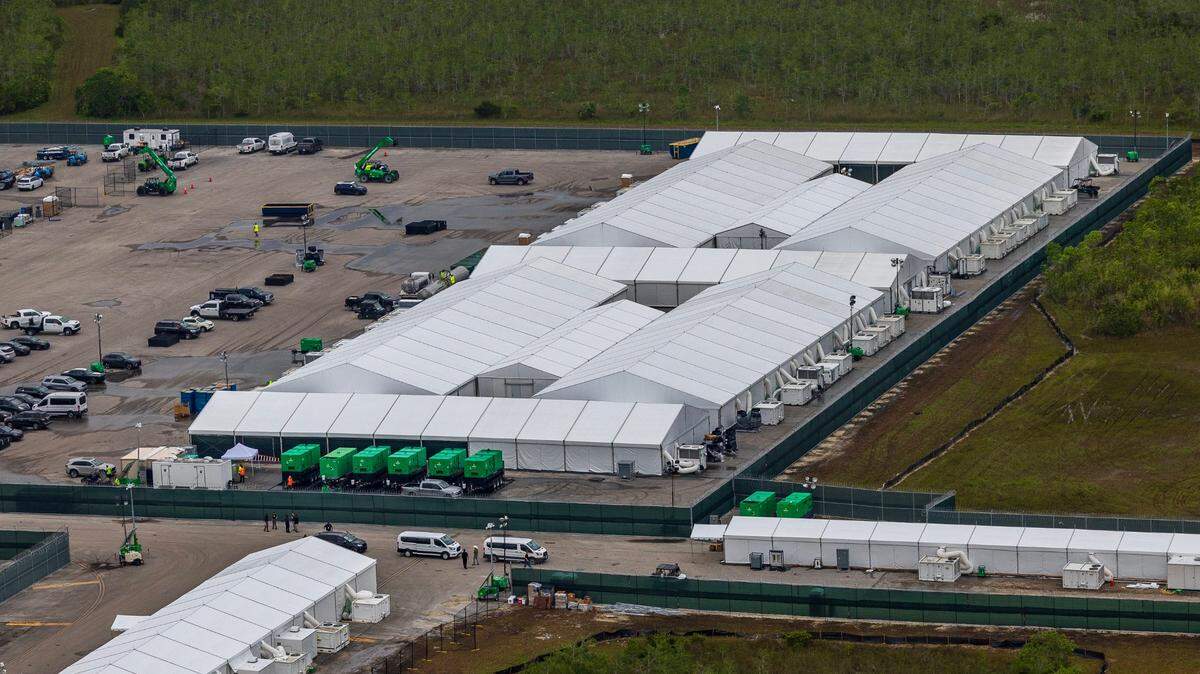
The Federal Emergency Management Agency has approved the state of Florida’s application for a $608 million grant to cover expenses related to immigration detention and enforcement, including at Alligator Alcatraz.
Although the grant application was approved on Sept. 30, the state said it has yet to receive any of the money.
“To date, no funds have been awarded to the State of Florida,” said Stephanie Hartman, director of communications for the Florida Division of Emergency Management.
In an email to the Miami Herald on Friday, Hartman stated that for the state to receive the money it must still follow the federal agencies’ reimbursement guidelines, which review every expense before handing over payment.
“As with the existing FEMA reimbursement process, once expenses are incurred, reimbursements will be requested from and reviewed by FEMA.” Hartman said. “Following approval, the appropriate funds will then be released to the state.”
When the state begins receiving federal funds, it could put its operations at Alligator Alcatraz in a precarious position, potentially leading to another closure of the site.
Environmental groups and the Miccosukee Tribe argued in a lawsuit filed in June that in their rush to build the facility, the state and federal governments failed to follow federal environmental regulations, which require an environmental impact assessment for such projects. They stated that continuous operation of the site caused irreparable damage to the surrounding wetland.
A federal judge agreed with the environmental groups and ordered the government to stop accepting new detainees at the site and to halt all construction, effectively shutting down the site within 60 days.
That decision, however, was short-lived, as a split decision of the Atlanta-based Eleventh Circuit Court of Appeals paused the underlying case and stopped the order. The appeal judges sided with the government’s argument that the federal environmental law, known as the National Environmental Protection Act, does not apply to state agencies. They reiterated the argument from the state and federal governments that all operations and funding at Alligator Alcatraz were by the state. The Florida Division of Emergency Management oversees the site.
The appeal judges also noted that, at the time, the state had not received any federal funding for its expenses at the detention facility and therefore should not be subject to federal environmental laws. They said that could change if the state filed and received federal money.
“There may come a time when FDEP applies for FEMA funding. If the Federal Defendants ultimately decide to approve that request and reimburse Florida for its expenditures related to the Facility, they may need to first conduct” an environmental impact statement, the judges said.
In the lawsuit, the state stated in August that it had already spent about $250 million at Alligator Alcatraz. Most of the expenses are linked to contracts with private companies that were awarded under a 2023 emergency order declaring illegal immigration an emergency, which allowed the administration of Gov. Ron DeSantis to bypass laws that would have required following specific vendor acquisition regulations.
When the facility, located on the Dade-Collier Training and Transition Airport in the middle of the Big Cypress National Preserve, opened, the Department of Homeland Security estimated that the site would cost Florida taxpayers $450 million annually.
During her visit to the site with President Donald Trump, Homeland Security Secretary Kristi Noem promised that FEMA would reimburse the state for those expenses through its $650 million shelter fund. The Biden administration created the program in 2023 to allow FEMA to award grants to state, local, or nonprofit organizations that provide support services to migrants released from ICE custody.
Upon the announcement of the grant approval, environmental groups immediately contended that, when the state receives federal funds, it is required to conduct an environmental review.
Elise Bennett, Florida and Caribbean director at the Center for Biological Diversity, one of the environmental groups involved in the case, called the award from FEMA a “smoking gun” that proves the group’s lawsuit is “entirely correct.”
“This is a federal project being built with federal funds that’s required by federal law to go through a complete environmental review. The Trump administration can’t keep lying through their teeth to the American public at the expense of Florida’s imperiled wildlife. We’ll do everything we can to stop this lawless, destructive, and wasteful debacle,” Bennett said.
Oral arguments regarding the merits of the state’s appeal of the lower court decision are scheduled for January.
This story was originally published October 3, 2025 at 5:13 PM.