As school starts in South Florida, families fear increased immigration enforcement
As South Florida students return to class for the new school year, many parents are not just worried about their children doing well in school and getting along with their classmates.
They are also worried about increased immigration enforcement.
In Miami-Dade County, where at least 82,000 students are English language learners — many of whom come from “mixed-status” families, where family members have varying immigration statuses — returning to school can mean anxiety and fear of immigration enforcement actions breaking apart families.
“We have a lot of fear. We go from home to work and work to home,” said Roselia, a Miami-Dade County Public Schools parent of four who is undocumented. She asked the Herald to use only her first name, citing her fears of deportation.
Roselia worries that she could be deported and that her four children, all born in the U.S., will come home from school without a parent to care for them.
Federal agents can now legally enter schools if they have a warrant or consent, and since local law enforcement has deepened cooperation with U.S. Immigration and Customs Enforcement, some families say they live in constant fear that a school day could end with a parent or a child questioned by immigration officials, or even in detention.
While most removals happen quietly, without teachers or classmates even knowing, the Miami Herald has documented several cases where students have been deported, had their parents deported or now live with the daily possibility of separation — a fear that is reshaping classrooms across South Florida.
“People are getting picked up every day. … Kids are going to go back to school in the fall, look to their left, look to their right, and it’s going to be kids missing,” said Frieda Goldstein, an immigration attorney and former U.S. immigration prosecutor for the U.S. Department of Justice.
Adding to the fear is the 287(g) program, which empowers local officers to act as immigration agents. Miami-Dade County Public Schools boasts that it has the largest school police force in the nation. Though there have not been any public conversations about the school police force signing a formal agreement with ICE, immigration advocates fear the possibility.
For Cesar Garcia, an incoming middle school teacher at iPrep Academy in downtown Miami, the start of his first year teaching brings both excitement and difficult conversations around immigration.
Garcia, an immigrant from the Dominican Republic who is now a U.S. citizen, will be teaching critical thinking, personal finance and business.
He said that teachers he knows who deeply care about their students are already having difficult conversations about what to do if immigration officials were to show up at school and how best to support students who may be affected.
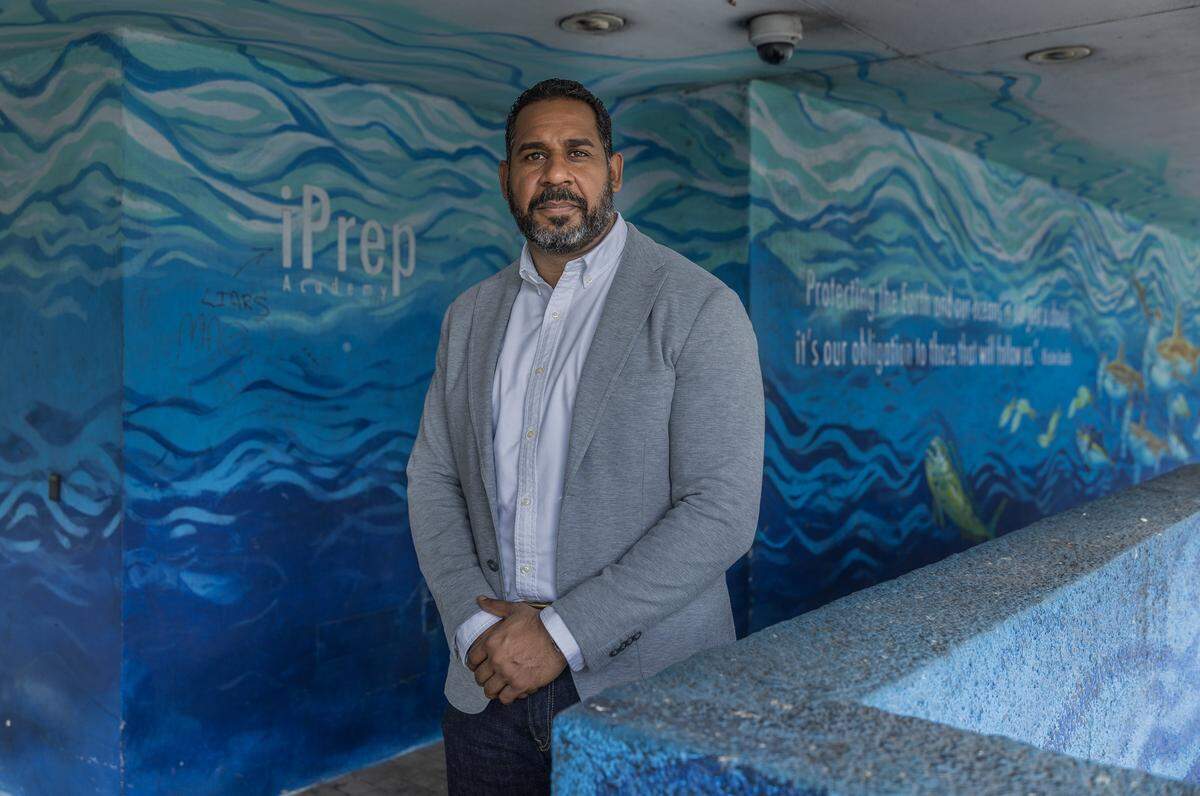
“I would never let a kid be taken away,” he said. “As a citizen of the United States and an immigrant, I think everyone in this country has rights, and they need to go through due process. We have seen a huge disregard for following the law — and this is supposed to be law enforcement.”
“I understand we need to address the immigration situation,” he added, “but I disagree with how it’s being implemented.”
Empty seats in the classroom
Two students won’t be returning to Coral Springs Elementary School on Monday, the first day of school in Broward County.
Geronimo and Salome, a kindergartener and a third grader, were deported alongside their father to Colombia in May, according to their mother, Catalina, and a lawyer representing the mother. Catalina is now awaiting deportation in detention. She agreed to speak with the Herald using only her first name because she fears repercussions while in detention.
Catalina, who is from Colombia and has been in the United States since October 2021 with an asylum case in process, was detained along with her children’s father, Yohan. When ICE told them that their two children would be detained as well, Catalina had to call a friend to pick up Salome, 10, and Geronimo, 5, from their public school in Broward County, she said.
At the ICE field office in Miramar, the children were crying as agents tore Catalina away from her son and daughter, said Goldstein, their lawyer.
Catalina said in Spanish that the female ICE officer told her “hand over your children because they’re facing deportation.”
After a day in immigration detention, the father and the two children boarded a plane back to Colombia, leaving their mother, life and school in the United States behind.
“There they are in school one day, going to school in Broward County, doing great things, and the next day, their life is ripped apart,” said Goldstein.
“They were very fine … happy… studying,” Catalina said over the phone from detention.
Catalina did not have a deportation order, according to her attorney. But she is now awaiting deportation in detention in Louisiana. She wanted to remain in the United States and see her asylum case through but took her lawyer’s advice to sign a self-deportation form. But she was told she must wait to actually leave.
Catalina was never able to call the school to tell them what happened because phone calls are expensive from inside detention. Even her calls with her children have been limited because of the cost and a bad connection.
“It is very sad,” Catalina said over a broken phone line from detention.
Keandra Fulton, the principal at Coral Springs Elementary, said she was unaware of the siblings’ deportation or any other deportations impacting students at her school.
Upon learning the news, she said, “It is obviously troubling because our priority is that our students are safe and receiving an education.”
“It makes you wonder how many others could be impacted,” she added.
The problem is not unique to Broward. In the southern part of Miami-Dade, two siblings at Redland Middle School were repatriated to their home country of Mexico after their mother was held in detention and then deported, according to repatriation documents obtained by the Herald and email correspondence with the mother.
Parents need to take measures to be protected, advocates say
Catalina’s family’s experience is a cautionary tale for undocumented parents with children in schools, Goldstein said. Immigration advocates and attorneys are advising families to ensure that their emergency contact cards are up to date in case a parent is detained and the school needs to release the child to a friend or family member.
Felipe Sousa-Lazaballet, the executive director of Hope Community Center, a 50-year-old organization in Central Florida that supports immigrants, said he knows of multiple families where parents were detained while the child was in school.
“It is widespread,” he said, adding that students impacted “are just in great distress, emotionally speaking.”
In Apopka, Florida, near Orlando, Esvin Juarez, a Guatemalan father who’d been living in the United States for over 20 years, was deported after showing up to his immigration check-in. The mother of the family was also detained and eventually deported, according to Sousa-Lazaballet and news reports.
Their four children, all American citizens, have been left behind — and the eldest daughter, Beverly Juarez, 21, is now tasked with caring for her three siblings.
Renata Bozzetto, the deputy director of the Florida Immigrant Coalition, advised all immigrant families to ensure they have a guardianship form filled out that assigns temporary care of children to someone they trust. The form must be notarized, and Bozzetto says it is best to have a lawyer help fill it out, although it is not necessary.
Bozzeto’s organization offers weekly events where interested participants can get free legal help.

Families should also ensure that the name of that guardian is listed as one of their child’s emergency contacts on school paperwork.
According to a public record obtained by the Herald, at Phyllis R. Miller Elementary in the Upper East Side of Miami, there was an instance in which a student’s mother was held in a correctional facility, and the principal needed to sort out who to release the student to.
“We know it is very difficult for a parent to think about a situation where they will not be there, and hopefully nothing bad will happen, but they need to take measures in this moment to be sure they are protected,” said Bozzetto.
‘Living in a state of fear’
Roselia, the mother of a 15-year-old sophomore at South Dade Senior High, says she has no plans to attend school events this year.
Roselia, who is from Chiapas, Mexico, has been in the United States for 19 years. She met her husband, who is from Guatemala, after they both immigrated, and they have built a family together. Both are undocumented.
In the summer, Roselia’s daughter Cristal, a 15-year-old sophomore, works alongside her at a small plant nursery in Homestead.
Cristal and her siblings were all born in the United States, and her mother tries not to burden her four daughters with the fact that both of their parents are undocumented and live at risk of deportation.
When her daughter was in kindergarten, Roselia volunteered at the school to help the teacher with the garden. “I was always there. We brought food to the schools,” Roselia said.
But now, Roselia says the fear of deportation is so strong that she avoids reading the news completely. “If I read, I won’t sleep,” she says.
U.S. Rep. Frederica Wilson, a former educator whose Miami-Dade district includes many immigrant communities, said she’s alarmed by the immigration enforcement activity around Miami, including the holding of people in conditions she believes are inhumane.
“I think that a lot of children and a lot of families are living in a state of fear, and that should not be the case,” Wilson said. “This is not who we are as a nation.”
“I don’t want Miami-Dade to become so terror-ridden that [families] are scared to go to school,” she added. “Children should go to school, they should be safe, they should be protected, they should be in school learning.”
What can ICE do?
The superintendent for Miami-Dade County Public Schools has said there have been no known incidents of ICE or other federal immigration agents showing up at school campuses. But a source within the district confirmed there was one instance where ICE agents were questioning construction workers who were at a school site. The workers were contractors, not district employees.
The superintendent for Broward County Public Schools also said there have been no instances of ICE showing up at schools.
Nonetheless, parents like Roselia are fearful. Videos and news reports of immigration agents picking people up outside of courts make them wonder: Could they also do the same outside school campuses?
Before an executive order signed on the first day of Donald Trump’s presidency, schools, hospitals and churches were considered “protected areas,” and federal officials could not enter the spaces.
But that has all changed. Law enforcement enforcing immigration laws can now legally enter a school site with a judicial warrant, and there have been examples of agents attempting to enter schools, including in the nation’s second-largest school district, in Los Angeles.
Districts across the state and country have offered different guidance and protocols to principals regarding how firmly they will uphold the law and what they would do if officers enforcing immigration laws were to show up on campus. The procedures and interpretation of the law and guidance vary widely.
Lee County Schools, on Florida’s Gulf Coast, for example, has a policy that ICE officers can interrogate and arrest any “alien or person believed to be an alien as to his right to be or remain in the United States.”
Miami-Dade has said that it will follow all local, state and federal laws.
A document shared with the Herald that was sent to Miami-Dade school principals in January reminds administrators that all students, regardless of immigration status, are legally entitled to a free and public education. It also notes that the school cannot maintain any information regarding a student’s or parent’s immigration status and that students cannot be interviewed by any officer seeking to enforce immigration laws without a warrant signed by a judge, a parent’s consent or a court order.
It also advises principals to contact the school attorney if there is ever an interaction with law enforcement.
But there has been no such reminder of policies publicly posted or sent out to parents, and immigration advocates say vague protocols can create fear.
“The absence of guidance is an issue,” said Bozzetto.
Complicating the matter is the fact that the Miami-Dade Sheriff’s Office and many other local law enforcement agencies in South Florida are now enrolled in the 287(g) program, which deputizes local officers to enforce immigration policies — meaning there are more eyes on the street as parents take children to and from school and after-school activities.
The school districts provide bus transportation to and from school, but there is not always transportation available for after-school activities, and parents and children without legal status are often most at risk of being stopped and questioned while driving. One of the most common ways immigrants get arrested in Florida is for driving without a license, a misdemeanor charge that has ended up with people being detained.
Miami-Dade Schools Police, the largest school police force in the nation, has not signed on to the 287(g) program, and the Broward Sheriff’s Office did not explain how its relationship with the public school system will be impacted by its own 287(g) agreement. Some of the school resource officers in Broward are from the Sheriff’s Office.
Fulton, the principal at Coral Springs Elementary, says she has noticed a drop in attendance but that it’s hard to attribute to parents being afraid to send their children to school because there has been a decline overall due to more students attending charter and private schools.
A data analysis of attendance records from Miami-Dade Public Schools between January and March did not show a trend of declining attendance, even at schools with the highest number of recent U.S. arrivals.
Bozzetto said that during a recent town hall, a member of the Haitian American community in Miami discussed the idea of virtual school in order to avoid the risk for students of attending in person.
In Palm Beach County, there was a high school student who was scared to attend school because she was worried about putting her mother, who is from Brazil, at risk, according to Bozzetto.
“What we don’t want is for kids to be out of school for fear,” said Bozzetto.
Luisa Santos, a Miami-Dade school board member who was once an undocumented student herself, says she hopes that undocumented students or students with parents who are not permanent residents can find solace in knowing that she, too, was once scared to show up at school for fear of deportation.
“I have felt firsthand what it means to be extremely afraid. There’s real fear, and it is probably 100 times stronger now,” said Santos.
“I will do everything in my power to make sure students are not worried,” she said. “Schools are sacred spaces for learning.”
This story was originally published August 8, 2025 at 1:56 PM.