Federal judge blocks Trump order on birthright citizenship, approves class-action case
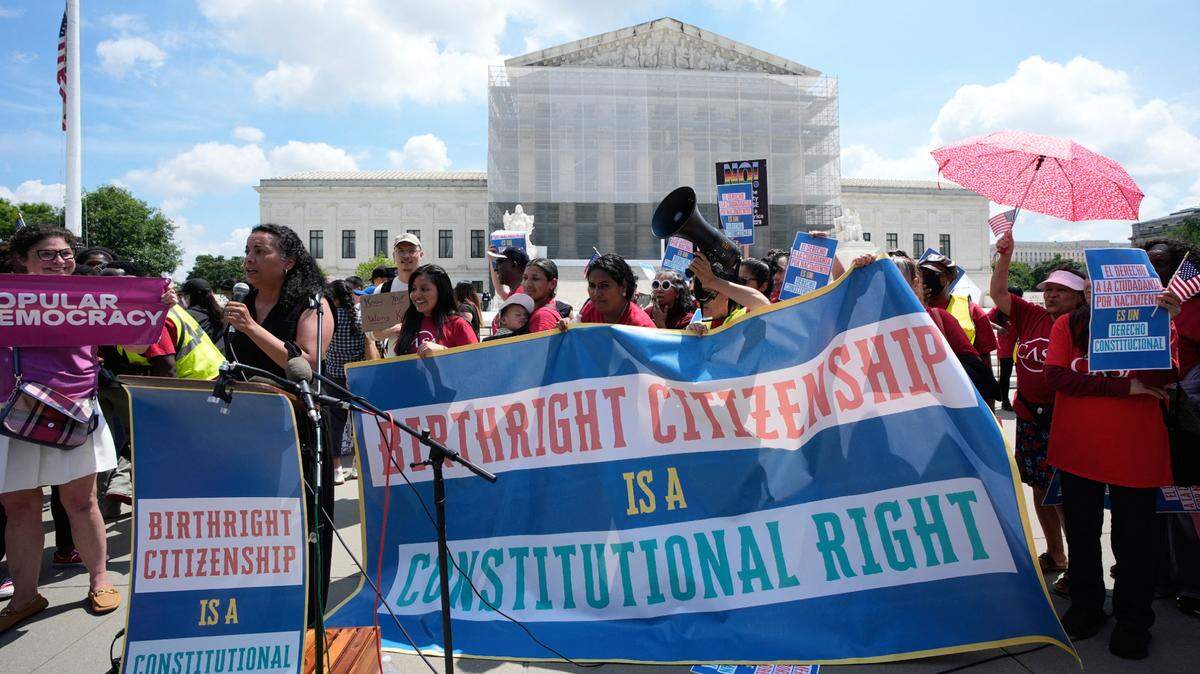
On the heels of a major Supreme Court ruling, a federal judge on Thursday approved a class-action case representing U.S.-born children of undocumented parents as protection against President Donald Trump’s order seeking to strip them of birthright citizenship guaranteed by the Constitution.
In his order, U.S. District Judge Joseph N. Laplante of New Hampshire issued a nationwide injunction to shield the class of children born in the United States on or after Feb. 20, 2025, to parents with no immigration papers or with temporary visas. Laplante, who was appointed by President George W. Bush, put his order on hold for seven days to allow the Trump administration to appeal his decision.
His order comes less than two weeks after the U.S. Supreme Court ruled in favor of the administration in its bid to throw out nationwide injunctions issued by three federal judges in three separate lawsuits challenging the White House executive order.
In a 6-3 ruling, the court vacated nationwide injunctions issued by federal judges in Maryland, Washington state and Massachusetts, removing the broad scope of their decisions blocking Trump’s Jan. 20 order, which was to take effect 30 days later. Those cases, however, were not certified as class actions.
The Supreme Court’s ruling in late June meant the judges’ injunctions blocking Trump’s executive order only affected the jurisdictions where immigrant groups filed their lawsuits — leaving the rest of the country, including Florida, subject to the president’s citizenship order. But in a concurring opinion, Justice Brett Kavanaugh wrote that a class action might be the legal avenue for seeking nationwide injunctions.
That same day, the American Civil Liberties Union filed the proposed class action in New Hampshire on behalf of recently born babies and their undocumented parents, seeking a universal injunction. Judge Laplante certified the class and injunction on a temporary basis, but only for the children.
The A.C.L.U.’s lawsuit warned that under the terms of Trump’s order, children born to parents in the country unlawfully risked being rendered “effectively stateless.”
“For families across America today, birthright citizenship represents the promise that their children can achieve their full potential as Americans,” the lawsuit said. “It means children born here can dream of becoming doctors, lawyers, teachers, entrepreneurs or even president — dreams that would be foreclosed if their citizenship were stripped away based on their parents’ status.”
In his order, Judge Laplante said that Trump’s executive action would clearly harm the class he certified — recently born and future children of undocumented parents. He said he decided to block the president’s order because the harm faced by the people who brought the lawsuit far outweighed any potential harm to the government. He also said the plaintiffs would likely succeed in arguing that Trump’s order was unconstitutional.
Birthright citizenship has its origins in English common law and was enshrined in the U.S. Constitution through the 14th Amendment.
The amendment holds that “all persons born or naturalized in the United States, and subject to the jurisdiction thereof, are citizens of the United States and of the state wherein they reside.”
Courts have consistently rejected the idea, put forth in Trump’s order, that children born to undocumented immigrants should not be covered by the 14th Amendment. Many constitutional law experts believe that the Trump order is unconstitutional on its face.
The majority opinion in the Supreme Court’s case did not rule on the merits of the president’s order. Instead, its order boiled down to a key finding that so-called universal injunctions issued by judges “likely exceed the equitable authority that Congress has granted to federal courts.”
”The Government is likely to succeed on the merits of its argument regarding the scope of relief,” Justice Amy Coney Barrett wrote in the majority opinion, citing the 1789 Judiciary Act passed by Congress that created the federal court system. “A universal injunction can be justified only as an exercise of equitable authority, yet Congress has granted federal courts no such authority.”
In a dissent, Justice Sonia Sotomayor accused the Trump administration of playing a game by asking the high court to allow it to apply the president’s “unconstitutional” citizenship order “to everyone except the plaintiffs” in the lawsuits challenging it.
“The gamesmanship in this request is apparent and the Government makes no attempt to hide it,” wrote Sotomayor, who was joined by Justices Ketanji Brown Jackson and Elena Kagan. “Yet, shamefully, this Court plays along.”
Calling the court’s ruling a “travesty,” Sotomayor emphasized that removing nationwide injunctions risks creating a patchwork of rights, where children born in some states may be considered citizens while others are not — leading to uncertainty, confusion and possible constitutional violations.
Jackson, who grew up in Miami and is the latest member of Supreme Court, concurred: “The Court’s decision to permit the Executive to violate the Constitution with respect to anyone who has not yet sued is an existential threat to the rule of law.”
Critics of the court’s ruling say that nationwide injunctions are necessary to prevent unconstitutional actions from taking effect nationwide. They argued that if the high court limited national injunctions, Trump’s policy could go into effect in areas where lawsuits have not yet been filed, creating a patchwork of enforcement issues across the country. This could lead to widespread legal uncertainty and a waterfall of litigation — which might be the unspoken aim of the Trump legal team.
Such a development could have sweeping implications in a state like Florida, where the federal government found that over half a million residents are undocumented. Other estimates put that number close to 1 million. And researchers have also found that roughly 280,000 children live with at least one undocumented relative, in many cases a parent.