Supreme Court blocks Trump administration on Alien Enemies Act deportations
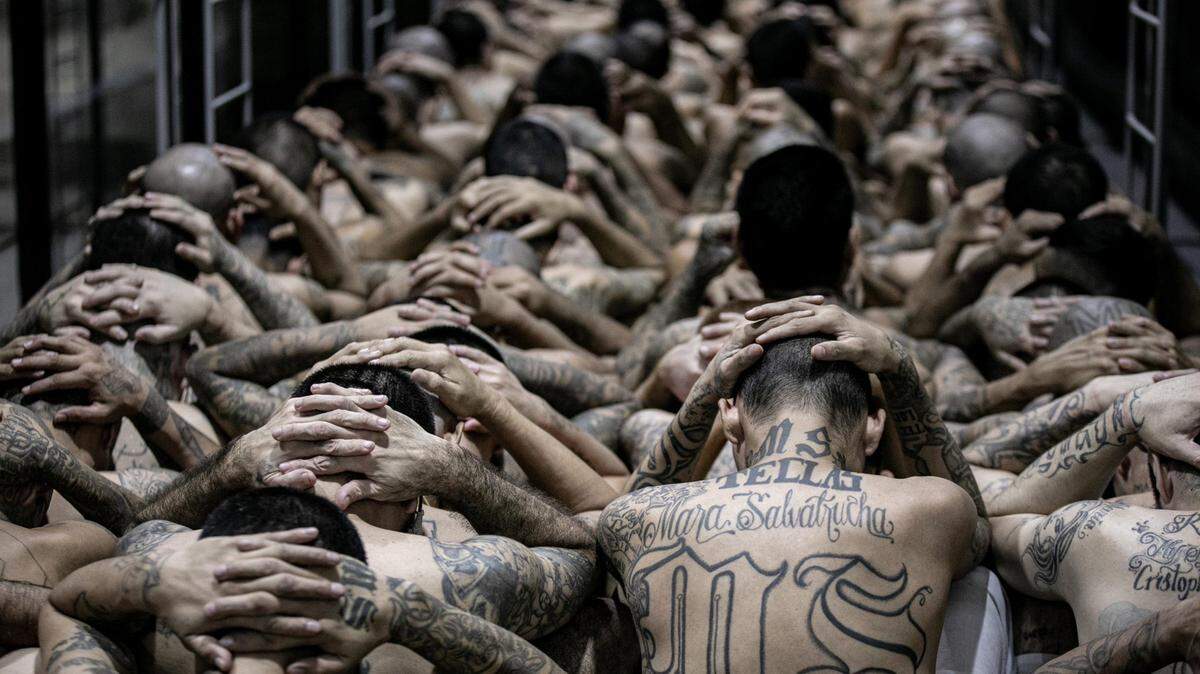
The Supreme Court on Friday extended a block on the Trump administration from deporting suspected Venezuelan gang members who are being detained in parts of Texas to a mega prison in El Salvador under a wartime powers act.
The justices also reprimanded federal authorities for failing to provide the detainees with more due process under the Alien Enemies Act.
In a 7-2 vote, the court’s emergency decision prevents immigration agents from removing alleged members of the Tren de Aragua gang under the 1798 law as two detainees pursue their challenge in the federal Northern District of Texas.
President Donald Trump, in a post on his media platform Truth Social, immediately blasted the justices: “THE SUPREME COURT WON’T ALLOW US TO GET CRIMINALS OUT OF OUR COUNTRY!”
“The Supreme Court of the United States is not allowing me to do what I was elected to do,” Trump added. “This is a bad and dangerous day for America!”
The Supreme Court, however, stopped short of addressing a request by the detainees’ lawyers with the American Civil Liberties Union to decide the merits of the case — whether Trump can use the archaic law to deport the suspected TDA gang members.
“To be clear, we decide today only that the detainees are entitled to more notice than was given,” the court’s opinion states.
The justices ordered the lower courts to act “expeditiously” in coming up with a process for reviewing the migrants’ challenge to their detention under the Alien Enemies Act.
In the majority opinion, the Supreme Court took the Trump administration to task for giving as little as 24 hours’ notice before attempting to deport suspected Venezuelan gang members to the mega prison in El Salvador.
“Notice roughly 24 hours before removal, devoid of information about how to exercise due process rights to contest that removal, surely does not pass muster,” the court wrote in its unsigned opinion.
The justices noted that the U.S. Court of Appeals for the Fifth Circuit, based in New Orleans, dismissed the Venezuelan detainees’ appeal based on a lack of jurisdiction and denied their motion for an injunction as premature because they “gave the [Texas District] Court only 42 minutes to act.”
“Here the District Court’s inaction—not for 42 minutes but for 14 hours and 28 minutes—had the practical effect of refusing an injunction to detainees facing an imminent threat of severe, irreparable harm,” the justices wrote.
After imposing the injunction themselves, the justices sent the detainees’ petition back to the Fifth Circuit “to determine in the first instance the precise process necessary to satisfy the Constitution in this case.”
Justices Samuel Alito and Clarence Thomas dissented. In his dissent, Alito criticized the majority for what he described as overreach.
“From the Court’s order, it is not entirely clear whether the Court has silently decided issues that go beyond the question of interim relief. (I certainly hope that it has not.) But if it has done so, today’s order is doubly extraordinary,” Alito wrote.
Adelys Ferro, executive director of the Venezuelan American Caucus, an advocacy group supporting the Venezuelan community in the U.S., welcomed the Supreme Court’s decision to shield a group of Venezuelan men detained by Immigration and Customs Enforcement from deportation to El Salvador. Federal authorities have alleged the men were members of the Tren de Aragua gang.
“The Supreme Court’s decision reaffirms what we’ve been calling for since the beginning of these proceedings: that every individual deserves the right to due process,” Ferro said.
She emphasized that it should be up to the courts, not immigration authorities, to determine whether someone has valid grounds to remain in the United States or be deported.
“Their backgrounds must be thoroughly reviewed, and if crimes have been committed, they should be held accountable,” she said. “But no one should be accused of a crime without due process.”
Federal court documents show the Trump administration has acknowledged that “many” of the 137 Venezuelans it deported to El Salvador on March 15 as alleged gang members, under wartime presidential powers, had no criminal records in the United States. Officials argued their clean records were due to their recent arrival in the country.
A Miami Herald investigation found that among those already deported without due process were asylum seekers and refugees. Many were flagged based largely on tattoos and a controversial identification guide, rather than verified criminal histories.
READ MORE: Administration: ‘Many’ Venezuelans sent to El Salvador prison had no U.S. criminal record
In its aggressive targeting of illegal immigrants, the Trump administration has zeroed in on the Venezuelan gang members by invoking the wartime powers act, which had only been invoked three times in the nation’s history: during the War of 1812 and World Wars I and II.
The ACLU has so far filed at least eight lawsuits challenging the Alien Enemies Act in Texas, New York, Colorado, Pennsylvania, Nevada, Washington and Georgia. Federal judges in six of those cases have issued provisional orders stopping the administration from using it to expel Venezuelans accused of belonging to Tren de Aragua to the prison in El Salvador.
In Texas and other states, detainees sought a review by federal judges after the Trump administration in mid-March flew about the Venezuelans that it accused of belonging to the Tren de Aragua to the Terrorism Confinement Center in El Salvador as part of a deal it had brokered with the country’s leader, Nayib Bukele.
But a federal judge In Washington, James Boasberg, put future removals of the Venezuelans on hold to determine whether they were subject to the Alien Enemies Act. The Justice Department persuaded the Supreme Court to lift the stay imposed by Boasberg, an appointee of President George W. Bush.
In a split 5-4 vote in April, the high court ruled the Trump administration could continue the deportations under the wartime powers law, but that the Venezuelan immigrants must first be allowed to challenge their removals on an individual basis by filing habeas corpus petitions in federal court in Texas.
Meanwhile, several lower court judges have concluded that the administration has exceeded the scope of the 1798 law, which can be invoked only when the United States has been subject to “invasion” or “predatory incursion,” and have blocked the deportation of groups of Venezuelans.
In early May, a federal judge in the Southern District of Texas ruled that the Trump administration cannot use the 18th Century law — meant to be deployed against members of a hostile foreign nation during a declared war or military invasion — as a basis to deport undocumented immigrants in the U.S. who supposedly belong to the violent Venezuelan gang.
Lawyers for the Trump administration have acknowledged in a major case involving a challenge to the Alien Enemies Act that immigration authorities mistakenly deported a Maryland man to the mega prison in El Salvador along with members of Tren de Aragua. Despite the admission of an “administrative error,” the lawyers said the government lacked the authority to return him to the United States.
In Maryland, U.S. District Judge Paula Xinis ordered immigration authorities to bring back the man, Kilmar Armando Abrego Garcia. The Supreme Court upheld her decision, ruling that the Trump administration must “facilitate” Abrego Garcia’s return from the Salvadoran prison. But since the high court’s ruling, Trump and senior officials have not taken steps to bring him back to the United States.
Abrego Garcia, who at one time was accused by a government confidential source of being a member of the Salvadoran gang MS-13, was allowed to stay in the United States in 2019 after an immigration judge stopped his removal order to El Salvador.
But in March, Abrego Garcia, whose wife is a U.S. citizen, was stopped by Immigration and Customs Enforcement officers who “informed him that his immigration status had changed,” according to his attorneys.
Abrego Garcia, the father of a 5-year-old son, was detained and then transferred to Texas before being sent to El Salvador.
The Miami Herald and other outlets have published stories showing many of the Venezuelans sent to El Salvador do not appear to have criminal records in the United States or elsewhere. One CBS investigation found three-quarters of the men seemed to lack any criminal history anywhere.
This story was originally published May 16, 2025 at 5:30 PM.