
Venezuelan migrants walked to the U.S. border — then slept in a Doral park for days
With a bullet and 12 screws in his left leg from a protest in his native Venezuela, Alexis Meléndez set off on foot in mid-January from his country through the wilderness and cities of Latin America, hoping to reach the United States.
The house painter, along with his teenage nephew and cousin, navigated the dangerous Darien Gap, the 66-mile jungle stretch that connects Colombia to Central America through Panama. Other Venezuelans braving the muddy, remote migrant highway became part of their clan along the way.
For three months, the group worked and walked their way through Panama, Costa Rica, Nicaragua, Honduras and Guatemala, taking buses when they could. A Nicaraguan man joined them halfway through. By mid-March, the sun-baked migrants reached the Mexican border town of Ciudad Acuña, where they swam the Rio Grande into Texas and surrendered to U.S. border authorities.
“What is happening in Venezuela is no secret to anyone. Money is not enough for anything. I have my children and mother to support,” said Meléndez, 36, a father of six from the northwestern state of Zulia.
The dozen or so migrants were allowed to enter the United States to head to South Florida, but their difficulties were nowhere near over. Since arriving in Miami-Dade County to await their immigration appointments, they have slept outdoors for days. Meléndez and two others — the first members of the group to fly from Texas before others made their way to South Florida — spent 10 days sleeping near Miramar’s Immigration and Customs Enforcement Office and then on the grass in a Downtown Doral park.
“We don’t want to be a burden to anyone. We simply want help to get under a roof,” Meléndez said, who added that he called a shelter hotline but could not get beds for himself and his relatives.
In recent months, more and more migrants like Meléndez have arrived in South Florida and are having trouble finding shelter, groups that help the homeless told the Miami Herald.
On a night when it rained, the group huddled under a large events tent someone had left behind. They picked up park litter. Onlookers gave them pizza and hamburgers.
Angél Pérez, 22, a member of Meléndez’s traveling group who is also from Venezuela, told the Herald that part of the difficulty is the group does not have connections in the United States.
“We don’t have family here or anyone who can lend us a hand to say, ‘Hey, there’s a room, hey, and look for a job,’ ” he said, “We need that. Support. Because we are all people, everyone has their job.”
On Wednesday evening, Meléndez and the other migrants at the Doral park found shelter in a Coral Gables motel through the Miami-Dade County Homeless Trust, the lead organization for the county’s homeless programs, which also oversees grants for shelters. The help came after Maria Bilbao, the campaign coordinator for the American Friends Service Committee, and others tweeted County Mayor Daniella Levine Cava. Bilbao came across the group as part of her work with the Miramar Circle of Protection, which goes to the ICE office every Wednesday to support immigrants.
“The challenges facing immigrants and refugees upon arrival in Miami-Dade remain,” Levine Cava said. “The immediate support we provide for their safety and health needs to be matched with long-term solutions from our partners at the state and federal levels.”
The Homeless Trust and one of its partner organizations told the Herald that they have seen a recent increase of newly arrived migrants coming from the southern border who need help finding places to live in South Florida.
Homeless Trust Chairman Ron Book said the increase began about six weeks ago. The pleas for help have come through on-the-ground teams, partner organizations and hotline calls.
“The explosion is not what we’ve seen [before]. We’ve not seen the mass numbers of people we are getting calls about now,” he said.
Meléndez’s experience raises questions about how South Florida’s strained homeless and housing services network — already facing a wave of post-Surfside evictions from unsafe structures, the challenges of COVID-19, and an expensive housing market — will handle what Book described as a “meaningful increase” of recently arrived migrants from the border looking for services. There were 970 unsheltered and 2,470 sheltered homeless people in Miami-Dade County counted in a late January Homeless Trust census.
“Without the faith-based groups from all over our community, without faith-based groups throughout South Florida, without not-for-profits who want to help make a positive difference in the lives of individuals who have fled their countries, we’re going to have a real problem,” said Book.
The goal of the Homeless Trust and its partners is to help resettle the arriving migrants where they want to go, whether it’s Miami or elsewhere, he added. The trust has been collaborating with partners, he said, and called on the federal government to help Miami-Dade County handle the situation.
“We take care of people, we help people, we make a difference in the lives of people, and that includes the immigrant population, but it is unfair to ask us when our resources are already tapped to find a way to stretch them further than the rubber band is going to let me stretch them,” Book said. “Somebody’s got to blow the trumpet in Washington.”
In early December, Hermanos de la Calle, a Christian nonprofit organization with the Homeless Trust that offers housing and services to the county’s homeless population, came across a homeless Venezuelan mother. She was crying outside the Government Center in downtown Miami with her 15-year-old son. The woman, whose appointment with ICE was in Miramar, had walked across the U.S.-Mexico border into Texas.
Since then, Hermanos has noted an increase in the number of immigrant families from the border arriving in South Florida, most of whom have walked on foot to the United States. The group has helped about 240 migrants who are looking for housing, including 35 families, said its housing director, Malena Legarre. She and Book said they have helped people from Venezuela, Nicaragua, Colombia, Cuba, Brazil, Mexico, Haiti and other countries.
“The growth is exponential. We did not use to have encounters with this type of case. It was very rare to receive calls like that from entire immigrant families. This explosion is new,” she said.
Legarre said the organization’s phones don’t stop ringing. Some people call from Texas or Miami airports looking for housing. Others are recent arrivals whose families or landlords can no longer or will no longer be able to house them. On Thursday, she said, she got a call from a Venezuelan family with two children living in a car in Miami because they can no longer stay with their relatives.
“People arrive at the airport, no one picks them or their phone calls up, and they start calling the government hotlines, or Hermanos de la Calle, or they simply spend days in the airport until someone helps them, or they leave the airport and go to a park,” said Legarre.
In collaboration with the Homeless Trust, Hermanos has been able to find longer-term shelter for some already. The young Venezuelan mother is now living in her own apartment with her mother and son. The organization sent pizza to Meléndez’s group at the hotel and found them housing in Ohio. But Legarre also told the Herald that services in South Florida are already stretched beyond capacity as they try to assist the recently arrived migrants.
“Now that they are here, we have to help them in whatever way we can,” she said.
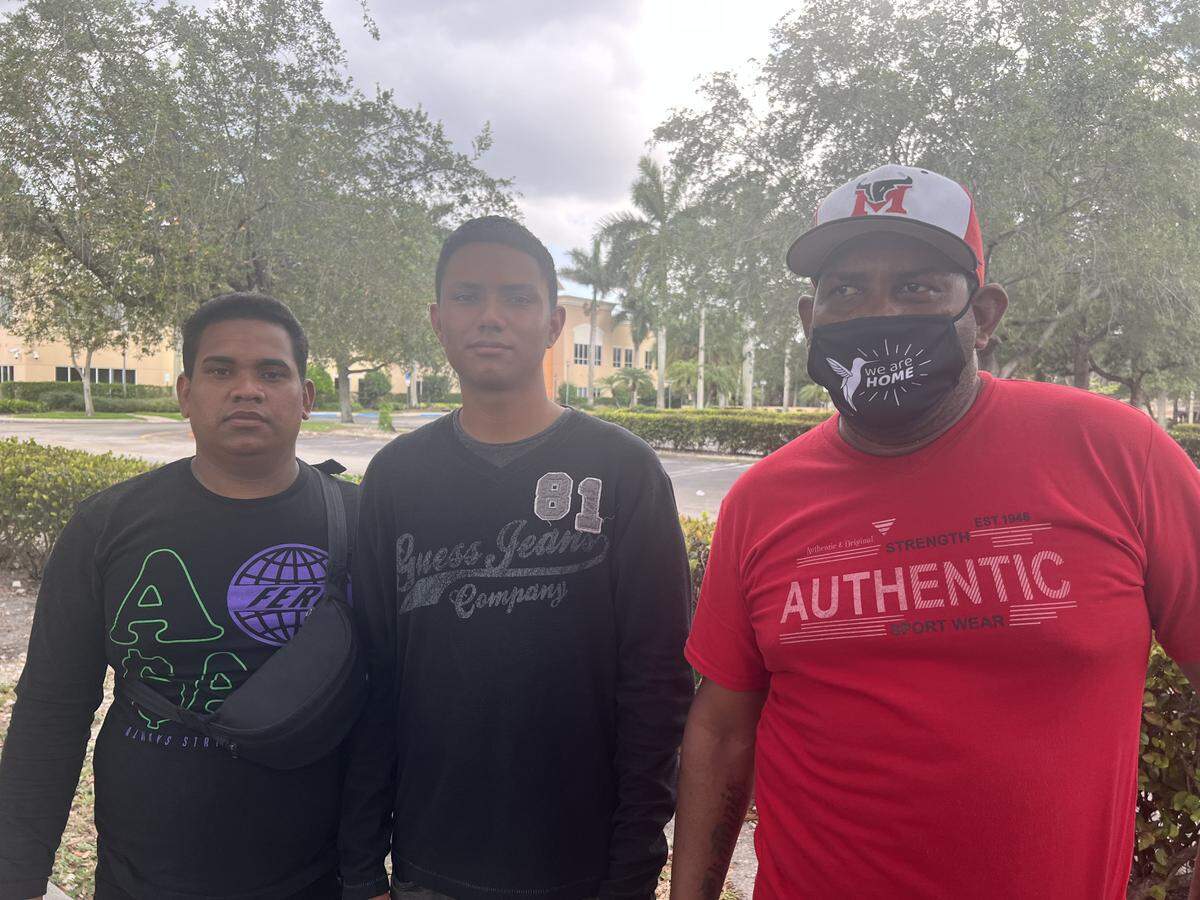
Meanwhile, Meléndez said he was “content, joyous and happy” to have secured shelter in a motel after sleeping outside for days. Along with his 19-year-old nephew José and 28-year-old cousin Miguel, who left behind his wife and 2-year-old daughter, they are hopeful for the life they can make in the United States.
“I came with a lot of desire to come to this country to work and do good and get ahead, for myself and for my children and my mother,” Meléndez told the Herald.
Pérez, the 22-year-old who met Meléndez in the Darien Gap, has been living outside of Venezuela since he was 17, after his mother could no longer afford his studies. He has lived in Colombia and Ecuador for the last five years and worked as a mason and baker’s helper. But money only stretched for food and rent, with only a few dollars left over to support his family back home.
“Let’s put it this way: If I don’t work, my mother doesn’t eat,” he said.
Despite the months-long, arduous journey, from the jungles of Colombia to the streets of Miami, Pérez said he feels the same way as Meléndez and the other members of his traveling group.
“I am truly grateful to the United States because it has opened the doors for a new future,” he said. “Suddenly we are sleeping on the street, but it’s one more step for us.”
This story was originally published April 8, 2022 at 11:05 AM.