Epileptic detainee sues ICE: ‘They threw me into the vehicle like a sack of potatoes’
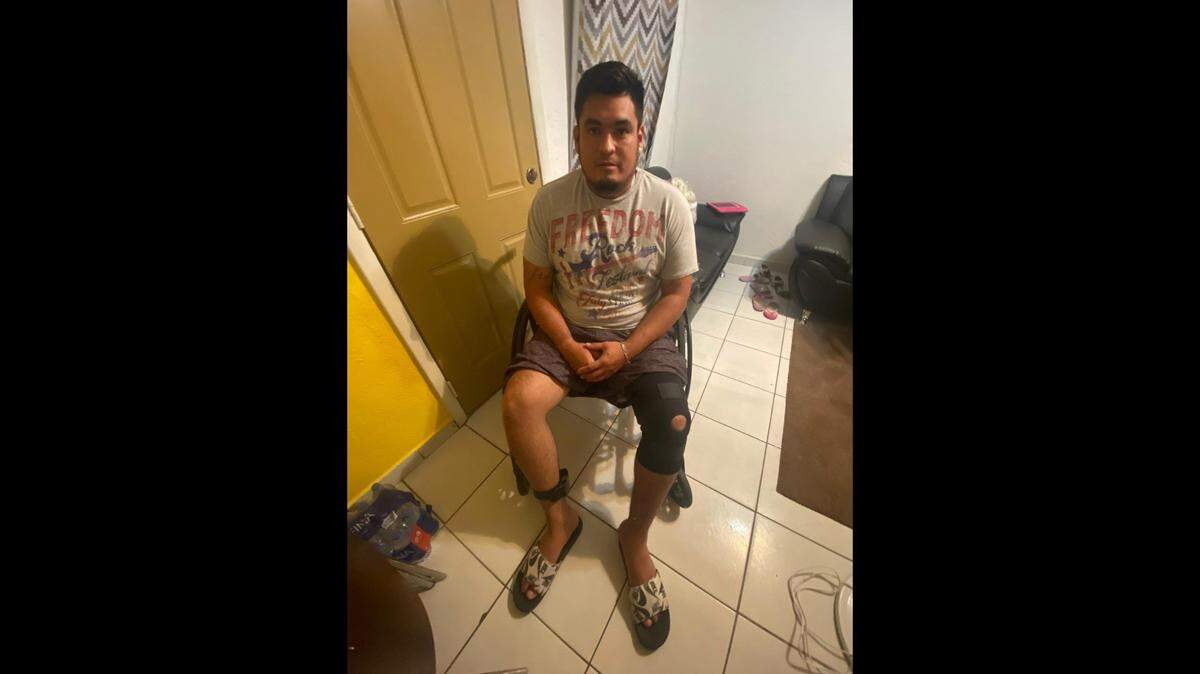
For about eight months, federal immigration officials tossed Alejandro Mugaburu into vehicles “like a sack of potatoes,” he said.
In a medical neglect lawsuit filed in Miami federal court earlier this month, the 6-foot, 2 inch, 250-pound immigration detainee told the judge he was consistently “dragged” off his wheelchair and carried onto a non-wheelchair accessible vehicle by three Immigration and Customs Enforcement guards. His arms and sides bore the bruises of being “yanked and grappled” so many times.
The 33-year-old epileptic man’s lawsuit claims he became immobile after having a seizure in September 2019 while going down the stairs at Krome, the ICE detention center in Miami-Dade County. Mugaburu said he “tumbled” down the staircase, lost consciousness and severely hurt his leg after ICE “denied” him his required epilepsy medications.
Fourteen months later, he says, his injury has yet to get “adequately” treated.
“Since that fall I’ve been in a wheelchair, unable to walk until this day,” he told the Miami Herald during a FaceTime interview. “They don’t care; it’s like I’m trash.” Medical records examined by the Miami Herald show Mugaburu suffered an anterior cruciate ligament injury on his left leg. His leg remains severely swollen.
In the lawsuit filed in Miami federal court against ICE, the Department of Homeland Security and Akima Global Services, the company contracted to operate Krome, the Peruvian national — who was released in May after the Miami Herald published a story that chronicled his trek in ICE detention during the COVID-19 pandemic — says his “mistreatment and discrimination” on the basis of his disability violates the Rehabilitation Act of 1973, the American with Disabilities Act, the Federal Tort Claims Act and the Constitution.
“Because of Mugaburu’s epilepsy, he should have been housed in a first-floor unit and assigned a bottom bunk sleeping placement,” wrote his attorney, Eduardo A. Maura. ICE has not responded to multiple Miami Herald emails seeking comment about Mugaburu’s case. His client was housed on the second floor, he said, with a stairway with 14 steps.
Maura added: “Medical professionals consistently ignored his various requests for attention to injuries and medication. He was placed in isolation for periods of consecutive weeks to limit the necessity for wheelchair mobility. He was denied access to bathing with a medical shower chair and was forced to use bathrooms and facilities that were not equipped for wheelchair access. The physical pain Mugaburu feels falls short compared to the pain of injustice.”
According to Department of Homeland Security documents obtained by the Miami Herald, ICE acknowledged Mugaburu’s claims and agreed to “informally resolve” the matter by implementing “corrective actions” that will be “reviewed” in late December.
ICE’s plan to address the situation was outlined in a Sept. 11 response by DHS’ Office for Civil Rights and Civil Liberties after Mugaburo had filed a complaint on Dec. 9, 2019, about the incident while in detention. ICE said it would:
▪ Provide Krome staff with training on the identification of detainees with special needs
▪ Develop a local practice of issuing special-needs passes to detainees and their custody officers
▪ Keep a “master list” of detainees with special needs to “improve communication”
▪ Have health administrators “review, train or modify” local operating procedures
▪ Identify Krome detainees who have a special need by using color-coded wrist bracelets
“We thank you for bringing this issue to our attention,” DHS told Mugaburu in the resolution letter dated Sept. 11. “Inquiries like yours help DHS meet its obligation to protect civil rights and civil liberties.”
NOT ALONE
Immigration experts and attorneys say Mugaburu’s case isn’t uncommon.
According to ICE’s Operations Manual for Standards of Medical Care, ICE has no policy that requires the agency to pay for medical treatment once a detainee is released from detention. And if a detainee gets injured under the care of ICE — which is required to provide access to medical care — oftentimes, many immigrants leave detention untreated for injuries, according to detainees, advocates and policy experts.
“Detainees shall have access to a continuum of health care services, including screening, prevention, health education, diagnosis and treatment,” the ICE manual says. “Every facility shall directly or contractually provide its detainee population with ... medically necessary and appropriate medical, dental and mental health care and pharmaceutical services.”
But for years, immigrants in detention, along with their lawyers and immigration policy experts, have said those policies aren’t always followed.
According to a congressional investigation released in September, detainees at ICE facilities “often do not receive critical treatment or face delays.” Additionally, the review found that many of the facilities lacked sufficient medical staff and failed to provide necessary care for chronic medical conditions, which resulted in several detainee deaths.
The findings by a House Oversight Committee came a week after a whistle-blower who previously worked at an ICE facility in Georgia detailed a high rate of hysterectomies and accused the agency of medical neglect in a complaint filed to the DHS inspector general.
ICE’s policies don’t address whether the agency would have to pay for medical care post-release if the detainee suffers an injury because of medical negligence.
Detainees “would have to sue,” said Heidi Altman, policy director of the National Immigrant Justice Center, a national organization that represents low-income immigrants. “There’s nothing in ICE’s policies that address this – no acknowledgment of accountability or responsibility for the harms caused by detention. And the only avenue for redress – a lawsuit – is inaccessible for most people in ICE’s network of remote jails.”
ICE and DHS did not respond to several emails from the Herald seeking comment about injury and medical-care protocols.
According to ICE’s operations manual for standards of medical care, the agency is only required to provide released detainees with a “discharge plan, a summary of medical records, any medically necessary medication and referrals to community-based providers as medically-appropriate.”
Lara Nochomovitz, an immigration attorney based in rural Louisiana, said getting medical attention while in ICE custody is difficult.
“If it’s not life-threatening, they just won’t do it,” Nochomovitz said. “The problem is, many of the people’s injuries may not be life-threatening, but they are life-altering.”
In an email to the Herald, Bryan Cox, a spokesperson for ICE, said the agency “cannot address non-existent allegations, and these sort of vague, anonymous suggestions made without any specifics should be treated with the greatest of skepticism.”
Nochomovitz said she represents a detainee who fell in the shower “and shattered some bones,” as well as another who fractured his ankle during recess.
“None of them got treated. ICE doesn’t want to pay for the reconstruction surgery or the physical therapy,” Nochomovitz said. “That’s what I mean by life-altering. Both those men aren’t going to die because of those injuries, but who knows what kind of long-term impact that will have on his nerves on his face; a broken ankle could impact my other client’s ability to walk forever.”
When the Herald asked ICE about both detainees, Cox said: “I’d simply point out any claim of persons being denied necessary and appropriate medical care is false. We just released our first annual report, which shows the agency spent more than $315 million on detainee medical care” in 2020.
The report, released on Nov. 5, detailed how ICE’s annual medical costs increased by 27% in fiscal year 2020, a year with a low average daily population due to COVID-19, compared to fiscal year 2019’s cost of $248 million. The pandemic led to an 88% increase in the daily cost per person, the report said, noting that 20,630 detainees were tested for the coronavirus since March.
Steve Cooper, a Jamaican national being held at the Glades Detention Center in Moore Haven, Florida, told the Herald that in the cases that detainees are taken to the doctor, it’s often too late.
In one instance, Cooper said, he had an impacted tooth pulled out. After it was pulled, it got infected, he said, and he was given an antibiotic that caused an allergic reaction and rashes.
“That’s when I blacked out because of the allergic reaction, fell off my bunk, and damaged the ligaments of my wrists in June 2019,” Cooper said, noting that he didn’t get surgery on his left wrist until February 2020. “I was told nothing can be done for my right wrist. ‘Til today I still can’t put any weight on it.”
Cooper said he was told he needed physical therapy for four months by the surgeon. It wasn’t until six months later in August that he was taken to a therapy session.
“The therapist told me they waited too long,” he said. “The doctor said I can’t work for now. My hand hurts every day.”
ICE did not comment about Cooper’s allegations.
In Mugaburu’s case, when he finally saw the orthopedic doctor several months after his injury, he was told he needed physical therapy.
““However, about a month and a half later he was finally taken to see a physical therapist, the therapist told him he can’t get physical therapy because he needs surgery or to be reevaluated by another orthopedic doctor,” said Jessica Schneider, director of Americans for Immigrant Justice’s detention program.
When Mugaburu was in detention, Schneider and her team represented him in hopes of getting him released during the global health pandemic. “He was repeatedly transferred to various facilities and still not getting the treatment he needs for his leg.”
For two months, the Miami Herald has interviewed and documented Mugaburu’s journey from the Monroe County detention center in Key West to the Krome detention center in Southwest Miami-Dade on March 7. On April 3, he was transferred to the Glades detention center in Central Florida and on April 21 was taken to the Baker County detention center in North Florida. On May 1, he was then taken back to Krome.
For every transfer, Mugaburu, who still uses a wheelchair, said he was carried on and off the packed bus by three security guards.
“Many times the guards told me that my ‘wheelchair isn’t going to be much help,’ ” Mugaburu said, recalling the times he and fellow detainees were handed a mop and bleach and told to scrub down the floors of the dormitories at Baker.
“It’s memories like those that will never leave me,” he said. “This lawsuit isn’t about money, it’s about walking again and restoring my sense of humanity.”
This story was originally published November 25, 2020 at 7:00 AM.