Protesters urge feds to cut ties with ICE contractor as COVID-19 cases skyrocket at Glades
Immigration advocates demanded Tuesday that the federal government cut ties with the Glades County Sheriff’s Office — which runs a detention center that ranks among the nation’s top 10 with the most COVID-19 cases — because they say detainees who have the coronavirus are being housed with those who haven’t been tested and that the facility provides inadequate medical care.
The advocates held a protest Tuesday outside U.S. Immigration and Customs Enforcement’s Miami field office in Plantation four days after a federal judge barred ICE from grouping infected detainees at Glades and two other centers in Miami-Dade and Broward with detainees who have not tested positive for the virus.
“ICE shall not engage in the practice .... unless ICE confirms through testing or other means that a prospective cohort candidate is a confirmed COVID-19 case,” wrote U.S. District Court Judge Marcia G. Cooke in her order early Saturday.
Her ruling came four days after the entire Glades County facility in Moore Haven, which the sheriff’s office runs under contract with ICE, was placed on lockdown after its 320 detainees were exposed to the virus. At least 11 guards have since tested positive.
ICE told the Miami Herald in an email that “all persons who test positive are placed into medical isolation. Persons who may have had contact with a positive case are placed into a medical cohort. Glades County has spoken to all of the detainees individually and they are aware of the test results. They remain cohorted; apart from the general population.”
The Miami Herald interviewed four COVID-positive detainees on Monday and Tuesday, after Cooke’s order. They all said that they were returned by staff to their housing units after testing positive for the virus.
“Yes, there are negative detainees mixed with the positive,” said Jermaine Scott, a Jamaican national who tested positive for COVID-19 on June 4 at the Krome detention center in Miami-Dade.
Scott says he was transferred from Glades to Krome to be processed to be deported, tested positive, and then was transferred back to Glades and placed in the general population, where he still remained Tuesday.
“It’s really messed up in here,” he said.
On Tuesday, ICE said it could not comment on “the movements of detainees” because of “pending litigation.”
.jpg "unnamed (8).jpg")
Rajesh Randy Gaines, a 38-year-old from Trinidad and Tobago being held at Glades, said he tested positive on Thursday.
“All detainees that tested positive are locked up with the ones that tested negative. ... It’s hard for me to breathe,” Gaines said.
The detainees’ claims echo three complaints filed with the Department of Homeland Security’s Office for Civil Rights and Civil Liberties. The grievances were filed on June 5, May 28 and May 23 by Friends of Miami-Dade Detainees, a nonprofit immigration advocacy group that runs detainee visitation programs across South Florida.
In her order, Judge Cooke acknowledged that ICE has been grouping infected detainees with people who are negative or those who haven’t been tested.
“Despite the fact that its own guidelines call for detention facilities to avoid group cohorting, ICE flagrantly flouts its own rules on the subject and groups asymptomatic detainees together,” Cooke wrote.
According to the agency’s policies, “[o]nly individuals who are laboratory-confirmed COVID-19 cases should be placed under medical isolation as a cohort. Do not cohort confirmed cases with suspected cases or case contacts.” The federal Centers for Disease Control and Prevention also says that people exposed to COVID-19 should be put in individual, not group, quarantine.
In a June 9 letter to ICE and the Glades County Sheriff’s Office, Friends of Miami-Dade Detainees summarized the complaints and urged the agencies to part ways.
“Detained people who have tested positive for COVID-19 are reportedly immediately returned to their housing units to eat, sleep, and live alongside other detained people not exhibiting symptoms of the virus,” the letter said. “Housing people confirmed to have a contagious virus alongside healthy people creates a breeding ground for transmission.”
The organization added: “It is clear that the Glades County Sheriff’s Office is not capable of keeping detained people safe or following prevention guidelines. We urge ICE to cancel the contract with the Glades County Sheriff’s Office before even more people become sick or die.”
In an email Tuesday, the Glades County Sheriff’s Office told the Herald that “as there is pending litigation on this subject, we are not able to speak specifically to the lawsuit as the Glades County Sheriff’s Office does not comment on pending litigation. That said, absence of a specific comment should in no way be construed as agreement to anything in a particular lawsuit.”
Health Services
Over the last two months, the Herald has interviewed detainees at Glades, who say that people in their housing units have had extremely high fevers, chest pain, coughing and some have passed out and have needed to be taken out in a wheelchair. Others have vomited blood and have lost their sense of smell and taste.
They’ve also said that while they are sometimes monitored by a nurse, they are only being given Gatorade, Tylenol and ice packs as opposed to medication, and are having difficulty seeing a doctor who can further evaluate their medical condition despite putting in numerous medical requests.
In a federal complaint, one detainee said, “everyone in here is coughing their lungs out, I’m asthmatic and scared for my life.”
A second detained person stated: “They are just testing detainees with very high temperatures over 100 degrees. Some detainees just got back their COVID-19 results and they came back positive. One person who sleeps about four feet from me is positive.”
.jpg "unnamed (9).jpg")
Some detainees with milder symptoms are denied testing altogether, four detainees say. Ashish Thomas is one of them.
On May 29, he says he had a fever of 101.2. He says he has requested testing three times — twice in writing — and says he’s told “just wait,” or “they’ll call you down.” Before being in ICE custody, Thomas suffered a traumatic brain injury; he now has a plate in his skull and suffers seizures, according to a complaint filed with DHS.
In response to a Herald request for comment, on Thursday, ICE did not address allegations of medical negligence but said that the agency “is committed to ensuring that everyone in custody receives timely access to medical services and treatment. Comprehensive medical care is provided from the moment detainees arrive and throughout the entirety of their stay.”
According to the May 2 complaint, Friends of Miami-Dade Detainees said ICE was using a product at Glades called “Mint Disinfectant.”
“Staff are spraying a chemical inside the housing units that is causing serious respiratory distress among people with asthma, bronchitis, and other medical conditions. They are reporting that after the spray is used, people with asthma must use their inhalers more frequently, and that some people are suffering from shortness of breath and/or headaches,” wrote the group’s lead organizer, Wendy King.
Safety guidelines from Spartan Chemical, the manufacturer of Mint Disinfectant, warn that it can cause “serious eye damage” and “eye irritation” and specify that skin should not be exposed to it. The guidelines say the chemical should be used only in a well-ventilated area with the use of protective gear and that anyone who inhales the chemical should be allowed to “breathe fresh air.” Additionally, the product guidelines warn to “avoid all unnecessary exposure.”
Now detention center staff have stopped using the product, as well as disinfecting in general, detainees said.
“The detainees are cleaning restrooms with toilet water,” said Scott. “There’s only one toilet and one sink where all of us 40 people share. Disgusting.”
Both ICE and the Glades County Sheriff’s Office said it couldn’t comment because of “pending litigation.”
“As far as the MINT disinfectant cleaner that too has come up in litigation,” an ICE spokesperson wrote in an email. “...The products are being used with the manufacturer specifications.”
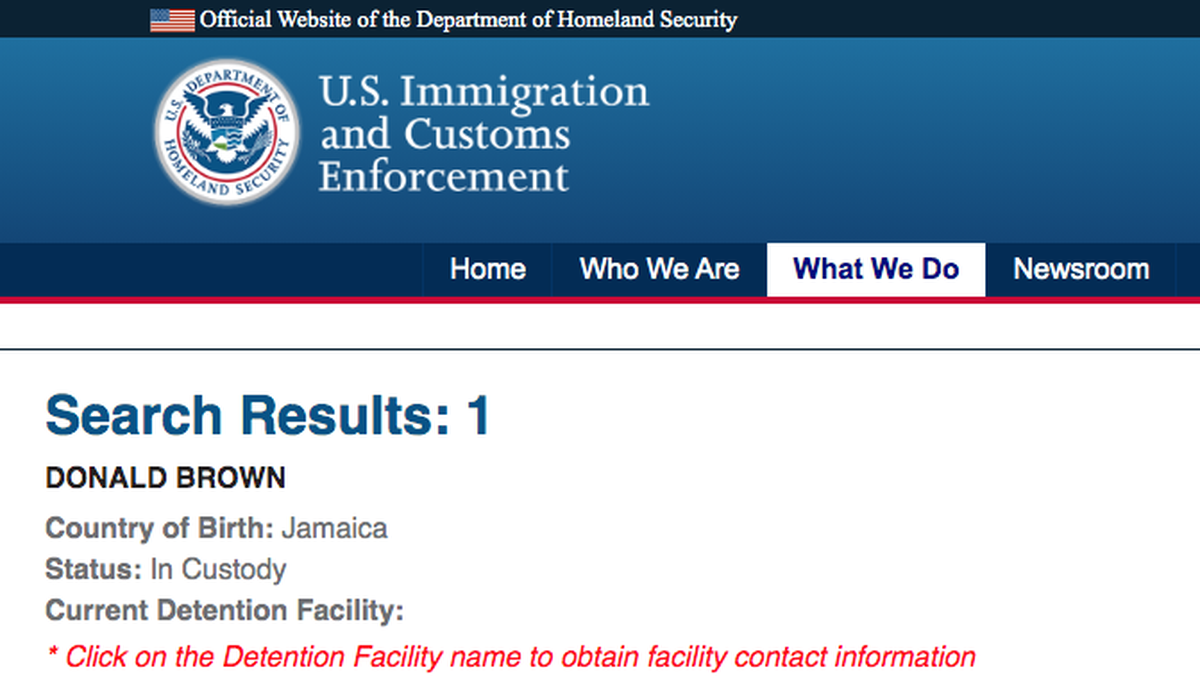
But none of that is significant anymore to Jarquette Cumberbatch, the daughter of Donald Brown, a 62-year-old Jamaican national she says “disappeared” from Glades 10 days ago.
“I haven’t heard from my dad, who usually calls me three to four times a day,” Cumberbatch said. “He was feeling sick and weak and then he vanished.”
She added: “When the family calls, we are told by staff that he’s ‘in medical’ and that he would call us. He has not,” she said. It’s unclear if that means he is at the detention center’s clinic or at a nearby hospital.
According to ICE’s online detainee database, Brown is currently listed as being in ICE custody. However, no detention center is linked to his name or immigration identification number, nor does the corresponding ICE field office appear — all data that’s standard for a detainee that isn’t at an area hospital, in transit to be deported or recently deceased.
ICE did not immediately respond to a request seeking more information about Brown’s whereabouts.
This story was originally published June 9, 2020 at 6:07 PM.