Judge apologizes to ICE after accusing the agency of filing coronavirus data in secret
This story has been updated to reflect that a Miami federal judge who accused immigration authorities of filing records in secret admitted Thursday night he had made a mistake.
A Miami federal judge apologized to U.S. immigration officials late Thursday night after he said he “mistakenly” accused them earlier in the day of filing COVID-19 records under seal.
The judge had ordered U.S. Immigration and Customs Enforcement and the U.S. Attorney General to detail by Thursday afternoon the number of detainees, agency staffers and third-party contractors who have tested positive for COVID-19 at three South Florida detention centers by Thursday afternoon.
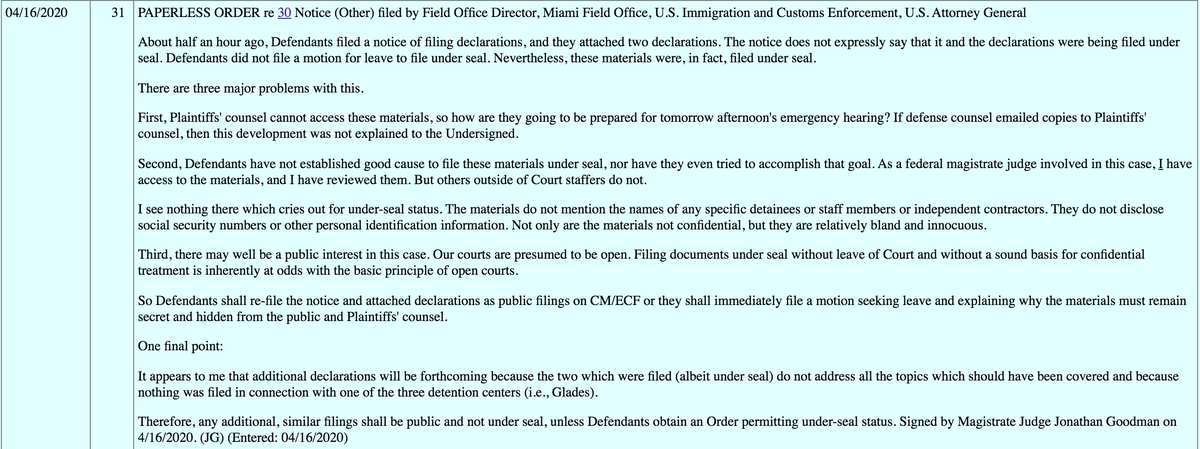
When they met their deadline, Federal Magistrate Judge Jonathan Goodman thought they had submitted the documents under seal, keeping it from public view, because of an error that popped up on his computer saying “Warning! This document is restricted.”
“This order is an apology to [ICE] and their counsel for incorrectly and unfairly criticizing them for purportedly filing two declarations under seal,” Goodman wrote in a court filing Thursday night. “They did not do that. I mistakenly believed that they had. The only person who goofed was me.”
A few hours before his apology, the judge had castigated the agency in writing, saying it had not asked for permission to file under seal, and added that the information hardly merited the secrecy.
“There are major problems with this. I see nothing there which cries out for under-seal status,” Goodman said. “The materials do not mention the names of any specific detainees or staff members or independent contractors. They do not disclose Social Security numbers or other personal identification information.”
He continued: “There may well be a public interest in this case. Our courts are presumed to be open. Filing documents under seal without leave of Court and without a sound basis for confidential treatment is inherently at odds with the basic principle of open courts.”
It turned out the records were not sealed after all, but rather they are not automatically viewable on Pacer, the online site for federal court records, from a remote location because it’s an immigration case.
“Defense counsel, a high-ranking and well-respected AUSA, advised that the Pacer docket might be restricted because this case is an immigration case and might not be available to the public,” Goodman said. “Apparently, the Clerk’s Office imposes a restricted access designation to all immigration cases — and does so automatically. This case concerns immigration detention centers in South Florida and appears to be classified as an ‘immigration case.’”
He added: “In any event, this restricted access permits the parties and their attorneys to have remote electronic access to the case file. However, it permits ‘other persons’ (e.g., the public) remote electronic access only at the courthouse. Neither the clerk’s office nor defendants acted improperly. The defense lawyers merely filed the declarations and the clerk’s office simply followed the rule.”
The Thursday court filing comes 10 days after a Miami Herald story revealed that ICE did not consider its third-party contractors ICE “staff,” and that the agency said it had no obligation to include them on its website detailing how many employees at its detention centers nationwide had contracted COVID-19. The Herald reported two guards who work for a contractor at the Krome detention center had tested positive for the virus. Since then, one more has tested positive.
The Herald also reported that the agency got around having to disclose that a Miami detainee was sick with COVID-19 because the detainee was technically no longer at the detention center, but rather at a hospital.
As of Thursday morning, ICE said on its website that only 25 of its employees nationwide have tested positive. However, that does not include third-party contractors that operate at least 217 of its 222 detention centers nationwide.
All three detention centers in South Florida— the Krome Processing Center in Miami-Dade, the Broward Transitional Center in Pompano Beach and the Glades County Detention Center in Moore Haven — are operated by third-party contractors: Akima Global Services, GEO Group and the Glades County Sheriff’s Office.
The Herald’s reporting was cited in a federal lawsuit — filed by by the University of Miami’s immigration law clinic, the Southern Poverty Law Center, the Rapid Defense Network in New York, the Legal Aid Service of Broward County and Prada Urizar, a private Miami law firm in Miami federal court Monday — seeking the release of detainees at the three facilities.
Though ICE did not file the information under seal, Goodman still ordered the agency to refile the documentation with more specific information.
“One final point,” he wrote. “It appears to me that additional declarations will be forthcoming because the two which were filed (albeit under seal) do not address all the topics which should have been covered and because nothing was filed in connection with one of the three detention centers (i.e., Glades),” he said, calling their submissions “relatively bland and innocuous.”
Citing the ongoing litigation, ICE declined to comment for this story.
The Miami Herald obtained copies of the documents ICE submitted to the courts after publishing this story. As of Thursday, two detainees and three security guards have tested positive for the coronavirus at Krome, while 20 detainees have been tested for the virus. It’s unclear if those results are still pending or if they came back negative. About 200 detainees who may have been exposed to the virus are being segregated together.
The Glades County detention center and the Broward Transitional Center have zero positive confirmed cases, according to ICE. Only one detainee was tested in Broward; its unknown if any have been tested at Glades.
This story was originally published April 16, 2020 at 12:00 AM.