There are 62,000 pending citizenship applications in Florida. Here’s what that means for 2020
Every four years, the prospect of participating in a presidential election galvanizes many eligible permanent residents to apply for U.S. citizenship, immigration lawyers and activists say.
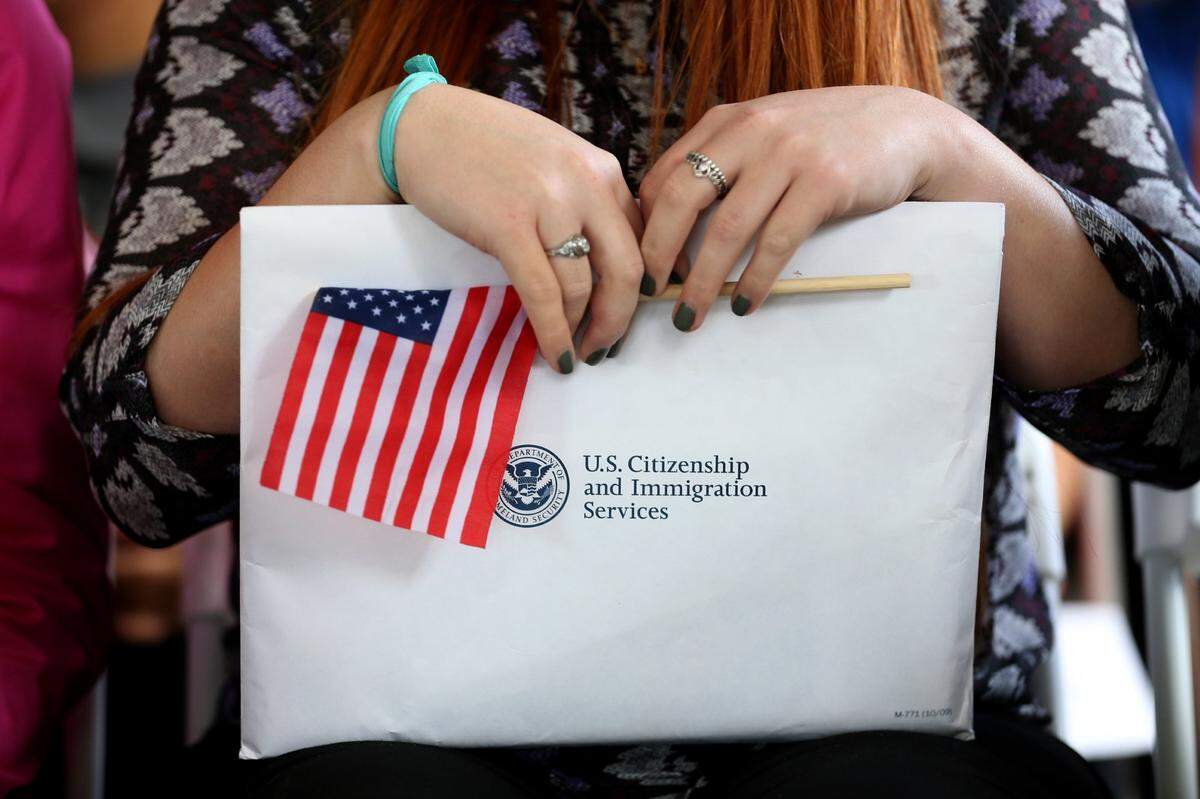
But in 2020, bureaucratic delays in processing naturalization applications and an enduring backlog of tens of thousands of pending cases at U.S. Citizenship and Immigration Services (USCIS) could keep scores of would-be Florida voters from the ballot box.
For local advocates working to mobilize minority voters, that’s cause for alarm: “In Florida we know that elections are won by razor-thin margins,” said Andrea Mercado, executive director of the New Florida Majority. “So every vote matters, and every vote from a naturalized citizen matters.”
As of last September — the most recent date for which USCIS data is available — the national naturalization backlog stood at nearly 650,000 pending applications. In Florida, that number was 62,079 — a more than 75% increase compared to the amount of backlogged cases in the state at the same time five years ago.
As backlogs have swelled, processing times for citizenship applications have shot up. Though the national average wait time for naturalization currently hovers around 10 months — that’s twice the amount of time folks had to wait to become citizens between 2012 and 2016 — the performance of individual USCIS field offices vary locale by locale.
By some expert estimates, Miami’s field office is the second-least efficient in the country, with maximum wait times for those seeking citizenship reaching 23 months.
For would-be new Americans eyeing the Nov. 3 general election — or the Aug. 18 primaries — their ability to register in time to cast a ballot will depend on the date their naturalization comes through. It’s a race against the clock that could have a meaningful impact on the results of those elections, since few votes separate winning candidates from losing ones in many local and statewide Florida races.
In 2018, more than 70,000 immigrants, and potential new voters, were stuck in the naturalization backlog in Florida. That same year, Ron DeSantis became governor with a margin of 32,463 votes. Rick Scott won his Senate seat by just a hair over 10,000 votes.

Loading...
THE NATURALIZATION BACKLOG, EXPLAINED
USCIS blames the delays and the backlog on a sharp uptick of citizenship applications, and the agency says it is processing those applications as fast as it can.
“The truth is that while many factors relating to an individual’s case can affect processing times, waits are often due to the high volume of naturalization applications received rather than slow processing,” said Jessica Collins, USCIS spokeswoman.
“USCIS strives to adjudicate all applications, petitions, and requests as effectively and efficiently as possible in accordance with all applicable laws, policies, and regulations,” she said.
It’s true that interest in naturalization among immigrant communities is high.
Applications spiked in the two years before the 2016 election — and nearly reached the one-million mark in FY 2016 — a common phenomenon in the lead-up to a presidential contest. Yet, instead of tapering off afterwards, the number of filings kept growing during the Trump administration. In FY 2019, the U.S. government naturalized 833,000 new citizens, marking an 11-year high.
But experts say the steady stream of new filings isn’t the only factor contributing to the backlog, citing lagging processing rates at USCIS that haven’t kept pace with the volume of incoming applications. According to a recent report by Boundless Immigration, a company that helps immigrants obtain green cards and citizenship, USCIS only reviewed about half of its applications in 2017, compared to 63 percent in 2016. The agency’s backlog processing rate remains, according to report authors, “at the lowest level in a decade.”
At issue is the fact that USCIS seems to be vetting individual applications more intensely than it did in previous years, with officers making more frequent requests for applicants to provide additional evidence and documentation — a time-consuming extra step in an application process that already includes filling out a 20-page form and undergoing biometric screenings.
“Essentially, USCIS is so overwhelmed that if an application has any kind of hiccups or anything at all that they need to look at more closely — which doesn’t have to be anything disqualifying, maybe it’s just a criminal record from many years ago — that gives them something extra they need to investigate,” said Miami immigration attorney Elina Magaly Santana. “And when people reply with more documents, it just sits on a shelf.
“They’re not equipped to deal with it,” Santana said. “Additional vetting means you end up in a giant pile somewhere.”
Naturalization backlogs are not new, and USCIS has seen bigger citizenship applications spikes in the past. As recently as 2007, for instance, the agency’s caseload swelled to 1.4 million.
But decision-makers at the time reacted quickly, allocating resources specifically for caseload elimination. An ensuing surge in processing volume caused the backlog to tumble to a 30-year low by 2009, with just 257,000 cases pending.
“Sometimes, backlogs are just a quick upshoot. Other times they are a little bit steadier, and that’s definitely what we’re seeing now,” said Vanessa Joseph, an immigration lawyer at Catholic Legal Services with a focus on citizenship.
For Santana, the current backlog — and the processing delays it has engendered — are unique.
“To me it really feels like one of the most extreme periods as far as wait times,” she said. “I’ve been practicing 11 years, and I don’t remember having to tell anyone before that the wait time could be up to 23 months.”
The citizenship quagmire has invited criticism from some Democrats and immigration advocates, who say the Trump administration has been slow to react.
“I think that the backlog is completely unacceptable,” said U.S. Rep. Debbie Mucarsel-Powell, D-FL. A naturalized citizen herself, Mucarsel-Powell and other members of the Congressional Hispanic Caucus (CHC) have been putting pressure on USCIS for months, urging for more efficient caseload processing.
Last spring, Mucarsel-Powell was among the signatories of a letter from the CHC to the Government Accountability Office (GAO), which asked for an investigation into what it described as “crisis-level” delays at USCIS.
“My job as a Congress member is to make sure that I hold agencies like USCIS accountable,” said Mucarsel-Powell, who was born in Ecuador. “We will put all the pressure we need on the Trump administration and on USCIS to ensure that these backlogs are dealt with in an efficient manner. This is a continuation of anti-immigration policies by the Trump administration.”
Krystina François, executive director of Miami-Dade County’s Office of New Americans (ONA), is also frustrated by what she sees as inaction from USCIS when it comes to backlog reduction.
“Since 2016 really is when we started seeing this major backlog, and there still hasn’t really been a clear plan by USCIS to address it,” said François, whose organization promotes the benefits of naturalization countywide. “We just want to ask the administration, like, ‘Hey, what is your plan?’ Because that hasn’t been communicated to anybody.”
Immigration advocates say the processing delays have coincided with the rollout of new proposals from the Trump administration that are likely to make it more cumbersome, and expensive, for green-card holders to naturalize in the future.
Last fall, USCIS proposed hiking the citizenship application fee from $640 to $1,170 — a more than 80 percent increase. That same rule, currently in the public comment stage, would also jeopardize low-income applicants’ access to fee waivers, and it would funnel more than $100 million dollars out of the USCIS budget to fund stepped-up enforcement by another agency (Immigration and Customs Enforcement, or ICE).
According to Iván Parra, director of services at the Florida Immigrant Coalition, transferring resources away from the agency responsible for reviewing citizenship applications likely isn’t good news for those stuck in the backlog.
“What does taking all that money from USCIS, which is entirely funded by fees, and giving it to ICE mean? It means that there will be less resources, less staff tasked with reviewing applications, and the backlog instead of going down will go up,” he said.
Telegraphing attempts to further restrict naturalization — or access to other kinds of immigration benefits — could also result in more citizenship applications in the short term, as folks try to move through the system under the current sets of rules before the status quo changes. That’s a phenomenon that’s been playing out throughout the Trump administration, immigration lawyers say.
“Before, people were thinking nothing was going to happen to them if they were permanent residents, green-card holders. They could come and go as they wished, they could work, they could get drivers’ licenses. But now people don’t feel that sense of security any more,” said Parra. “There’s fear, and that makes them want to take that extra step [and naturalize].”
Joseph, from Catholic Legal Services, agrees.
“There’s increased attention being paid to what’s happening with immigration. We are seeing people who are just a little bit terrified of their status, even though they do have status,” she said. “They’re like, ‘You know what, I’m going to apply for citizenship because I want a 100 percent guarantee that I’m protected from deportation.’”
IN MIAMI-DADE, WAIT TIMES VARY
Citizenship applicants in Miami-Dade have one thing going for them: USCIS operates three different field offices in the county alone, meaning there’s more staff to review applications compared to most other states, which have just one or two field offices statewide.
“But [having multiple field offices] hasn’t made the processing better or easier,” said François, from Miami-Dade’s Office of New Americans.
How fast someone’s citizenship application gets adjudicated hinges on which field office they get assigned to.
At the Kendall field office, processing time for naturalization currently ranges from 4.5 to 11 months, according to the USCIS website. At the Hialeah field office, the listed range is from 4.5 to nine months. But in Miami, the wait is significantly longer, lasting anytime from a year to 23 months. (The processing time range at Oakland Park office in Broward County: six to 14.5 months).
Regardless of where applications end up getting processed, immigration lawyers advise their clients to hunker down for long waits.
“The range is almost an invented figure at this point. It can be above the range, it can be below the range. So that’s what I tend to tell my clients,” said Santana. “It’s almost like a complete crapshoot.”
Joseph said she holds out hope for speedy processing, but noted that “we tend to look at the maximum number as the minimum number.”
For Miami’s immigrant community, long waits have become a source of anxiety.
“People want to be citizens. It’s a very emotional and personal decision. When you do all the things that you are supposed to do and you saved your money and you paid all the fees only to find yourself waiting by the mailbox, it’s frustrating,” said François.
“And it’s a turnoff for people. If I tell a client that it’s going to be 24 months, they’re like, ‘Why even bother?’”
ELECTORAL RAMIFICATIONS
Even as some Congressional members have sounded the alarm over backlogs at USCIS, there has been little emphasis placed specifically on the voter suppression impact of those backlogs, which could be more pronounced in Florida than in any other state.
That’s because naturalized citizens make up an increasingly potent part of the U.S. electorate. They cast more than eight percent of the ballots nationwide in the 2018 midterms —almost double their share in the 1996 presidential race — and they have a significant presence in the Sunshine State.
Every year, Florida swears in between 70,000 and 100,000 naturalized citizens, most of them hailing from Latin America and the Caribbean. In FY 2017, 10 percent of the more than 700,000 new citizens across the country called Florida home. And within Florida, the Miami metro area is a naturalization juggernaut, welcoming 44,540 new citizens in FY 2017, or six percent of the national total.
“When we talk about naturalization, it’s important to understand that this is a really big, local issue for us down here,” said François.
In FY 2017, the only places that welcomed a greater number of new citizens than Florida were California and New York, but both are reliably Democratic bastions not likely to sway the outcome of this year’s presidential race. That’s not true of Florida, one of the country’s biggest swing states where elections are decided by razor-thin margins.
Here, limiting the number of new citizens could have an actual electoral impact, experts say.
“In any electorate like Florida’s that is closely and evenly divided, any shift in demography can be decisive,” said Casey Klofstad, a political scientist at the University of Miami whose areas of expertise include elections and immigrant political behavior.
Potentially accentuating the political ramifications of the citizenship slowdown is the fact that, as far as Latinos are concerned, the naturalized-citizen turnout rate is higher than that of U.S.-born Latinos. In other words, naturalized Latinos are more likely than their native-born counterparts to register to vote and actually show up at the ballot box.
That’s no surprise to the advocates working inside Miami’s immigrant community.
“Voting is something that everyone I talk to who is applying for citizenship is excited about,” said Santana, the immigration lawyer. “Everyone is hoping to be able to register in time.”
Whether folks will be actually able to naturalize and register to vote in time for the election could determine which way the results shake out, François added.
“I mean, it’s huge, not only for the presidential election but for local races too,” she said. “Elections in Florida are decided by hundreds or thousands of votes here or there. It will definitely have an impact not having our new Americans’ voices at the ballot box if they don’t get to naturalize in time.”
Mercado, the executive director of New Florida Majority, draws a voter suppression parallel between the naturalization backlogs and the action Florida’s Republican Legislature took last year to limit the restoration of voting rights to ex-felons, which voters overwhelmingly approved in a 2018 constitutional amendment.
Mobilizing minority voters, as a result, “definitely feels like an uphill battle,” she said. “But it’s a battle that we need to win. We’re the largest battleground state in the country and we have to put in that work.”
With the amount of green-card holders in Miami-Dade eligible for citizenship numbering over 400,000, the pool of potential new citizens, and voters, in the county is considerable. If they started the naturalization process today, would they be able to cast a ballot nine months from now, in November?
“I can’t promise them that, because of the backlog, but you never know,” said François. “We want you to do it. Our simple slogan is: ‘naturalize now.’ Naturalize now and hopefully your voice will be heard at the ballot box this year.”
This story was originally published February 6, 2020 at 7:00 AM.