At this Miami Gardens school, students learn to fix and build electric cars
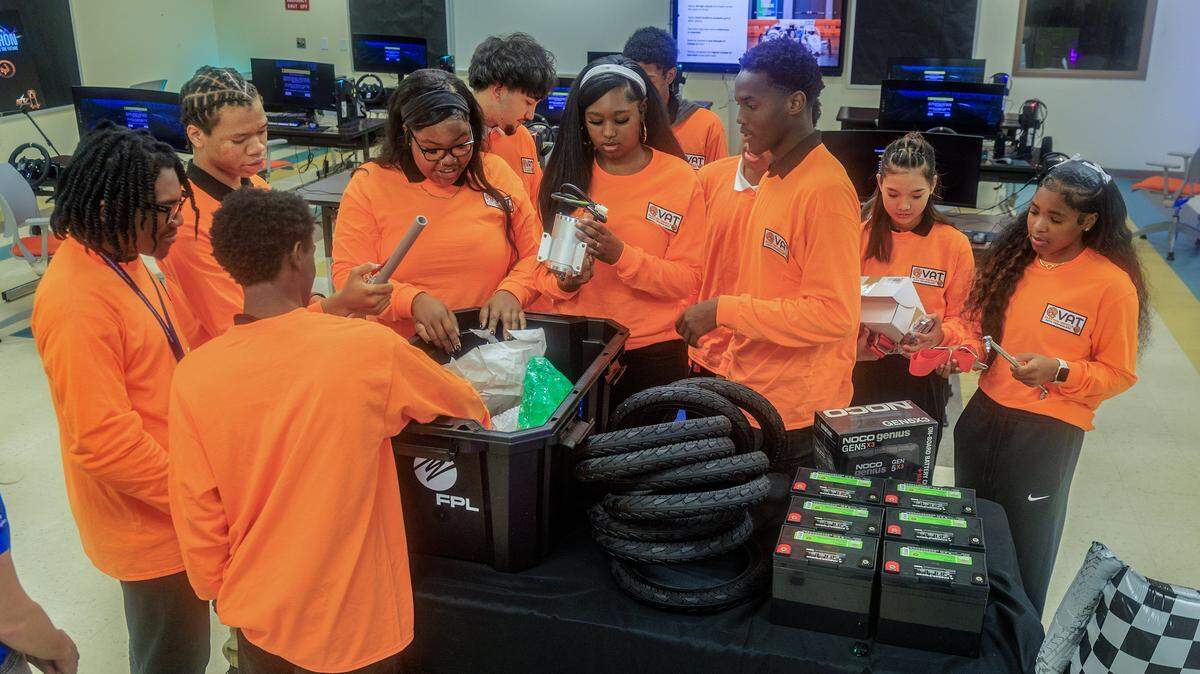
For some Carol City Senior High School students, their class schedule takes them beyond algebra and literature and into the shop, where they learn how to repair electric cars for school credit.
On Thursday, the innovative public school program got a jolt, in the form of a big box filled with motors, rims, seatbelts, mirrors and a battery. Piece by piece, students pulled out everything they’ll need to design, build — and eventually race — a fully electric go-kart.
The donation from Florida Power & Light is the latest addition to the school’s electric and automotive magnet program, which Principal Bridget McKinney says is one of a kind. McKinney said Carol City High is the only public school in the nation with an EV magnet program.
McKinney said the program is designed to prepare students for careers in the booming field of electric vehicles, which are growing increasingly popular with drivers looking for a high-tech ride, a climate-friendly set of wheels or both. Florida is the number two state in the nation for registered EV drivers.
“I have one of the most unique programs in the district, so I’ve attracted more students,” she said. “EVs are the future.”
There are 81 students in the automotive magnet program at the high school, and they’re the latest to join FPL’s “Electrathon” program. Miami Carol City Senior High School will join five other Miami-Dade high schools that received kits in past years.
FPL has donated kits across the state from Pensacola to Homestead and at the end of the program in the summer, they get to race against other high schools in Florida.
But unlike a usual race, where speed is king, winners are chosen based on endurance. Whoever travels the farthest in one hour with one kilowatt of energy wins, said Isabella Burckhardt, FPL community relations specialist.
Throughout the school year, FPL provides guidance and support.
But even with the components barely unpacked, Carol City is already feeling confident. McKinney believes Carol City may have an edge thanks to the training students have already received since the launch of the Electric Vehicle Automotive Technology Magnet Program.
A car shop at school
The EV program officially launched last year, combining hands-on lessons with experts from the field on electric, hybrid and gas-powered vehicles.
“I wasn’t too sure what I wanted to do, and this program kind of gave me a footnote on where I wanted to go in the future,” said Gerray Bartlett, a senior at Carol City.
Before touching real cars, students train virtually through a “gamified” learning approach. The idea is that by the time they’re in the shop, they’ve already practiced the fundamentals.
One space is the “Virtual Reality” room, dimly lit with colorful dots speckling the walls, almost like an arcade. Using VR headsets, students learn how to perform oil changes, rotate tires and align wheels.
“It gives a more exciting feel to it. It’s not like just sitting in class learning how to work on cars, this is boring. With this, there are different levels and confetti pops when you get things right,” said La’Nyla Conley, a 12th grader in the program.
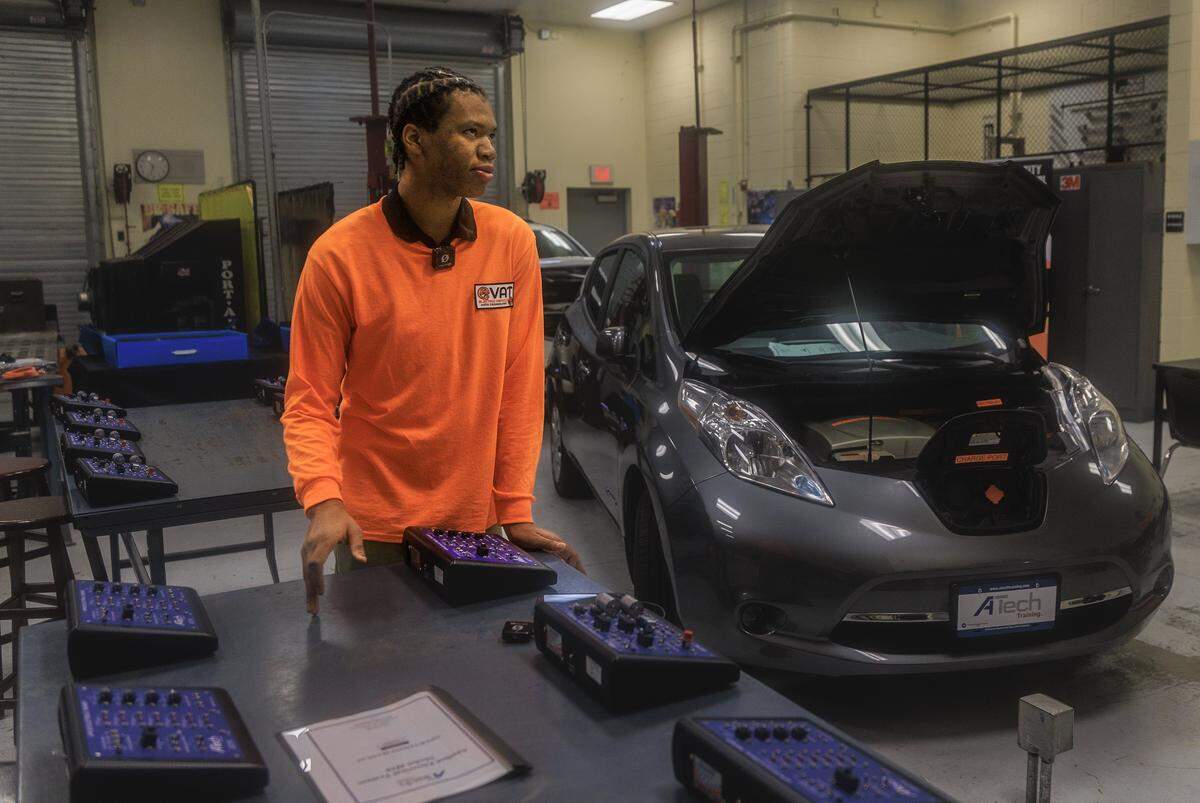
In another garage, known as the “power plant,” students work with circuit boards featuring resistors and capacitors that simulate electric vehicle systems. An electric car sits with its hood open, components labeled. The program has also received support and vehicle donations from Acura and Honda.
Students have to master simulations before working on real electrical systems.
“Electric is definitely more difficult, because there’s more danger involved when you’re working with it,” said Bartlett. “There are orange wires on electric vehicles, and if you mess with them while the car is still alive, you shock yourself.”
Another lab looks more like a gaming room at first glance. Driving simulators with steering wheels and pedals place students in different environments and weather conditions, deducting points for speeding or failing to check intersections. For some students, it’s their first exposure to driving.
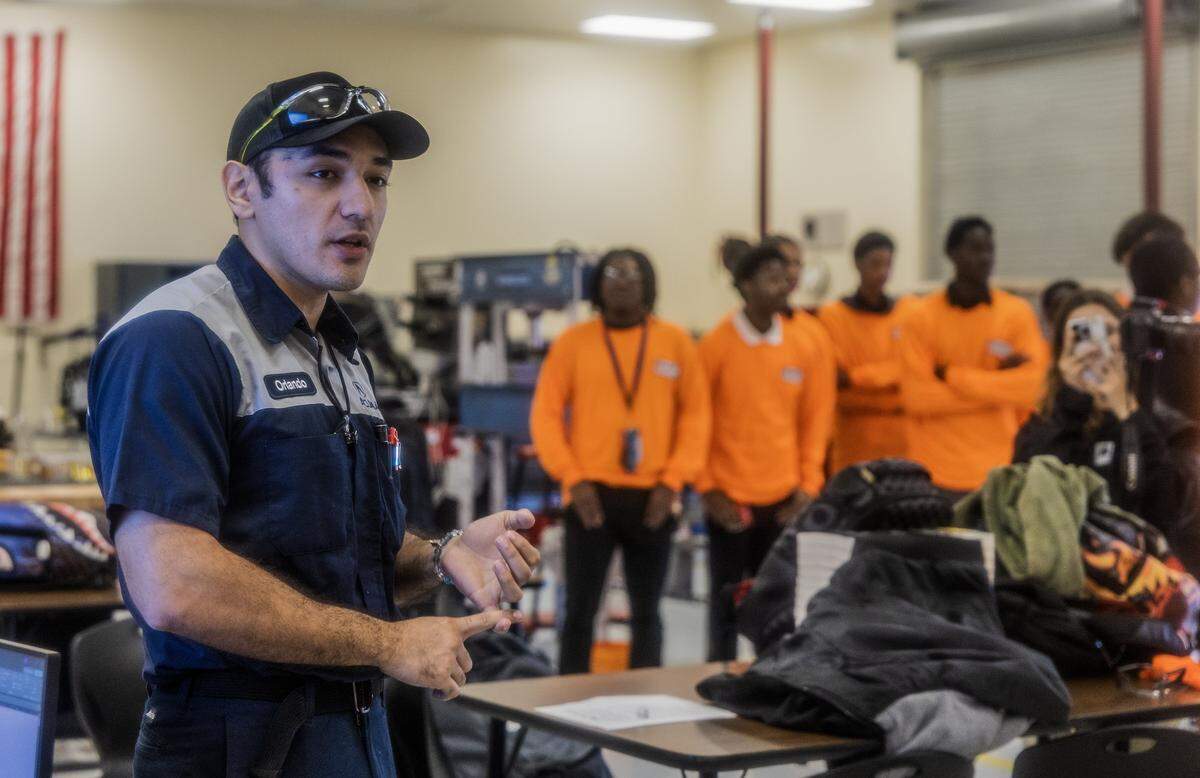
Orlando Gonzalez is the automotive teacher for the entire program. He also works in Doral at an Acura shop. He said he recreates problems brought into at the Acura shop in the classroom and has the students diagnose the issue.
“Like, here’s this multimeter. Find out why that bulb isn’t turning. It’s not going to be a bulb. It’s going to be a wire. I want them to do voltage checks and see where the problem is,” Gonzalez said. “Maybe they’ll find it and maybe they won’t. All I care about is that they try to take it apart, and that way I can help them get ready for the real thing.”
There’s also a “dealership lounge,” where students plan to offer basic services like tire changes. So far, they’ve serviced a few staff members’ vehicles. On some Fridays they hold “shop talks” where professionals from the industry, including Mercedes-Benz, met with students. They’re also working with Miami-Dade College to prepare students to audition for the school’s Tesla training program.
With all this training, McKinney hopes they’ll be ready for the jobs of tomorrow. According to a 2024 U.S. Energy and Employment Report, Florida has over 12,900 electric vehicle jobs, a steady growth of nearly 18% growth over two years.
“It’s a good program for people that don’t know their place in life yet,” said Conley, a senior. “I’ve learned more than I ever imagined.”
Ashley Miznazi is a climate change reporter for the Miami Herald funded by the Lynn and Louis Wolfson II Family Foundation and MSC Cruises in partnership with Journalism Funding Partners.
This story was originally published January 22, 2026 at 4:44 PM.