Sunny Isles buildings ’100 percent safe’ but city reviewing them in wake of sinking study
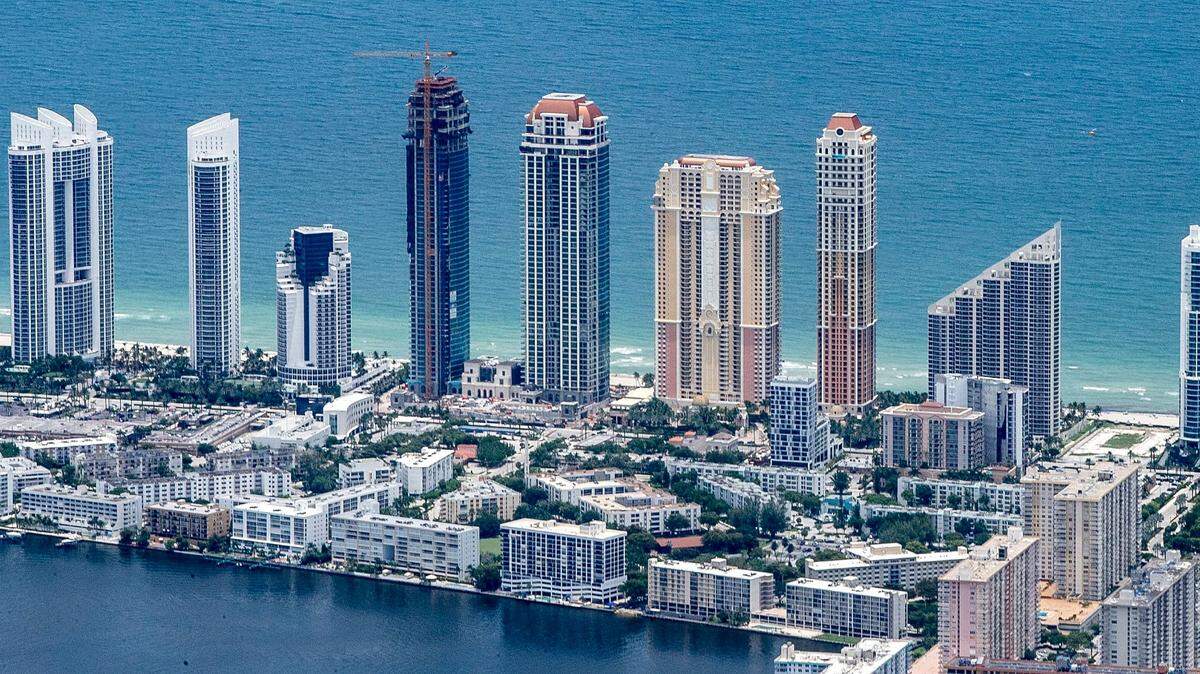
Sunny Isles Beach is already taking another look at many of its gleaming high-rises in the wake of a new study by the University of Miami that found 35 beachside buildings along Miami-Dade’s barrier islands are sinking to an “unexpected extent.”
But Mayor Larisa Svechin stressed the city is also confident its towering skyline is structurally sound and will do a review largely to address any concerns or questions from residents and visitors.
“We are 100 percent confident that everything is safe,” Svechin told the Miami Miami Herald on Monday night, saying that all inspections were up-to-date and that the luxury high-rises and hotels were built to the nation’s highest standards by “the best of the best”.
She said structural engineers always expect some subsidence — or sinking — but on Tuesday code officers and the city’s chief building inspector were visiting buildings named in the study. “We will absolutely make sure that anything that has been approved by the city of Sunny Isles, in any capacity, any way, we will take a look at again – only because we can, and for the sake of making sure that our residents feel 110% safe,” Svechin said.
The study by researchers at the UM’s Rosenstiel School of Marine and Atmospheric Science, published Friday night in a science journal, used satellite imagery taken between 2016 and 2023 to measure subsidence. Their work showed that some buildings in Sunny Isles, Surfside, Bal Harbour and Miami Beach have sunk between roughly 0.8 to just over 3 inches. In central and northern Sunny Isles, the study found that nearly 70 percent of buildings were affected to varying degrees.
Read More: Study shows some of Miami’s beachside buildings sinking
Though experts interviewed by the Herald agreed the study raises a range of questions, John Pistorino, who has worked as an engineer in Miami for more than five decades and sits on the state’s engineering board, said it’s unclear what, if any impact, it might have on high-rises built to stand up to the harsh coastal environment.
“These buildings are designed to be, basically, flooded underwater, the foundation systems and all that,” said Pistorino. “We do consider it to be fairly stable.”
The mayor of Surfside, Charles Burkett, said Saturday that he was unaware of the study as well as of any subsidence concerns. Burkett and the City of Miami Beach, as well as the Ocean 2 and the Trump International Beach Resort, two of the buildings identified in the study, declined to comment Monday. Requests for comment from several other affected buildings — including the Porsche Design Tower, the Regalia, the Marenas and L’atelier – went unanswered.
In and of itself, subsidence doesn’t pose a risk, especially if a building sinks evenly. Issues, however, can occur if different parts of a building sink at different rates. The UM study did not seek to evaluate whether this type of differential subsidence took place.
Engineers also know that buildings naturally sink a little during and after construction – known as settlement – simply because their weight causes the land underneath to compress, Pistorino said. “When buildings are first constructed, it’s anticipated that they will be settling over a period of five years,” he told the Herald.
However, about half of the buildings the University of Miami researchers identified were completed more than five years before the first images were taken in 2016. For those buildings, Pistorino said, “all the settlement that was going to occur should have occurred by that time. So they should not have additional settlements.”
Large affected area
The study marks the first time this phenomenon, known as subsidence, has been observed in such a large area in Miami-Dade, and with so many buildings affected. Experts called it a “game changer” that highlights the need for more research into subsidence.
Why dozens of buildings — with tens of thousands of residents — appear to be slowly sinking is so hard to answer shows just how little even scientists know about what, exactly, is happening right below our feet. Though subsidence has not been identified as a factor in the catastrophic 2021 collapse of Champlain Towers South, the disaster has heightened public and research interest and sparked new state laws mandating construction reviews of older structures.
The experts the Herald contacted named a host of potential causes for the sinking: buildings being too heavy, too much construction packed on barrier islands, to the effects of climate change and underground wells used for flood control. Most likely, several factors are at play.
What’s unlikely, though, is that the subsidence is solely due to design or construction flaws, Paul Chinowsky, a professor of civil engineering at the University of Colorado Boulder, told the Herald. “The whole neighborhood is having a problem,” he said.
“What’s going on with this whole area of soil, and how are we going to solve this? Because you’re not solving it building by building,” he said. “It’s a larger problem.”
Building on sand
Generally speaking, South Floridians know what’s under their buildings and roads: Sand, water, limestone. But the makeup is far from uniform, and the density and number of layers of sand and limestone changes dramatically from one location to the next.
Analysis of the geology that contractors performed at four construction sites show just how extreme those differences can be. Within less than seven miles that separate the L’atelier in Miami Beach from the Porsche Design Tower in Sunny Isles, the images show the ground changes from simple sand-silt-limestone to a complex, multi-layered alternation of sand and limestone well below 160 feet deep.
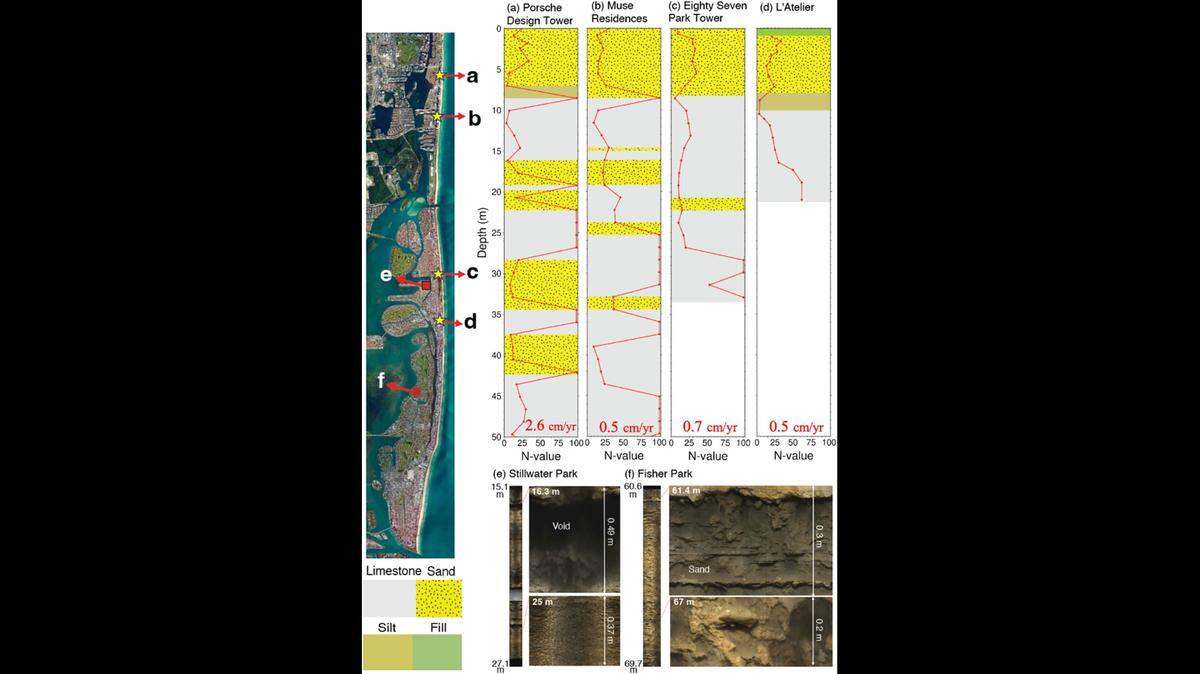
“The further north you go, the more sand layers you have,” Gregor Eberli, a geoscience professor and co-author of the study, told the Herald on Monday.
Development companies drill into the ground to see what, exactly, they’re dealing with. Depending on the makeup, they’ll decide how many pilings need to go into the ground to keep the building on top stable.
While reviewing satellite imagery, the scientists noticed that some of the buildings’ movement coincided with the start of new construction projects nearby. These projects “accelerated, if not instigated,” the subsidence, the researchers wrote in the study.
Some of that could be due to vibration from drilling the pilings into the ground. Though pilings are often driven 100 to 200 feet deep, the requirements to inspect the condition of neighboring buildings before any construction can start are strict, and include measuring even the smallest cracks. Generally, though, they are focused on what’s visible above ground – not hundreds of feet below.
Eberli and Falk Amelung, the lead author of the study, told the Herald that they believe the vibration helped rearrange and compress layers of sand, potentially creating more empty space into which the buildings were slowly sinking.
In Sunny Isles Beach, the most affected area, the buildings identified had an average height of more than 600 feet and were mostly built during the construction boom of the past two decades. Dozens of luxury condos and hotels now rise from a sandy coast. Some have more than 300 units.
“This wasn’t a problem when we had the smaller buildings of like five, six, maybe 10 stories – the ground would hold it,” Eberli said. “You have to ask: How tall do we want to build these buildings?”
Too much water?
It’s not just the ground itself but also the water flowing through and into — both from the forces of nature and Miami-Dade’s flood control systems — that may be contributing.
To help alleviate increasingly common flooding, more than 5,700 stormwater drainage wells have been installed within just over half a mile of the shoreline. Other cities, too, are building more and more stormwater drainage. The difference here, though, is that the ground is already full.
“Everything is completely saturated, from the water table downward,” Mike Sukop, a hydrologist at Florida International University whose team mapped the wells, told the Herald.
.jpg "Map_2 (1).jpg")
Already shallow groundwater is being pushed up by the rising sea level underneath our feet. In many areas, the groundwater is so close to the surface that even a hole of just a few feet will immediately fill. Adding excess stormwater from the top, Sukop said, could create “a pressurizing effect on the layers that is causing them to move around a little bit.”
And more water is yet to come: With every degree human-made climate change has warmed the planet, the air’s capacity to hold water increased by 7 to 10 percent. Globally, this has made rainfalls heavier and more extreme.
The more fresh water, the higher the risk that it reaches underground areas it hadn’t touched before, which could exacerbate the dissolution of limestone that all of South Florida is built on, Chinowsky said. Changes in tidal flow and higher, stronger storm surge are also moving water.
“You’re exposing that stone, that sand, to movement that typically is not there,” he said, “and any time you change that movement of water, that’s where you start being concerned about erosion.”
Any potential concerns over the impacts climate change might have on Florida, however, are not reflected by the more than 43,000 people who moved to the Miami-Fort Lauderdale-West Palm Beach metro area between 2022 - 2023, according to the US Census.
“As long as people keep wanting to move here, we will welcome them,” Svechin, the mayor of Sunny Isles, said, adding that she believed that development in the city had now reached a rate “that is in response to the needs and wants of the community.” Safety and quality of life are prioritized, she said, and the city will ensure that residents “don’t feel like we turned into some sort of Manhattan, God forbid.”
Chinowsky, however, said that building designs and construction — especially in at-risk coastal areas — might need to be adapted in the future.
Building foundations, for one, can be made even safer — though at a higher cost. “Real estate developers hate to hear it’s more expensive. But safety over expense,” he said. “You don’t want to see failures because we didn’t account for what was going to happen going forward.”
While we’ve long taken for granted that things like bedrock doesn’t change. The study, and the realities of climate change, seem to suggest that that’s no longer the case. “It’s not that the [building] codes were wrong – it’s that the codes made an assumption that the future was going to be the same as the past,” he said.
This climate report is funded by Florida International University, the John S. and James L. Knight Foundation and in partnership with Journalism Funding Partners. The Miami Herald retains editorial control of all content.
If you have questions for the climate team, please email climate@miamiherald.com
This story was originally published December 17, 2024 at 10:17 AM.