
As nights grow hotter in Miami-Dade, experts say cooler homes are the answer
This story is being shared in the Miami Herald through a partnership with the Local Media Association’s Covering Climate Collaborative, of which Florida International University is a member.
Lifelong Miami resident Robertson Adams has fond memories of camping outside in the summer as a child.
“It wasn’t so hot that you couldn’t sleep at night,” he said. “I remember being under blankets, trying to stay warm. But I can’t imagine having to do that now.”
As a current resident of Coral Gables, Adams — now 58 — commented that he has watched the climate in South Florida change drastically since his childhood and that the new lows are not what they used to be.
“It’s common now that the lowest temperature is 80 degrees,” he said. “That’s really high. That would be an uncomfortable temperature to sleep at as a camper, and it never used to be like that.”
Adams isn’t the only South Floridian seeing these changes.
According to leading experts in both science and urban planning, nights are growing warmer, and extreme heat will continue to be an issue in South Florida if residents don’t have adequate energy resources and architecture is not improved to withstand such intense temperatures.
The New Low Temperature
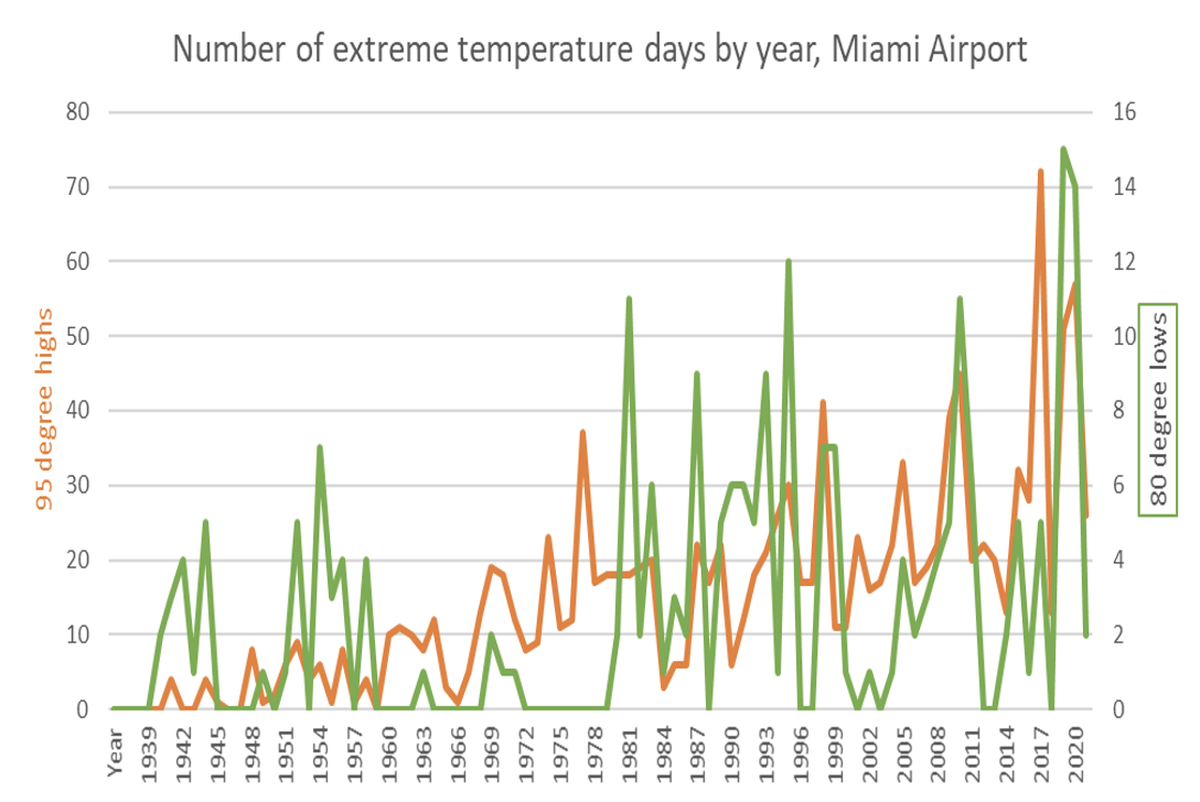
Climate scientist Laurence Kalkstein of the Extreme Heat Resilience Alliance, a coalition of heat experts and county leaders, has tracked heat waves internationally and in Miami specifically, for over 30 years. His research shows a gradual increase in the number of days with lows of over 80 degrees Fahrenheit near Miami International Airport from 1939 to 2020.
Data from the Alliance suggests that the most extreme low temperatures in Miami are typically above 83°F (28°C) overnight with high humidity.
“The research [Miami-Dade County is] doing with the Alliance will be applicable to climate change over time, but we’re interested in saving lives now,” Kalkstein said. “Heat has been a major problem to human health for many a decade, and it’s just now that we’re becoming aware.”
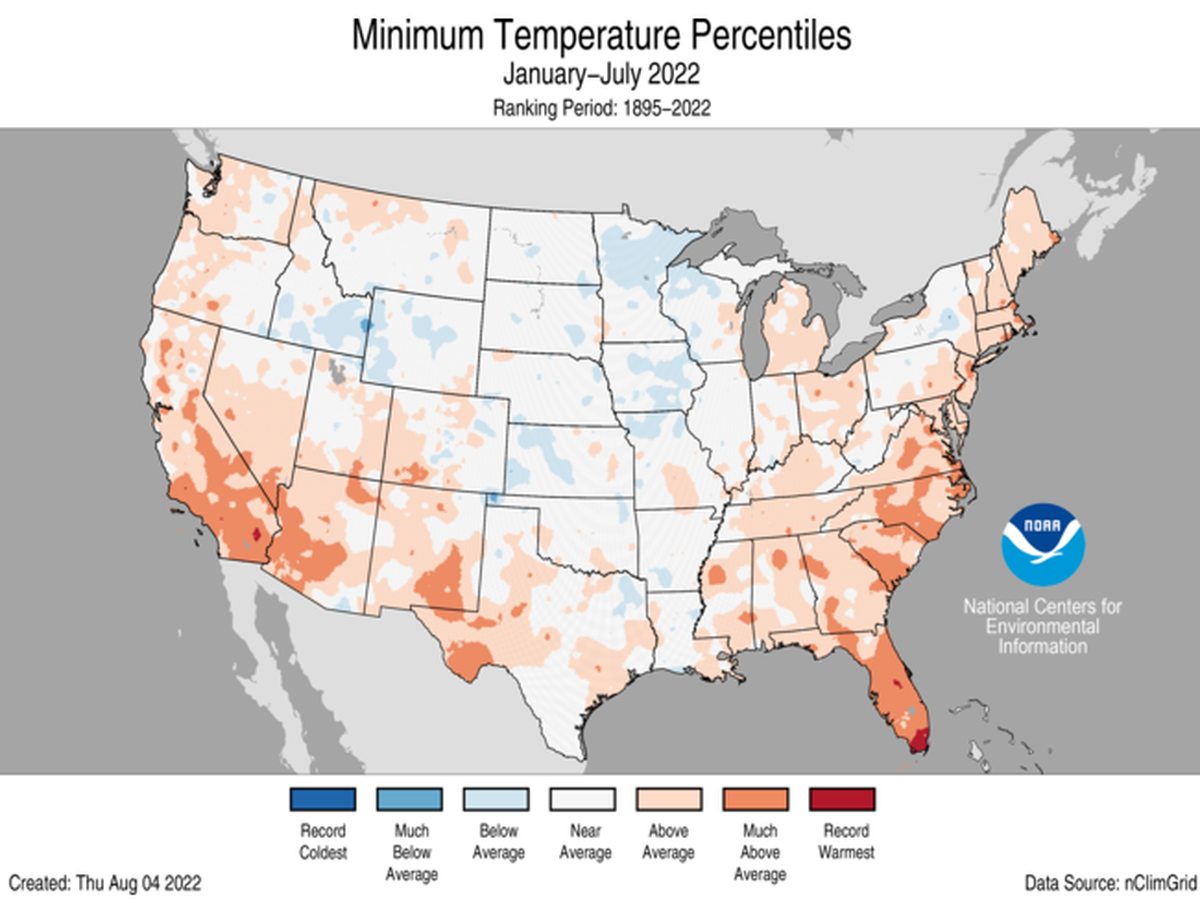
Similarly, a recent study by the National Oceanic Atmospheric Administration showed that climate change has set a new, balmy standard for low temperatures in South Florida.
NOAA reports nighttime temperatures were above average for many regions in the country and South Florida was one of the only areas with record-hot minimum temperatures this year, as shown in the map below.
When Heat Affects Poverty and Health
The combination of higher night-time temperatures and humidity with little respite can have both psychological and physiological impacts on people, especially those without air-conditioning. As many as 57% of all low-income residents in South Florida are currently struggling with energy poverty, or a lack of access to energy services, according to the Extreme Heat Resilience Alliance.
Miami-Dade County has occasionally tried to counteract extreme heat by offering resources to residents. This past November, Mayor Daniella Levine Cava announced a county-wide distribution of free air-conditioning units to alleviate the effect of extreme heat.
For organizations like the Solar and Energy Loan Fund, the higher temperatures are a major concern.
This program, often referred to by the acronym SELF, offers low-to-no-cost financing for those wanting to make energy improvements on their homes or businesses. Through the SELF program, Florida residents like Elizabeth O’Neal have had the chance to improve their homes in some of the most trying times.
O’Neal, a 63-year-old retired teacher, found herself in a tough situation when she lost the air-conditioning in her home. Her husband had just passed away and she could not afford to install a new ventilation system.
“He didn’t even get to enjoy it, but they really helped me a lot when I was having problems,” O’Neal stated, while holding back tears.
SELF offered more affordable air-conditioning, lowering her payment from over $300 to about $105 a month. O’Neal said that before finding SELF she felt taken advantage of by other air-conditioning services because of her age and disabilities.
“I just didn’t feel like getting up and doing anything,” said O’Neal, who also suffers from chronic obstructive pulmonary disease, or COPD. “I get winded and the heat makes it even worse. So, it was a very stressful time and I couldn’t do anything about it. It was just too hot to even move.”
According to health experts like Dr. Cheryl Holder, a Florida International University professor and one of the founding faculty members of the Herbert Wertheim College of Medicine, people with COPD face more discomfort, stress and unstable blood pressure as a result of extreme heat. Holder has dedicated her career to investigating and helping underserved populations, especially those suffering from climate-change-related illnesses.
She said she often sees the effects of extreme heat, including in younger patients struggling with asthma, the elderly with COPD and outside workers with dehydration or kidney disease.
“When the heat messes up sleep patterns though, everything changes,” she said. “There is no relief at night and when you don’t sleep well, your memory worsens, so there is a cognitive decline faster. It’s like a domino effect.”
Holder also serves as part of the Climate and Heat Health Task Force for Miami-Dade County, monitoring heat effects and providing guidelines for those impacted by it at home.
“The heat causes these bad mental functions both in the short term and long term and it leads to change in metabolism or obesity, which then leads to higher risk of cancer and heart disease,” said Holder. “So it leaves us as clinicians to start investigating more about what’s going on at home.”
How We Build Our Homes
Although there are programs to assist people when the heat becomes too intense, the heart of the problem is that homes are not built to withstand extreme heat.
University of Miami architecture professor Joanna Lombard suggested that in the future, houses should be constructed differently, especially in low-income neighborhoods.
Lombard explains that working-class neighborhoods like Little Havana, for example, are built mostly with concrete, which is efficient for storm resistance but not ventilation. Because concrete absorbs heat from the sun during the day, the heat radiates in these homes at night.
“This worked really well when the nights were cool, but you don’t really need that heat when the nights are hot,” she said. “That pushes us further into needing more and more air-conditioning, and then that also means we’re contributing to carbon emissions. We can’t have people suffering in the heat, but all of our solutions to the problems are pretty challenging.”
Lombard is a founding member of the University of Miami Built-Environment Behavior & Health Research Group, which has funded projects for improving neighborhood design and health across South Florida.
“Now people are realizing it’s an ethical responsibility to design buildings that are environmentally responsive before air-conditioning even comes into play,” she said. “Our strategies for heat adaptation used to rely heavily on nighttime temperatures to recover, but there’s this accelerating level of heat that’s very hard to dissipate.”
Some Miami residents, like Robertson Adams, are lucky to live in greener spaces and cooler neighborhoods. But how long will their luck last as temperatures rise?
“My house is in a nice part of Miami that has a lot of trees, but that won’t rescue me from the overnight high temperatures, which were in the 80s up until the first week of December,” said Adams. “My family is privileged enough to have the AC running all of the time.”
This story is contributed by Florida International University’s Lee Caplin School of Journalism & Media, a member of LMA’s Covering Climate Collaborative, a partnership focused on covering the impacts of climate change at the local level.