PortMiami and cruise lines have curbed pollution in Miami — and plan deeper cuts
As massive cruise ships conspicuously sail into PortMiami — one of the world’s busiest cruise ports — offloading thousands of travelers and taking on thousands more with only a few hours of a turnaround, a mostly invisible revolution has taken place in the last few years.
Thanks to a hefty financial investment from Miami-Dade County and the cruise lines themselves, these floating cities are now plugging in to the city’s power grid when they’re in port instead of burning fuel — significantly slashing the pollution spewing from these notoriously gas guzzling boats.
It’s called shore power, or cold ironing in marine industry speak. And PortMiami is considered a success story.
Five of its nine cruise ship berths offer ships the ability to plug in, the most of any passenger port in the nation, according to a review of annual reports and port websites.
PortMiami isn’t a pioneer in using shore power. Several ports on the West Coast, in Alaska, Washington and California started decades earlier. Miami-Dade County’s efforts came after a Miami Herald report questioning what it was waiting for. And cruise companies have been far ahead of it in adopting the technology. Yet, PortMiami is catching up fast.
“This is a project we are so proud of here at the port,” said Hydi Webb, director at PortMiami. “It was a big feat to go from never doing this before to doing five berths at once.”
So far, she said, the county has had ships plug in for 175 days (or calls), leading to a reduction of 6,000 tons of greenhouse gasses spewed into the atmosphere — about the same amount that 1,250 homes burn in electricity use in a year, according to the EPA.
That number is expected to rise as more shore power enabled ships show up in the Magic City. Thirteen ships that regularly visit can plug in now, with another ten expected to come online in the next few months.
PortMiami’s big investment — a cool $125 million — has won it the praises of many in the cruise industry, according to Miami Herald interviews with executives from several companies.
“Miami is the perfect place to lead. A lot of times, Miami is called ground zero for climate change and they’re already demonstrating leadership there,” said Jill Stoneberg, senior director of social impact and sustainability at Virgin Voyages. “We were really supportive and thrilled that PortMiami was making such a big effort to adopt shore power.”
Getting here was the result of a 2021 Miami Herald investigation that prompted Miami-Dade to finally follow through on its long-promised goal of installing shore power, nudging from many in the cruise industry and tens of millions of dollars in grants and county dollars.
And others may soon follow in Miami’s footsteps. Port Everglades has been discussing adding shore power to several of its berths as soon as 2028, Joseph Morris, Port Everglades CEO and Port Director, said in an email to the Herald.
Electrifying the port’s eight cruise berths is projected to cost approximately $172 million, according to a 2023 study.
Why shore power matters
Cruise ships are a dirty business. Most of them run on some of the dirtiest fuel in the world, the leftover gunk after all the other useful parts are siphoned off to make gasoline and other more valuable petroleum products.
International regulations require ships to clean the emissions from burning that fuel before it fumes out into the atmosphere, usually with scrubbers, which act like mufflers on a gas-powered car to trap some pollutants from the exhaust.
And at most ports in the world, cruise ships keep burning that fuel while they’re hanging out right next to busy city centers. That’s a health hazard to anyone living within breathing distance, and a source of greenhouse gas pollution that worsens global warming.
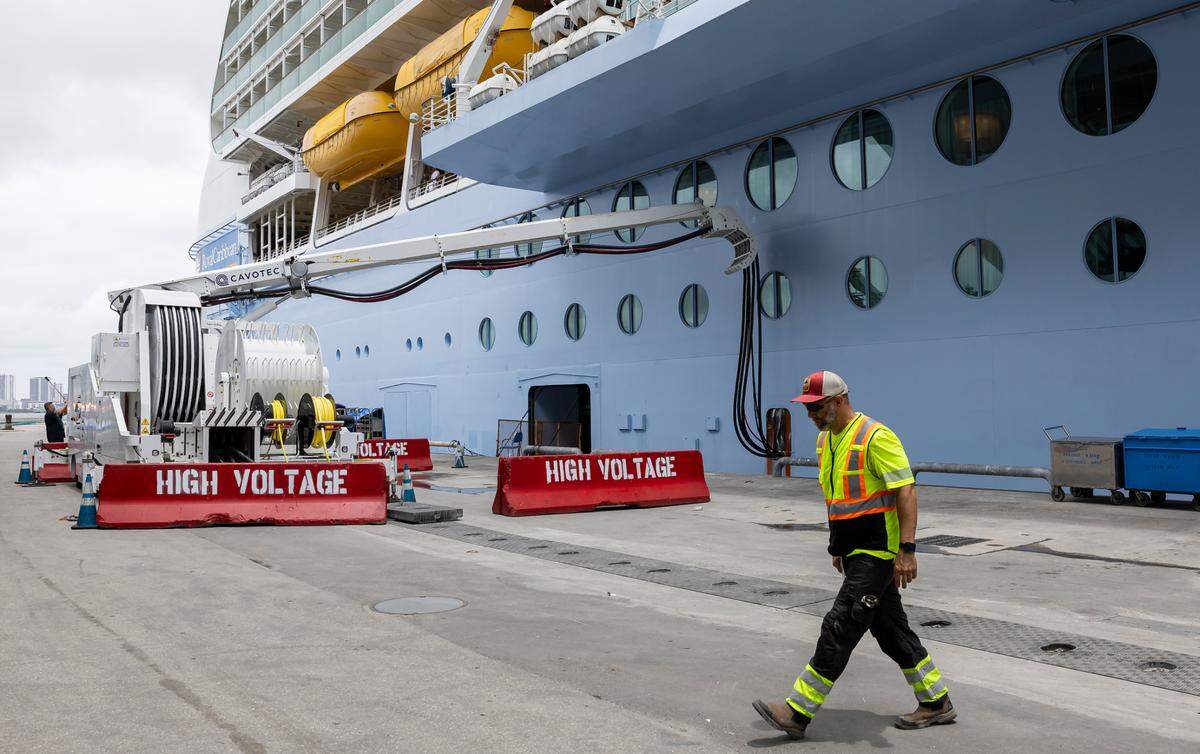
Shore power lets cruise ships turn off their engines and plug in to the power grid instead, usually a much cleaner option. In a pre-pandemic year, cruise ships at PortMiami emitted as much greenhouse gas in one year as almost 7,000 houses — a bigger city than Pinecrest.
With shore power now up and running, Miami can take a big slice out of those emissions.
It was a pricey upgrade. Although the county won about $28 million in federal grants, the total project cost just north of $125 million.
“We’re very grateful for the funding. It adds up to about one terminal,” said PortMiami’s Webb.
The county is slowly making that money back with fees it charges cruise ships to connect — $4,115 per day, plus several thousands more to initially connect. And that’s on top of whatever price the cruise lines pay to Florida Power & Light for the electricity they use.
That makes shore power more expensive for cruise lines than simply burning the fuel already on board, Stoneberg acknowledged. However, the benefits are worth it for Virgin, she said.
“We advocated for shore power before it was a widely adopted initiative,” Stoneberg said. “It also comes down to our reputation and community impacts as well.”
What cruise lines think about it
Shore power is more common — and more often, required — in Europe than the U.S. The European Union has set a goal for most large ports to require large ships (including cruise liners) to plug in to shore power by 2030, although a recent study suggests that many ports may fall short of the deadline.
Compared to other recent green initiatives in the cruising and shipping world, the push for shore power in the U.S. has been largely led by the cruise industry.
“More ships can plug in than there are ports available,” said Virgin’s Stoneberg. “We’d like to see more ports follow Miami’s lead.”
Marcel Goncalves, vice president of decarbonization at Carnival Corporation, said only about 4 percent of the 800 ports worldwide the carrier calls on today are shore power ready. Meanwhile, over 70 percent of Carnival’s fleet are equipped. All of its new ships will be too.
“Shore power is one of the critical pieces of our decarbonization strategy,” Goncalves said. “It’s part of everybody’s decarbonization strategy.”
Virgin — a smaller and younger cruise line — said shore power was part of the conversation from the very start. Three of the cruise line’s four ships are shore power ready, and the fourth is set to undergo a multi-million dollar retrofit over the next year or two to make it fit to plug in.
“Shore power’s been on our radar before we even launched a ship,” Stoneberg said.
For legacy cruise brands, the name of the game is retrofitting older ships. MSC has been retrofitting ships since 2017; at this point, 18 of its 23 ships are shore power capable.
Every scheduled call in Miami for MSC for the next three years is shore power capable, said Linden Coppell, MSC’s vice president of sustainability.
Of Royal Caribbean Group’s 68 ships, 37 of them are equipped for shore power. And that number is growing, said Nick Rose, vice president of corporate responsibility at Royal Caribbean Group.
Before PortMiami, Carnival had used the technology in San Diego, Long Beach, San Francisco and Seattle. Royal Caribbean also started plugging in on the West Coast years earlier, starting in California in early 2020.
“That’s where it started for us,” said Rose.
What’s next for shore power
While PortMiami has five of its nine berths wired for shore power, only three can be plugged in simultaneously. Growing any further would require FPL to expand the power plant it runs within PortMiami.
“When we go to the next phase, the goal would be to plug in five at once,” said Webb. “The capacity is not there right now.”
PortMiami trailed most of the West Coast of the U.S. in installing shore power, but there may be some advantages in doing so, say cruise executives.
Standards for developing shore power still aren’t uniform, but that’s only becoming evident now as more ports adopt the technology. Some carriers have drawn analogies with the electric car industry, where not all electric vehicles have the same plugs and one brand can’t necessarily use another one’s outlets. And some of the first ports to use shore power built static systems rather than mobile ones, so they couldn’t be moved up or down a pier. As a latecomer, Miami was able to address that issue early.
“That’s one thing that early movers such as the West Coast didn’t quite understand,” said Rose. He noted that several ports there are now retrofitting their shore power systems to accommodate more ships.
And while other ports, like Seattle and some in California, have mandated ships plug in to shore power, in Miami the port has signed voluntary agreements with cruise lines to require them to plug in any shore power capable ships if a plug is available. Mandates can often start changing companies’ behavior but as technology becomes widely used, ports need to collaborate more with cruise lines. That’s something Miami has understood from early on, executives say.
Despite advances, shore power has limitations. It’s an impactful change for ports looking to cut pollution, but it doesn’t get at the heart of the issue for emissions-heavy cruise ships.
“Today [shore power] is a small piece of the pie,” said Goncalves, the Carnival executive, pointing out both the low percentage of ports that use shore power and that the time spent in the port is a small part of the ship’s journey.
“Overall, we do require more energy when we’re moving the ships than when we’re not moving the ships,” he noted.
But the effort is one of several methods cruise lines are using or experimenting with in their attempt to reduce net emissions.
“Decarbonization is not something easy where there’s just one solution for all,” Goncalves cautioned. “When the ship is in port, shore power is the best solution that we have.”