Jane Goodall reveals to fellow ‘Canes the moment she realized her destiny
Jane Goodall, the world’s foremost primatologist whose intimate observations of chimpanzees in the African wild compelled people to reframe how they looked at our shared planet, died Oct. 1 at 91. The indefatigable London-born conservationist was on a speaking tour in California, The Jane Goodall Institute reported.
Goodall’s speaking tours brought her to Miami on many occasions, including an April 2023 lecture at Florida International University’s Ocean Bank Convocation Center and, a decade earlier, to the University of Miami’s BankUnited Center (now Watsco Center) in April 2013.
The Miami Herald’s report from the 2013 UM presentation is republished below:
Jane Goodall at UMiami
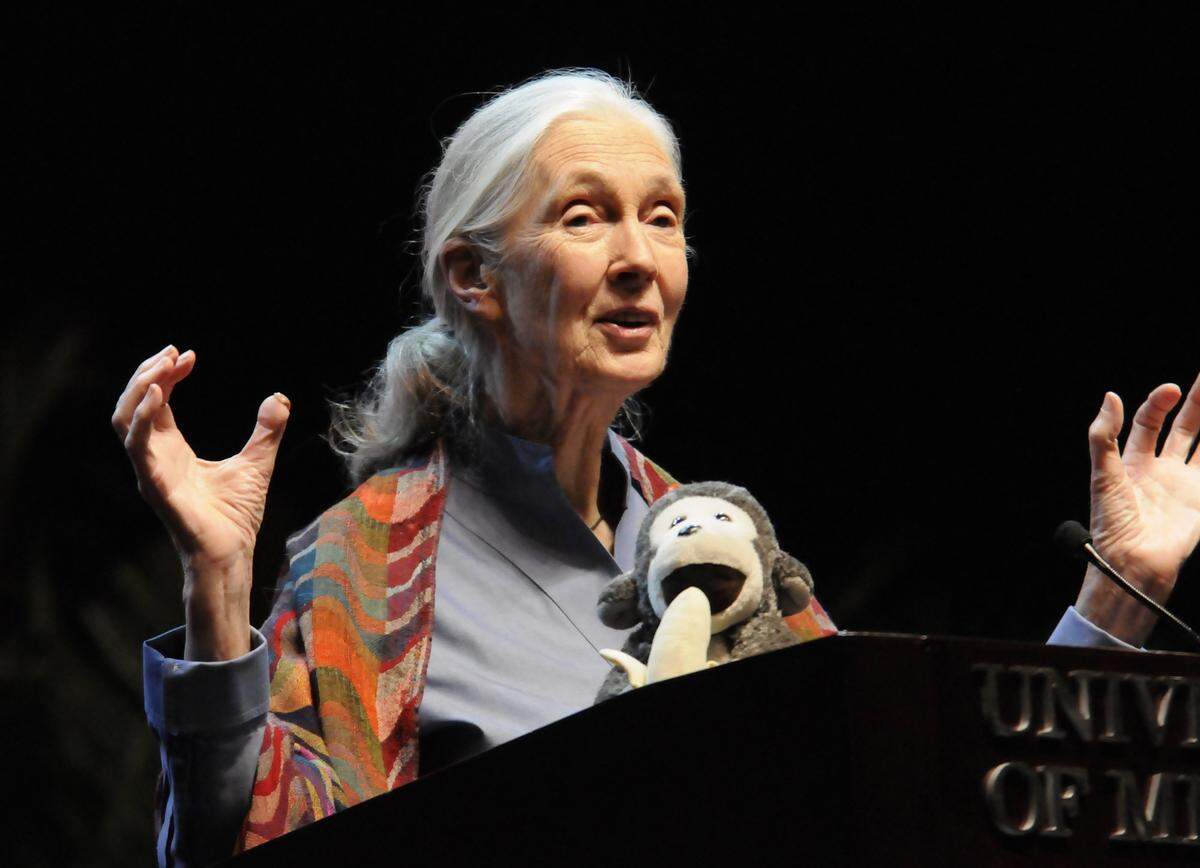
For Jane Goodall, the world’s foremost primatologist, it all started when she was 4 ½, a curious “animal loving” child in pre-World War II London who was tasked with gathering eggs around a farm while on holiday with her family.
“The hens were supposed to lay their eggs in these little wooden henhouses,” she began, before an audience of 2,300 University of Miami students and about 700 guests at the BankUnited Center on the Coral Gables campus.
“I was collecting the hens’ eggs and putting them in my basket, and apparently I began asking everybody, ‘Where does the egg come out of the hen?’ I couldn’t see a hole like that. And apparently nobody told me to my satisfaction, so I decided I would have to find out for myself.”
Goodall, now 79, an anthropologist, a United Nations Messenger of Peace — “and a ‘Cane,” added UM President Donna Shalala in her introduction since Goodall was awarded an honorary degree by the school in 1993 — told of crawling in after the hen and hiding in some straw to witness the miracle of egg-laying.
“And I waited. And I waited. Which was fine for me, but my poor family didn’t know where I was. Now, imagine my poor mother, worried, wondering where I was. It was getting dusk when she saw this excited little girl rushing to the house. Instead of saying, ‘How dare you go off?’ which would have killed the excitement, she sat down to hear the wonderful story of how a hen lays an egg.”
Goodall’s life-altering moment
For Goodall, whose trailblazing work in the study and interaction with the wild chimpanzees in Tanzania’s Gombe National Park just entered its 54th year, the moment was life-altering.
“If you look on that story with kind souls, isn’t that the making of a scientist?” she inquired during her hour-long presentation. “The curiosity? Asking questions. Not getting the answer you want. Not giving up. It was all there. Now, if I had a different kind of mother, my curiosity might have been crushed. I might not be standing here now. I might not have done what I did.”
The Gombe chimps taught her much about life, love and resourcefulness. Chimpanzees’ DNA differs from humans’ by only 1 percent, and the bond between mother and child, as in humans, is strong and enduring.
“Human intellect differentiates us the most from chimps,” Goodall said. But if man is so smart, “how come we’re destroying our own home?” she lectured, as she spoke of dwindling species, the devastation of the forests, climate change and green energy.
She also touted Jane Goodall’s Roots & Shoots, a global environmental and humanitarian youth program she founded in Tanzania in 1991. The program is now in the United States and 133 countries, with ongoing expansion into Latin America.
UM students’ reactions

“I saw her on TV as a child and think her work is fascinating,” said Katie Lang, 27, a communications master’s degree student.
“I find the work she did with wildlife and in the community in Tanzania inspiring,” said marine conservation master’s student Christina Marmet, 24.
Sharon Sanders, 55, a nursing student, wants to help. “If she’d hire me to work out in the field, I’d be there next week,” she said. “She’s done an amazing job and left a legacy for people to follow in her footsteps.”
The trio’s enthusiasm rubbed off on Goodall.
“I’m asked often, ‘You’ve seen so much damage. Do you really have hope for the future?’ I do have reason for hope,” Goodall said. “And it’s these young people in 133 countries. . . . And it’s the human brain. . . . And the resilience of nature. If you guys lose hope, there’s no hope for the future.”