It’s the $4 billion ‘crown jewel’ of Everglades restoration. But will it be enough?
Massive and massively expensive, it’s been touted as the “crown jewel” of Everglades restoration, the key to unlocking every other project that will come after it.
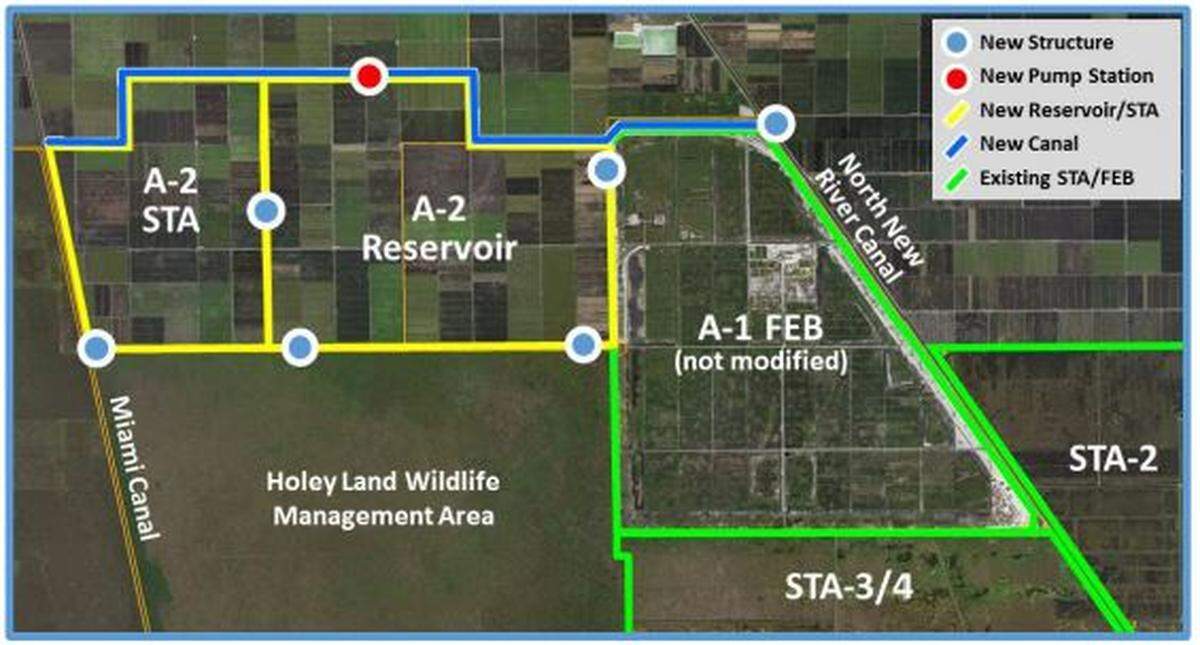
The $4 billion Everglades Agricultural Area reservoir — about half the size of the city of Hollywood and twice as deep as Lake Okeechobee — finally got underway last week with the ceremonial flinging of shovelfuls of dirt and celebration from federal agencies, state water managers and many environmental groups.
It’s a rare undertaking with bipartisan support. President Joe Biden’s administration calls it a “national priority.” Gov. Ron DeSantis, who does not exactly see eye to eye with the president on many issues, also bills it as a “top priority” and has even gone to political battle to support it.
But the reservoir also ranks among the most controversial projects in more than two decades of Everglades restoration efforts — and there are still questions whether it can come close to meeting the lofty goals of curtailing foul fish-killing algae blooms that have crippled waterways on both coasts and restoring the flow of clean water to the southern Everglades.
The reservoir, dramatically downsized from original plans, has divided once-united members of Florida’s environmental community and generated lawsuits embroiling a host of players, from Florida’s ecological boogeyman, Big Sugar, to a respected Everglades scientist whose opposition to the reservoir put him at odds with his employer, the state’s most influential environmental group.
“The EAA reservoir has become so political that legitimate questions about its scientific viability are stifled,” said Eve Samples, executive director of Friends of the Everglades. “It’s kind of the third rail of Everglades restoration.”
In the simplest terms, the reservoir will become Florida’s largest above-ground pool.
Ringed with 37-foot earthen walls, the reservoir is designed to hold a tremendous amount of water that will be siphoned from its larger neighbor, Lake Okeechobee. That water, polluted with runoff from cattle farms, suburbs and sugar fields, will be filtered through a series of man-made marshes. If everything works as hoped, the plants there will suck up much of the pollution — primarily, the damaging fertilizer component phosphorus — and release a stream of clean, fresh water south into the thirsty Everglades.
By 2030, when the project is scheduled to be finished, it will be used to divert water when Lake O becomes too full. That should mean fewer discharges of polluted Lake O water and fewer algae blooms along both coasts and more water for farmers, South Florida communities and especially parched Everglades National Park.
“The environmental catastrophe we’ve been experiencing because of the way water is managed on the peninsula, all of that changes with the construction of this restoration project,” said Eric Eikenberg, chief executive officer of the Everglades Foundation.
The $4 billion reservoir is one of the biggest environmental restoration projects the U.S. Army Corps of Engineers, the federal government’s builders, has ever worked on. And it’s also the largest and most expensive to date in a decades-long restoration plan that is now projected to cost $23 billion or more.
But the path from idea, to paperwork signed into law by President Bill Clinton and Gov. Jeb Bush in 2000, to shovels in the ground has been dogged by delays and debates and far more winding than the movement of water from Lake Okeechobee to Florida Bay.
“There’s been more twists and turns on this particular project than a mystery novel,” said Eikenberg.
A shrunken footprint
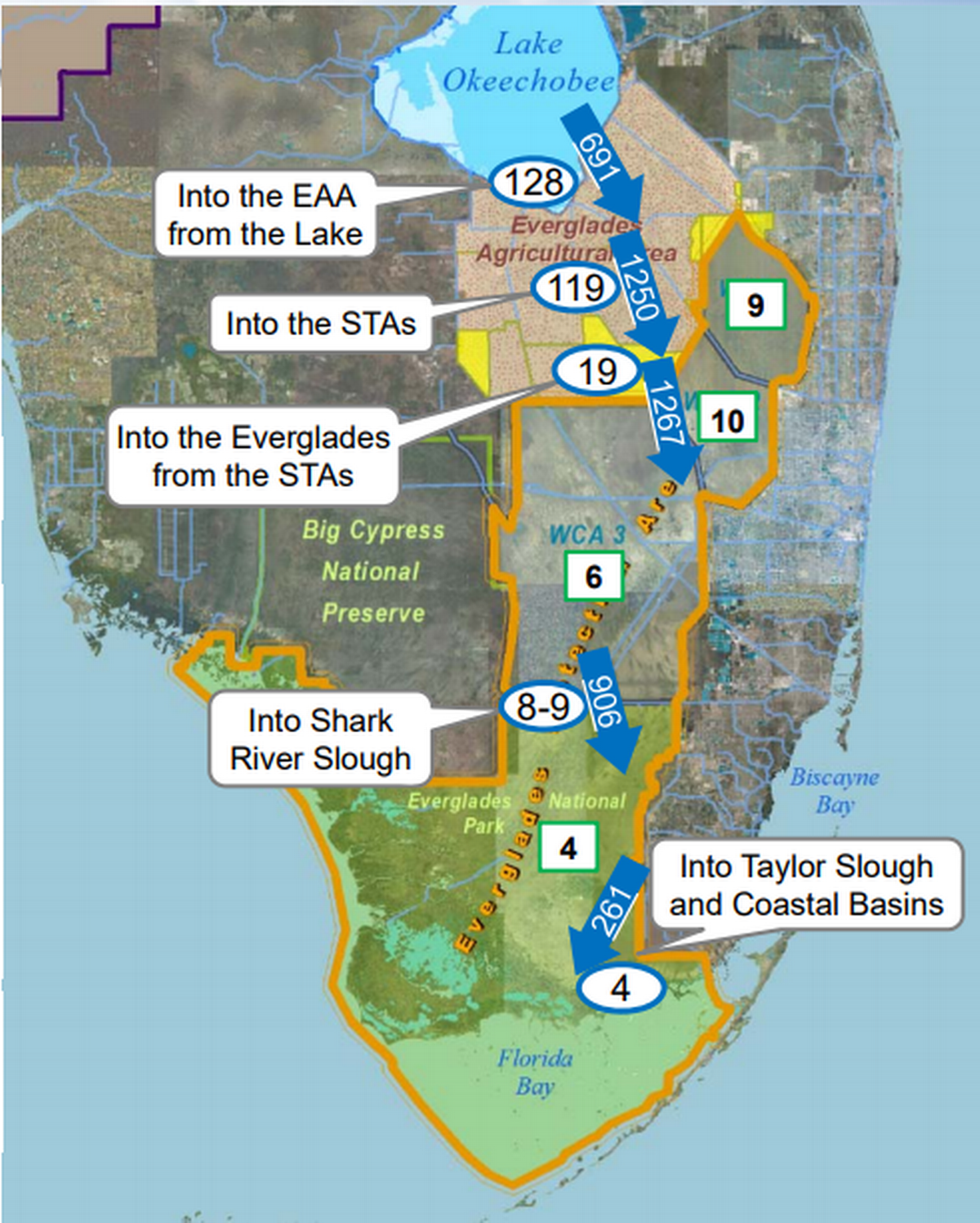
The specific science of fixing the Everglades may be devilishly complicated, but the concepts at its heart aren’t. To restore the ecosystem, experts agree that more water in Lake Okeechobee needs to flow south through Everglades National Park and down into Florida Bay.
“The park is consistently in drought,” said Cara Capp, senior Everglades program manager for the National Parks Conservation Association. “With more water south we get fewer seagrass die-offs, fewer fish kills in Florida Bay and a more resilient ecosystem.”
But the water from Lake O has been fouled by decades of agricultural and stormwater runoff from sugar fields, cattle ranches and suburbs, as well as from leaky septic tanks. So it needs to be filtered through man-made wetlands. The state has already invested nearly $2 billion in about 60,000 acres of artificial marshes, called stormwater treatment areas or STAs. But they still don’t supply enough clean water to restore the natural flow of the River of Grass.
But acquiring more land for restoration has been an ongoing and bitter battle. Most of that land south of the lake is owned by farmers — primarily politically powerful sugar growers like U.S. Sugar and Florida Crystals.
The most ambitious effort, former Florida Gov. Charlie Crist’s deal to buy out U.S. Sugar land for nearly $2 billion in 2008, collapsed under the one-two punch of an economic recession and U.S. Sugar changing its mind. And Gov. Rick Scott let contracts to buy at least some of that land expire under his administration.
Efforts to find new willing sellers in the area were unsuccessful, and environmentalists failed to convince the state to exercise its powers of eminent domain and forcibly buy the land. So even though the concept of a reservoir was included in the initial 2000 Everglades restoration plan, it never really got off the ground.
That was until blue-green algae blooms triggered by Lake O dumps caused havoc on Florida’s coasts in 2015. Dead fish, fleeing tourists and outraged residents prompted incoming state Senate President Joe Negron to throw his weight behind a bill mandating a new reservoir, fast.
The original pitch called for a project spanning 60,000 acres that could hold and treat 360,000 acre-feet of water. But there was a big problem. The state didn’t have anywhere near that much land, and no one was willing to sell enough to get to that number, The final bill, which became law in 2017, didn’t spell out a size and included a clause banning the state from using eminent domain to snap up any more sugar land.
So, faced with a deadline imposed by a new law, the reservoir design got smaller but also deeper. The resulting numbers are a fraction of the initial vision: a 10,500-acre reservoir designed to hold 240,000 acre-feet of water with 6,500 acres of wetland to clean it.
Will it work?
Everglades advocates were not fans — at least at first.
The Everglades Coalition, the collective voice of all of Florida’s various Everglades nonprofits, wrote Gov. Scott that it was too small to meaningfully treat enough water. The politically powerful and well-funded Everglades Foundation released a review of the plan that said the same thing, and it proposed an alternative, shallower reservoir instead.
Research from William Mitsch, a wetlands researcher at Florida Gulf Coast University, suggested that it will take another 43,000 acres of wetlands to treat the water stored in the new reservoir — more than seven times what the state plans to build.
Critics, including Samples from Friends of the Everglades, also worry that the 23-foot high water will be so deep and hard to clean that algae blooms will flourish, like they already do in the lower levels of Lake O. That could make it unsuitable for restoration purposes.
The plants that make up the base of the Everglades food chain are incredibly sensitive to pollution. Even small amounts of phosphorus can change the ecosystem, encouraging the spread of plants like cattails that can crowd out what is supposed to be there. While the southern Everglades and Florida Bay both need more water, Everglades National Park scientists and other experts have long warned that dirty water can do more harm than good.
“If we build it and it makes water dirtier, creates more algae blooms, then we will need even more STAs than we would if it had been configured differently. It is a big waste of taxpayer money if our concerns come to fruition,” Samples said.
But the state had a set amount of land, limited options for getting more, and the new bill approving the reservoir came with a deadline. The project was approved.
And somewhere along the line, the majority of the Everglades groups that once railed against the smaller version of the project changed their stance. Most now support it — confronted with the political reality that something was preferable to nothing. Advocates admit they wanted a win.
“At the time, our decision was yes it wasn’t what was originally envisioned but my goodness, we were not going to be left with nothing,” said Eikenberg. “That was ultimately the decision that we were faced with, and we took it.”
Perfect vs. good
Still, schism remains in the environmental community, with a handful of holdouts, including the Sierra Club, the Center for Biological Diversity and Friends of the Everglades, still against it.
Kelly Cox, director of Everglades policy for Audubon Florida, said her organization’s decision came down to supporting a project that could happen today instead of waiting for a better one that might never come.
“If we make perfect the enemy of good, Florida Bay is going to suffer. The national park is going to suffer. It’s not a hard choice for us,” Cox said. “It’s still a major, major step forward for Everglades restoration that we should be embracing.”
But Samples and her colleagues argue their questions remain unanswered.
Currently, Florida’s sprawling network of man-made wetlands of STAs isn’t absorbing enough pollution to avoid altering the sensitive ecosystem of the Everglades. There is time to tweak the system, with the federal standard for releases toward Everglades National Park not coming into play until 2027, and the reservoir project does include a large new STA.
But it remains uncertain, even after everything is built, if the state’s system can meet those strict federal water quality standards, especially with the reservoir potentially increasing the volume of dirty water to cleanse.
Even the Army Corps, which is building the reservoir, has signaled it’s worried about whether the finished project will meet the water quality standards it’s supposed to. If the new project missed the mark, it’s possible the “crown jewel” of Everglades restoration might not work, or at least operate at projected capacity.
“There was a lot of political pressure to get this thing done quickly,” Samples said, “and I think it can lead to overlooking concerns that we’re raising.”
Politics and lawsuits
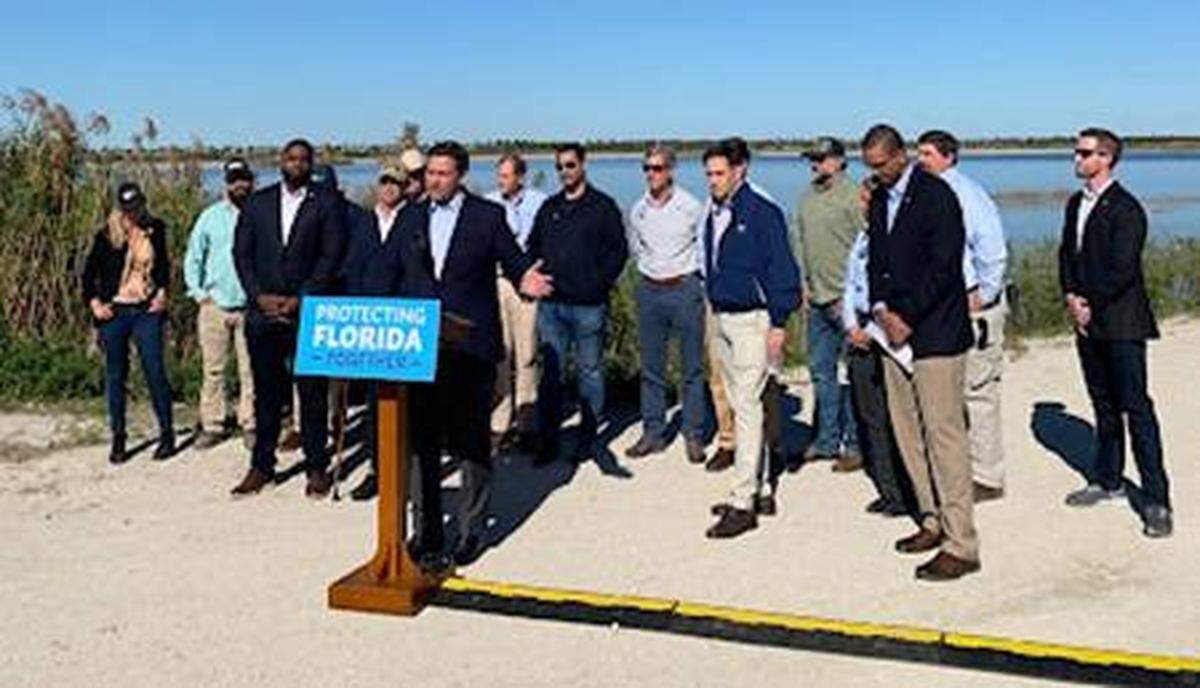
That push included Tallahassee’s most powerful force: DeSantis made his support for the EAA reservoir and addressing coastal algae blooms a focal point of his first campaign for governor. He underlined that in his first weeks in office.
When the South Florida Water Management District unanimously voted to extend a sugar company’s lease on state land needed for the reservoir just days before he took office, DeSantis dismissed the entire board. The state eventually paid the sugar company $1 million to break its lease early to make room for the reservoir.
And last year, when the Biden administration agreed to spend a record-breaking $1 billion on Everglades projects but didn’t allocate any for the reservoir, DeSantis railed against anything blocking his “number one priority.” His Republican allies, including U.S. Sen. Marco Rubio and U.S. Rep. Brian Mast of Florida, accused the Biden administration of denying funding for the project because it was important to DeSantis.
The White House denied the charge, and in the next few rounds of Everglades funding has put more than $500 million toward the project.
When then-Florida Senate president Wilton Simpson, now the state’s agriculture commissioner, called the reservoir a “mistake” and pushed forward a bill that could dilute funding for the reservoir with other restoration projects, DeSantis vetoed it.
The project has also drawn opposition from sugar companies and other agricultural interests, which sued the Army Corps over concerns the new reservoir wouldn’t deliver farmers the water they say they’re owed. But many of those ag leaders still support what should be a potential new source to tap for irrigation. Pepe Fanjul Jr., executive vice president of Florida Crystals, even attended Wednesday’s groundbreaking.
READ MORE: Sugar growers sue Army Corps over water level in reservoir for Everglades restoration
The reservoir may also play a role in another lawsuit that surprised members of the tight-knit Everglades scientific community: the Everglades Foundation’s lawsuit against its longtime former chief scientist, Tom Van Lent. It’s not clear exactly why Van Lent left, but he had been a vocal critic of the smaller reservoir.
Van Lent, a former Everglades National Park hydrologist, resigned late last year, and marked his departure with a cryptic tweet saying his new employer, Friends of the Everglades, “put facts over politics.”
A few months later, the Foundation sued him. It claimed Van Lent stole confidential information from the foundation for personal financial gain by failing to provide the passwords to his accounts and “wiping” his devices clean of all information. Van Lent denies the allegations.
The case was eventually settled in September with a confidential agreement that requires Van Lent to never disclose any private information about the Foundation. But last month, the Foundation’s lawyers argued that he broke the agreement. The judge held Van Lent in contempt of court and slapped him with the Foundation’s legal fees. He faces a potential criminal charge in a May hearing.
In a GoFundMe for his legal fees, Van Lent said he was “blindsided by a hyper-aggressive suit based on patently untrue allegations that I stole unspecified confidential data and “classified trade secrets.”
More land anyway
Despite their show of support for the EAA project, most advocates acknowledge that part of their original criticism still stands. The way they see it, the state has promised to only send clean water into the Everglades. If the EAA reservoir and wetlands don’t work as planned, it’s on the state to buy more land and create more man-made wetlands to further clean the water.
“Anybody who’s been working in Everglades restoration for a long time knows we need more,” said Capp.
But that, Eikenberg said, is a problem for another day.
“Everyone from sugar to the environmental community needs to lean in to make sure this happens at the end of the decade,” he said. ”And if it doesn’t? Woe to those interests that try to stop that progress.”
This story was originally published February 26, 2023 at 5:30 AM.