Large shade trees line the streets throughout Coral Gables.
Nicolas McComber
Getty Images
As tropical South Florida continues to be impacted by climate change, Miami-Dade residents face rising temperatures. Neighbors share that electric bills are becoming more expensive and others worry about their children playing outside on searing afternoons. For residents looking for solutions to the blazing heat, one answer is trees, which can be gotten free from the county.
Here’s information Miami-Dade residents need to know about trees and steps to take to get some on your street.
What are the benefits of more trees in my neighborhood?
Trees provide a wide array of environmental, economic and health benefits to the communities they are planted in. Trees can help cool down communities and lower electric bills, mitigate the effects of air pollution and flooding, increase property values and protect residents from the harsh effects of heat and the sun.
Unfortunately, various communities across the county are missing out on these benefits. In 2021, an assessment conducted by the University of Florida and Florida International University found that communities of color and low-income communities in Miami-Dade County tend to have fewer trees. To see how the amount of trees in your community compares to other places in the county, you can use this interactive map.
The map will show you the tree canopy for your ZIP Code, municipality, commission district and more. You can also read more in-depth information about the tree canopy and your community in the 2021 Urban Tree Canopy Assessment.
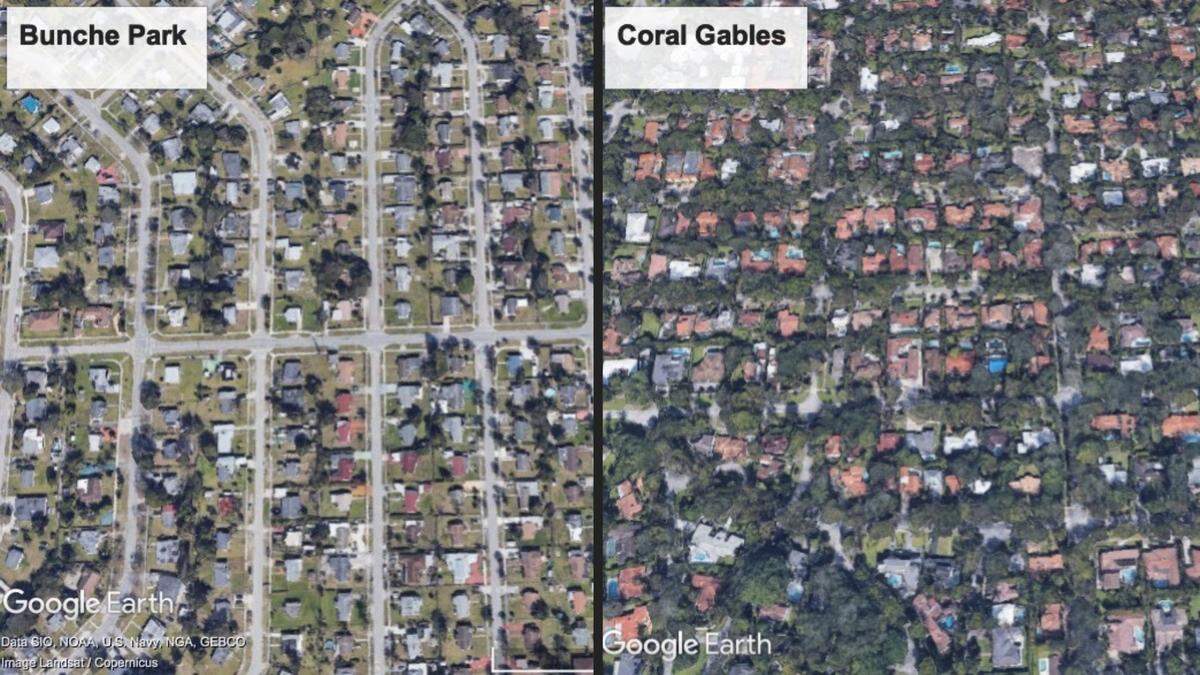
Google Earth images of Bunche Park and Coral Gables show the difference in trees throughout each community.
What is a tree canopy cover?
A tree canopy cover is the percent of a given land area that is covered by leaves and branches when viewed from above. As of 2021, the overall tree canopy of Miami-Dade County was 20.1%.
The more trees an area of land has, the higher the tree canopy percentage will be. For example, in side-by-side images of Miami Gardens’ Bunche Park neighborhood and Coral Gables, Bunche Park was found to have a tree canopy of 15.12% in 2020 while Coral Gables was found to have 44.24%. In Bunche Park, a place where the poverty rate is over 20%, people with less money likely have to pay more proportionally to keep their shade-starved houses cool, kids play in parks that are more scorchingly hot, and local schools often have barren recess areas.
If your neighborhood has too few trees, here are some ways to get free trees from the county.
County and Local Government Resources
Neat Streets Miami Tree Giveaways
Neat Streets Miami is a multi-jurisdictional board that oversees initiatives related to tree plantings and increasing the county’s tree canopy. Throughout the year, Neat Streets will have tree giveaways where residents can get free trees for their property. To find out about upcoming giveaways:
Another resource to get a free tree for your property is the Adopt-a-Tree program. Adopt-a-Tree happens multiple times a year and allows duplex homeowners and those who live in single-family homes to get up to two free trees per year. Here are some things to know about this program:
▪ You need to bring photo identification and proof of your residential address.
▪ Trees are limited to a first-come, first-served basis.
▪ Apartment buildings and mobile home parks do not qualify.
To find out more, you can contact the program at 305-372-6750 or follow the Regulatory and Economic Resources Department on Instagram for updates.
Contact 311
If you’re looking to get a tree for public property, like the swale in front of your home or for a county-owned right-of-way, contact 311. The request will go to Parks, Recreation and Open Spaces as that department has a certain time of the year when it plants trees. To get in touch with 311 you can:
Another option for getting a tree is to contact your district commissioner. While it is important to file a request to 311, the district commissioner can reach out on behalf of a constituent to get a tree for a swale or right-of-way. Contacting your commissioner is also a way to express any concerns about a lack of trees in your area. To find out more about your individual district and district commissioner, visit here.
GREEN Miami-Dade Matching Grant Program
If you are interested in partaking in an organized effort to get more trees in your community, an option is the Growing Roots for Environmentally Equitable Neighborhoods (GREEN) Miami-Dade County Matching Grant program. The GREEN program is funded by the county and allows municipalities, nonprofit organizations and community groups to plant trees on publicly owned land. Grants from $5,000 to $100,000 can be awarded to those who apply. Each group’s planting plan will be judged based on the following criteria:
▪ Existing Tree Canopy and Income Level
▪ Project Enhancements
▪ Resiliency/Impact
▪ Community Outreach
Help us report on shade throughout Miami-Dade
Our journalists want to learn more about the experiences of residents living in places with too few trees. Are your electricity bills high? Is your neighborhood noticeably hotter than other places in the county? If any of these experiences apply to you, please fill out our form. A Spanish version is available here.
You can also help us report by sharing the link to this page on social media with friends and other community members.
This story was originally published November 11, 2022 at 5:00 AM.
Alyssa Johnson is an investigative reporter fellow at the Miami Herald in partnership with the Ida B. Wells Society. She is a 2022 NIHCM Award Winner and Gold Smith Finalist for her work on air pollution at ProPublica, where she was previously an engagement reporting fellow.