Saving village from sea rise will take millions, ‘historic’ tax hike. That’s just for roads
North Bay Village is made up of three islands scraped from the bottom of Biscayne Bay in the 1940s and plopped — at sea level — in an attractive location between Miami and Miami Beach.
Now, as oceans are rising, the small community’s modern-day residents are grappling with how to deal with the water that surrounds and threatens it.
Like Miami Beach, the village is starting with road-raising projects and this month commissioners will vote on how high to elevate flood-prone streets. Paying for the “optimal” plan could mean taking out a $60 million bond. That’s a steep price for a population just shy of 8,000, and could require one of the largest tax hikes in village history.
The roadwork still wouldn’t be enough to protect some homes from flooding 40 years from now and, some residents fear, might worsen it — like it did in some places following Miami Beach’s first road-raising projects.
Still, the village seems largely in agreement that something has to be done about climate change. And the sooner, the better.
“I consider this an existential threat to our life on Treasure Island,” said Village Commissioner Rachel Streitfeld, who also lives on the community’s largest island. “We should be as ambitious as we can be, because these projects are only going to get more expensive.”
Most of that $60 million price tag would go to Treasure Island, which also has the most single-family housing. Flood-proofing that neighborhood alone could cost upwards of $40 million, city officials said.
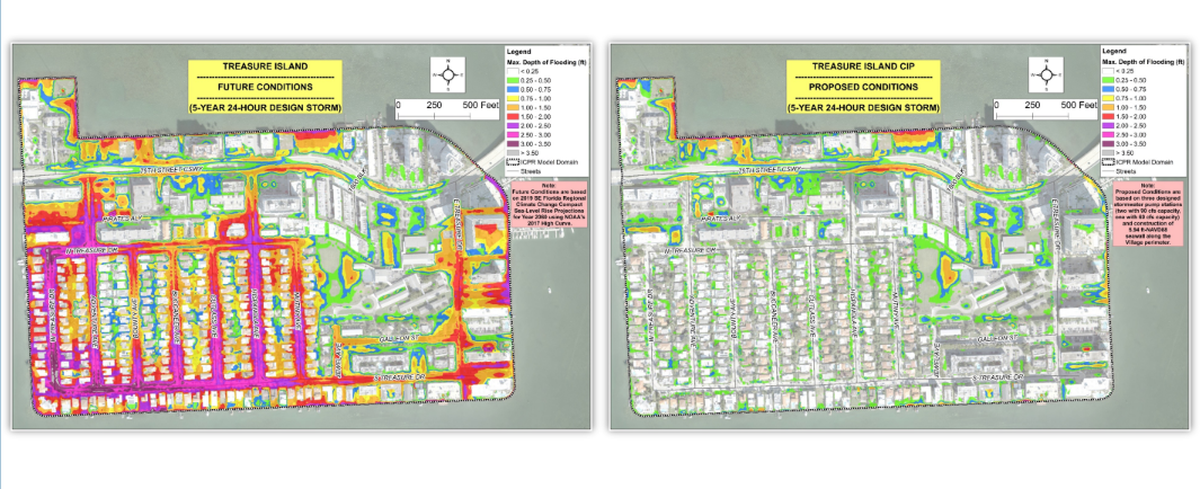
In a city meeting last week focused on solutions for Treasure Island, city-hired engineers painted a picture of the island community in 2060 if nothing is done. In that timeline, a moderate summer rainstorm would leave nearly three feet of water on some streets.
“We won’t be here by then,” one resident in the audience mumbled.
“My kids will,” another shot back.
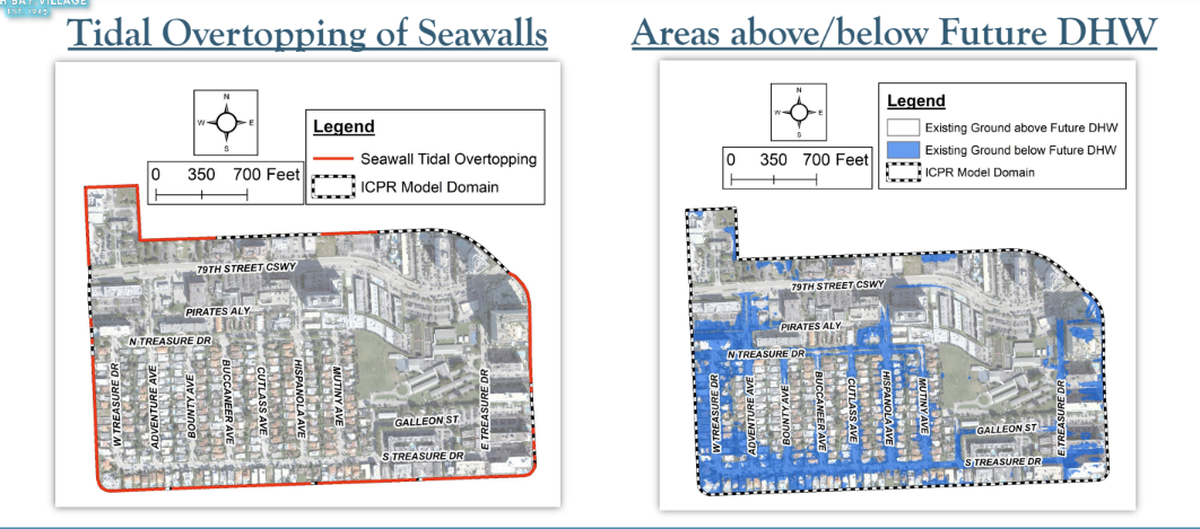
A map of their island showed most of it a deep blue, signifying spots where sea level rise will push up groundwater levels to the surface. That means even on a sunny day, some yards would look more like pools during high tide.
“This is pretty scary stuff,” said Alex Vazquez, head of BCC Engineering, which designed the city’s stormwater master plan. “If there’s nothing done, there’s going to be pretty significant flooding pretty regularly.”
The presentation laid out four options to solve the problem of flooded streets. Well, really three options, because one was keeping the roads the same height they are now, and none of the two dozen residents in attendance seemed to be a fan of doing nothing.
The first was to pour three inches of “black base,” a strong substance that better resists the degrading powers of saltwater, on top of the road. The second option called for six inches of black base. Those run an estimated $4 million and $8 million respectively.
The third option, which city officials called “the optimal solution,” and some residents called “the Cadillac,” calls for raising roads two feet and installing storm pumps and drains to collect all the runoff water. The roadwork would run $7.5 million. Three stormwater pumps and drainage pipes on the island would cost another estimated $22 million.
That top-tier option came with a caveat. To ensure that there wasn’t a precipitous drop-off from the newly elevated streets to residents’ driveways, as well as enough room to install all the necessary drains, it would require making every road on Treasure Island one way. And it would take away some parking spots.
But the biggest issue residents had with that plan, besides losing crucial parking, was where the water from the newly raised roads would go.
Miami Beach’s infamous and well-publicized stumbles in its road-raising program were the main topic of conversation for much of the night. Residents worried that their low-lying homes would be flooded by the elevated streets, and shared a social media video from a Palm Island resident showing exactly that. They talked about residents who sued the city over it and the — now fixed — issue with a ground-floor restaurant temporarily getting denied a flood insurance payout after being declared a basement next to the higher roads.
“We do not have to make the same mistakes Miami Beach made. ... We are not going to do that,” Commissioner Streitfeld reassured the crowd. “Everything we’re going to do is geared toward keeping the water off the roads and off your private property.”
She showed residents the draft engineering plans for higher roads, which included drains on either side of the road designed to catch all runoff stormwater and pump it away using the three pump stations that would be installed on the island.
Not everyone was convinced. Some pointed to the groundwater flooding maps shown earlier. What happens when the ground is wet all the time? Can the pumps and road drains help with that?
City officials and engineers eyed each other, each waiting for the other to say the unpopular but necessary answer: No.
“If you are living in an original home that is slab on grade, you are going to need to take steps to protect your property,” Streitfeld eventually said. “Like elevation.”
As sea levels rise, experts and planners agree that one of the best ways to adapt is to elevate everything, including homes and buildings. But it’s an expensive proposition, and the last time a city official openly told residents that they would likely have to tear down their homes and rebuild higher as sea levels rose, it led to a revolt against the city’s road-raising plans.
To pay for work on all three islands — Treasure, Harbor and North Bay — village officials proposed taking out a $60 million bond, withdrawn in four $15 million increments. Residents would have to vote to approve the measure, potentially in this fall’s election.
Robert McKnight, a self-described house flipper who recently lived on Treasure Island and is running for a commission seat, said he’s worried that residents can’t afford the Cadillac plan.
“I would like to see a manageable plan, not $60 million,” he said. “That’s the largest tax increase in the history of the village.”
The village estimated that over the 30 years of the bond, a homeowner with a $250,000 property would pay an additional $140 to $740 a year in property taxes, with that rate rising as the city uses more of the bond money over the years.
The commission will vote on which of the four plans to explore on July 19.
This story was originally published July 13, 2022 at 7:13 AM.