This Everglades project would help stop algae blooms. DeSantis wants Biden to fund it faster.
The Biden administration just set aside a record-breaking $1.1 billion to help revive the Everglades. Florida Gov. Ron DeSantis wants a lot more — $725 million more, to be exact, for a project he calls “the crown jewel” of Everglades restoration.
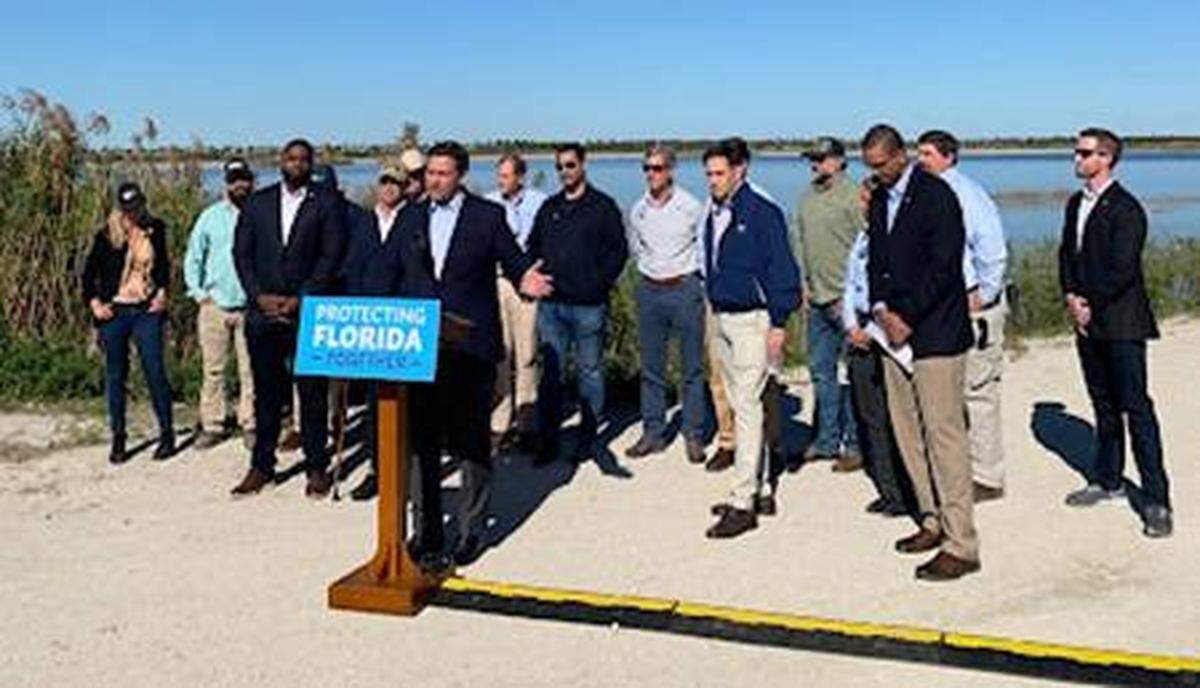
In a Monday press conference, the Republican governor — a frequent and vocal critic of the president — said the White House had failed to include the additional funding in his upcoming presidential budget for the Everglades Agricultural Area Reservoir.
“We are disappointed. It was a big missed opportunity for the federal government to have put not even one dime toward the EAA reservoir,” DeSantis said. “This is not just a project for people in central and south Florida, this is a project for all of America. It’s so significant.”
The reservoir is considered one of the most vital projects in Everglades restoration because it would decrease the amount of polluted Lake Okeechobee water — fowled with fertilizers from farms, wastewater from leaky septic tanks and runoff from urban stormwater — that gets flushed to the east and west, causing destructive algal blooms.
The $2 billion project would also offer a way to cleanse that water before it gets released to the rest of the Everglades.
“Now’s the time to do it. We want it done, but we want it done in a manageable time and not have it drag on forever,” said DeSantis, who’s called funding for the reservoir his “number one priority.” The Governor has made it a day one issue to address the federal releases of polluted water that led to blue-green algae blooms and red tide on both coasts in largely Republican communities.
In response to DeSantis’ press conference, South Florida Democratic Reps, Lois Frankel and Debbie Wasserman Schultz released statements criticizing their Republican colleagues as “hypocritical” for complaining about not getting a specific project funded in a year Everglades restoration got more funding than ever before.
“Restoring the Everglades is a deeply complex, comprehensive plan, and each project we’re able to complete is a monumental win for the millions of Floridians, and hundreds of endangered plants and animal species that rely on this ecosystem. It’s beyond hypocritical for the Republican Members who voted against this bill to turn around and complain about this historic investment. Their lack of graciousness is an embarrassment to our state,” said Rep. Frankel.
Eric Eikenberg, CEO of the Everglades Foundation, said the reservoir is the most important project in the entire Comprehensive Everglades Restoration Plan.
“No project will play a bigger role in reducing algae-causing discharges from Lake Okeechobee, with the added benefit of massive carbon sequestration to help mitigate the impacts of climate change,” he said in a statement.
When the EAA reservoir wasn’t included in the list of recently funded projects, South Florida Republican U.S. Rep. Brian Mast, and Sen. Marco Rubio accused the Biden administration of depriving funding to the project due to politics.
“I think it’s why it wasn’t funded, because they realized it was a funding priority for leaders in Florida,” Rubio said.
Mast said Monday that congressional leaders were aware that the reservoir was considered the keystone project for restoration.
“This was addressed at every step, every level along the way. It wasn’t new to them,” he said.
Neither politician voted for the infrastructure bill that funded the $1.1 billion, which fell short of the $1.5 billion the entire bipartisan Florida delegation requested from the Corps.
The reservoir has also been delayed and scaled down over the years, and faces multiple lawsuits from the powerful sugar industry, which some environmentalists think will delay the project.
Jim Yocum, a spokesperson for the Jacksonville district of the Corps, told the Miami Herald the total cost to build the reservoir — $2 billion — was more than the $1.9 billion budget the Corps got from the infrastructure bill.
“The Infrastructure Investment and Jobs Act was intended to fully fund projects, while the EAA Reservoir was planned and is being constructed in increments,” he said in a statement.
President Biden proposed $350 million for Everglades restoration in his 2022 budget, which has yet to be approved by Congress. DeSantis said he wants to see the $725 million of funding in the President’s upcoming 2023 budget request.
The concept of a reservoir in the Everglades Agricultural Area was a part of the original federal plan to restore the Everglades in 2000, but work didn’t start in earnest until recently.
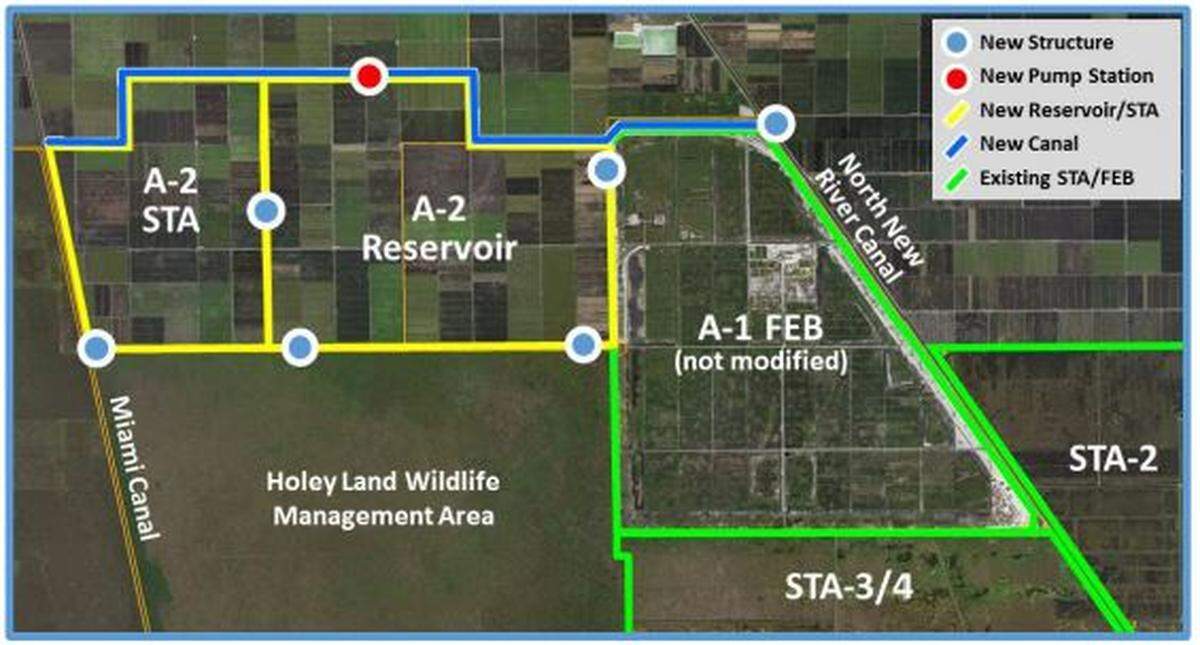
In 2020, the South Florida Water Management District began construction of its part of the project — a 6,500-acre wetland designed to clean stormwater from Lake Okeechobee to standards appropriate for releasing to the rest of the Everglades. It’s expected to be completed in 2023.
But the centerpiece of the project — a 10,500-acre reservoir ringed with 37-foot walls — is still in the planning stage.
The U.S. Army Corps of Engineers, which is responsible for building the massive reservoir, finalized its first contract for $80 million for building canals and roads nearby the reservoir in September. It has yet to break ground on building the actual reservoir, which could take 8 to 9 years to build, according to SFWMD Executive Director Drew Bartlett.
Yocum, a spokesperson for the Jacksonville district of the Corps, said construction for the foundation of the embankment will begin this year.