Threat from below: Sea rise is pushing up groundwater — and flood risks for South Florida
You don’t have to dig deep to hit water in South Florida. In some places in Miami-Dade, a mere foot or two is all that stands between the dry ground and the water running through the porous rock below.
As global warming swells sea levels, groundwater rises too. But unlike the climate change-driven threats from tides, rain and storm surge, groundwater has been an often ignored and little understood enemy.
That’s quickly changing. Scientists say there is now enough data to show that rising groundwater levels will add to flood risks for South Florida — particularly in low-lying areas or coastal areas that already see repeated problems during heavy rains, like Little River and North Miami.
And new studies, like one charting sharp increases in sea rise at the site of Champlain Towers South, point to potential concerns beyond flooding. The Florida International University analysis found the number of times per year sea level rose higher than the underground garage floor of the doomed Surfside condo has nearly tripled over the last 30 years.
This emerging research raises questions about the impact of rising seas and groundwater on coastal construction, especially for aging high-rises whose stability depends on ramming giant cylinders of concrete and steel hundreds of feet below the surface.
For now, there are no clear answers but Randall Parkinson, the FIU professor behind the Champlain Towers study, said he believes South Florida has been ignoring a problem right below its feet.
“The lack of anecdotal information isn’t because there’s no evidence, it’s because no one has been looking for this,” Parkinson said. “I suspect the more we do that the more we’ll find.”
The Surfside tragedy was a bellwether moment in many ways, elevating climate change concerns and questions with policymakers, the public and researchers.
Although sea level rise has not been identified as a potential factor in the domino effect that led to the shocking collapse of a 12-story condo, basic engineering and science dictate that water (especially saltwater) interacting with the concrete and steel that sustain a building isn’t a good thing.
In the wake of the collapse, a team of researchers, including ones from FIU and the University of Miami, applied for a National Science Foundation grant to study the impacts of rising shallow groundwater on old coastal buildings. There are no researchers, agencies or governments exploring the issue, and if funded, this collaboration would be the first.
Mike Sukop, a hydrogeologist at FIU, is one of the groundwater experts on the research proposal. His previous research in North Miami found that groundwater is rising at nearly the same rate as sea level in low-lying spots in the county — a potential looming threat down the road for many areas of the county.
“It seems really important to me,” he said. “The risks from it seem pretty substantial.”
Groundwater levels are rising
Throughout most of Miami-Dade, there’s an average of five feet between the ground and water underneath during the wettest time of the year — October. But in coastal, riverfront and far western pockets of the county, that number drops to under three feet.
The best way to see how high groundwater levels are is to look at the canals crisscrossing the county. It’s a safe bet to assume the water there is the same height as underground.
“When you look at any canals and they have water, that’s the groundwater table. You know the groundwater is higher than sea level, but not that much higher,” said Parkinson, a research associate professor with FIU’s Institute of Environment. “On rainy days when it ponds inland, it’s ponding above sea level.”
The effect of high groundwater on flooding is obvious just about every rainy season in South Florida. After repeated heavy rains saturate an area, much of what doesn’t run off into drainage canals filters down into the porous lime rock underlying much of South Florida. It recharges the drinking water supply in the shallow Biscayne Aquifer, but every inch of dirt turned soggy by higher groundwater and sea levels leaves less room to absorb torrential summer downpours.
It’s why Miami-Dade and Broward saw tremendous flooding after Tropical Storm Eta in 2020; the ground was already soaked with days of rain and couldn’t hold much more. Rising groundwater can have the same effect.
Current predictions show Miami-Dade could see around two feet of sea level rise by 2060. And research done by FIU scientists in North Miami, one of the areas where groundwater levels are already high, shows that groundwater is rising at the same rate as the sea. The study projects that sections of North Miami could go from experiencing about three months of rain-driven flooding a year now to six months a year by 2060. And that was considered a conservative estimate.
A University of Florida hydrology researcher, Young Gu Her, is working on a long-term project that models how sea rise and climate change are affecting groundwater in South Florida. His early results show a “quite obvious” rise in groundwater levels along the coast, where sea levels have risen about five inches over the last 30 years.
He said that although other factors like development, pumping drinking water and rainfall changes due to climate change may complicate the picture inland, “sea level rise is the most influential factor that may increase groundwater level in South Florida.”
Projecting groundwater levels by 2040 with sea rise
As sea levels rise, studies show groundwater levels in South Florida could rise just as fast. This map shows the projected depth to water in Miami-Dade by 2040, a measure of how far someone would have to dig before they hit groundwater.

In South Florida, which relies on gravity and canals to drain water toward coastal outlets, higher groundwater levels compound flooding problems, said Tara Root, a hydrologist at the U.S. Geological Survey, which monitors groundwater.
“As water levels near the ocean rise, that difference in water level elevation to the coast decreases, which means it’s harder for water to flow off,” she said. “One of the big influences that sea level rise is going to have is that reduction in drainage capacity.”
That’s already happening in places like Little River, where Miami-Dade County has spent tens of thousands of dollars and more than a year analyzing the impact of sea rise on the low-lying, waterfront community.
“It rains and there’s nowhere for the water to go,” said Katie Hagemann, the deputy chief resilience officer for the county. “In a handful of pockets, we are at that point where the groundwater is just so close we have to think of something else to address those flooding challenges. Either raise the homes and then the roads or in some sort of concert there.”
In those pockets, high groundwater doesn’t just mean more flooding. It can also cause septic tanks to back up and spew waste in yards and homes because they have no place to drain.
An unobserved problem
More flooding is almost inevitable with rising groundwater. The effects on the foundations of buildings, both old and new, are less clear.
But groundwater has long been a construction challenge in South Florida — and one reason, along with drainage from storms, that some underground parking garages need periodic pumping.
Late last year, contractors digging the deepest underground garage in Miami hit groundwater. The giant pit set to one day become UNA Residences, a 47-story luxury bayfront condominium, quickly filled to the brim with murky water.
Frantic neighbors pleaded with the city to halt construction until they were positive the condos next door were safe — and the city did. That remarkable response was likely due to the tragedy in Surfside a few months earlier, which prompted massive reinspections of tall, old condominiums across South Florida.
State records show 60% of the 1.5 million condos in Florida are more than 30 years old, and many are clustered along the coast. When they were constructed, builders and planners did not consider that the seas might rise.
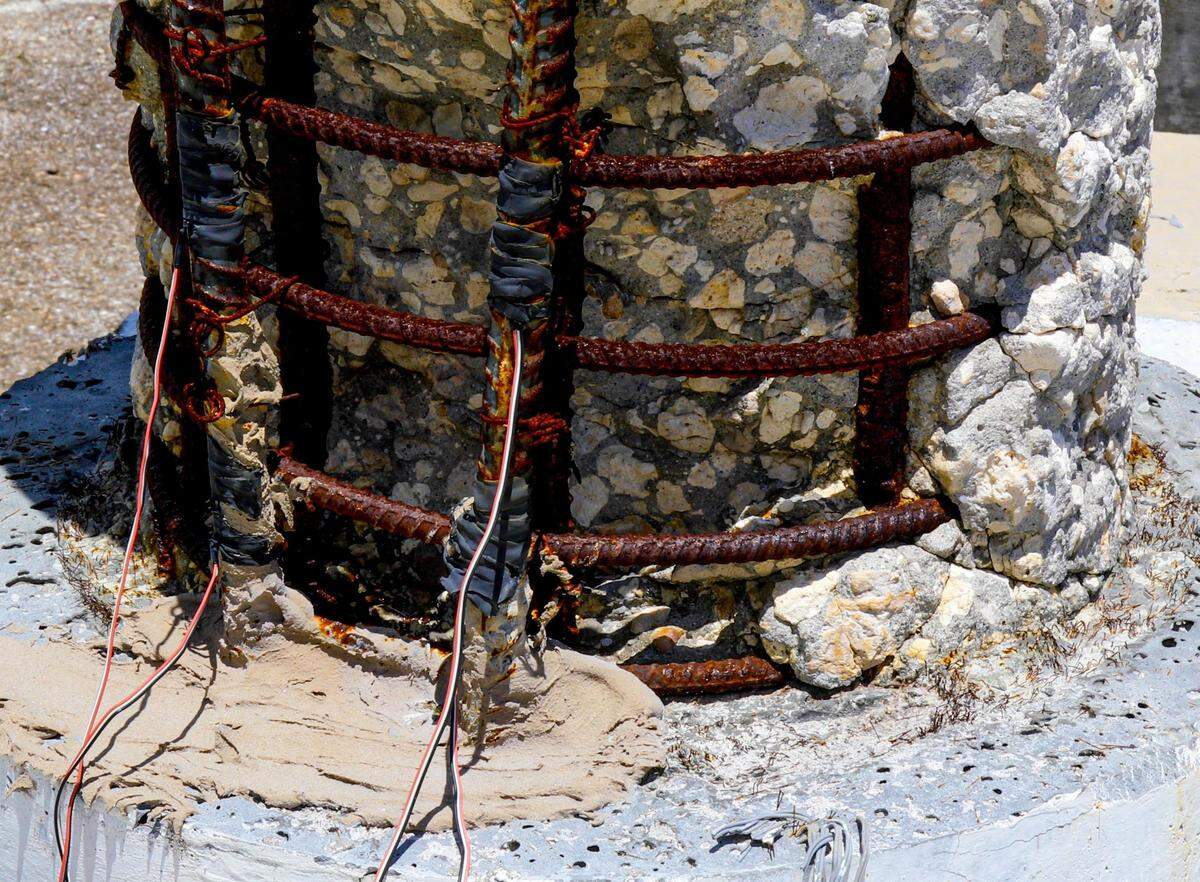
As tides rise, the steel and concrete used in building foundations go from being dry all the time to the occasional soak. Then the occasional flooding gets more common. Water, especially saltwater, eats away at concrete and exposes the steel within to oxygen, a process known as corrosion.
Dawn Lehman, a professor at the University of Washington and a structural engineer hired by the Herald to investigate the Surfside collapse, said over time this could degrade the steel and concrete, but no one knows for sure.
“I don’t think we have enough research on this to be able to definitely say what kind of impact is that having,” she said. “This is a critical, critical problem in coastal regions that we really need to start addressing.”
Lehman, along with FIU’s Sukop, is among the researchers seeking the National Science Foundation grant to study those unknown impacts on coastal buildings.
If Sukop and his FIU team won the grant, they’d use some of it to install more groundwater monitoring wells and tools to measure how salty that groundwater is.
There are nearly 200 wells in Miami-Dade alone, dug by the county, the water management district and the U.S. Geological Survey They’re mostly meant to monitor how clean our drinking water is, so they drill down hundreds of feet.
That’s great for tracking exactly how far the saltwater shoved inland by sea rise has traveled, but it’s not great for measuring the situation with shallow groundwater. Barrier islands, in particular, don’t have many wells. Miami Beach is a rare exception, and those wells were specifically installed to help scientists and the city track the effects of groundwater on its infrastructure.
Possible solutions
In the wake of the Surfside collapse, a slew of official bodies ranging from Miami-Dade County, the Miami-Dade Grand Jury, the Florida Bar, nonprofit homeowners association advocacy groups and professional engineering organizations have all pushed for more inspections of high-rise condominiums.
The state’s engineering associations also recommended that buildings within 3 miles of saltwater be inspected more frequently and that all buildings be tested for issues rather than just visually inspected, as current law requires. Some even suggested that the testing look underground with techniques like ground-penetrating radar.
A change in inspections is likely the first step to seeing new buildings built to better withstand rising groundwater. Once enough inspections identify common problems, then researchers can use that information to suggest solutions. Any change to the building code requires a lot of data, Parkinson said, and that’s lacking in Florida.
“We have excellent sea rise data and we have sketchy groundwater data and nobody is putting those two together,” he said. “A lot of these things are being thought about for the first time.”
The Florida Building Commission, the agency in charge of suggesting changes to the building code that make buildings stronger and safer, most recently examined the impact of groundwater in 2019, when it commissioned a study from FIU on how sea rise might prompt changes to the building code.
The research showed that groundwater levels will likely rise along with sea levels and suggested a slew of changes, including raising all buildings another foot, but the building commission has yet to adopt any of the suggestions. The next year, the building commission decided, moving forward, to only fund research into the impacts of hurricanes.
Parkinson said he worries that even when future inspections identify problems, it will be years before the building community adapts to it, leading to hundreds or thousands of new, unprotected buildings being built in the meantime.
“The rate of change that we’re experiencing these effects is much, much faster than the pace of normal human activity,” he said.
This story was originally published March 6, 2022 at 7:00 AM.