Another study finds climate gentrification in Miami, this time in the rental market
Miami’s booming real estate industry continues to make the metro area one of the least affordable in the county, pushing low-income residents out of formerly affordable neighborhoods.
A handful of recent studies have shown that climate change — or at least the fear of it — is likely playing a role in where developers and home owners choose to buy in Miami-Dade, a theory known as climate gentrification.
But a new paper under review for publication in the journal of Environmental Justice suggests the rental market may be a better (and faster) indicator of the widely suspected but difficult to pin down ripple effect of climate change.
“The bigger problem here is the time scale. The rental market is likely more reactive and possibly faster than home sales,” said lead author Marco Tedesco, a research professor at the Lamont-Doherty Earth Observatory of Columbia University.
Over the last several years, a handful of published papers show evidence that single-family home buyers are indeed choosing higher elevation properties, contributing to the rising rates in what were once affordable areas, and the value of lower elevation properties isn’t rising as fast in comparison. Most of that higher ground is in historically Black and Hispanic neighborhoods, a holdover from racist redlining practices of the 1950s.
Instead of hunting for climate gentrification in property sales, as most other researchers have, this paper looked at evictions and rising rental rates instead. Tedesco said the goal was to develop an early monitoring tool to help advocates and local governments develop policies to protect the communities from the onslaught of developers.
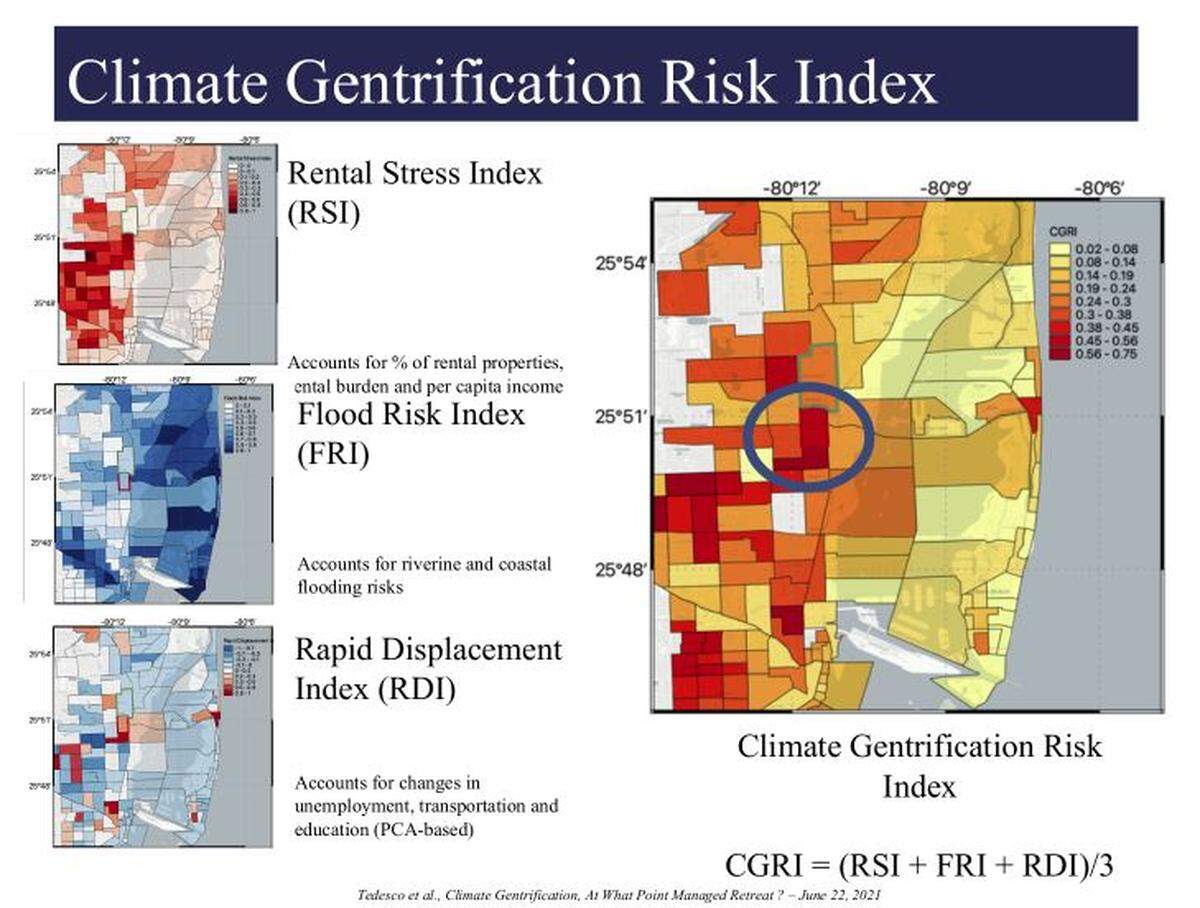
In a presentation Tuesday afternoon at the conference “At What Point Managed Retreat?” Tedesco showed maps identifying parts of Miami most at risk for climate gentrification. Little River was one of the spots on the map marked most at risk.
The city of Miami was the first in the country to study the impacts of climate gentrification and possible solutions, but nearly three years after the commission asked staffers to investigate the phenomena, no proposals have been suggested.
Annie Lord, head of affordable housing advocacy group Homes For All, said the findings weren’t shocking. The spots identified on Tedesco’s map are already neighborhoods at the brink of major gentrification, she said.
“This paper confirms what we know and we can intuit, which is as people accept sea level rise as a fact that is happening, and as people understand where that is going to have an impact first and most then, of course, that’s going to impact the market,” she said. “And of course, as we see places on higher elevation, these correspond to places that represent to investors a potentially undervalued opportunity.”
Other studies have pointed out that Miami-Dade’s affordable housing is some of the most at-risk in the nation to rising seas, an issue the county is trying to address with its Keep Safe Miami program, which shows landlords of multifamily affordable housing buildings the risks they face and where to find money to fix their buildings.
Lord said researchers’ focus on evictions and skyrocketing rents instead of home sales offers a more immediate look at the problems Miami-Dade is facing in these neighborhoods than home sales.
“The selling is the story of the last decade. The homes are all bought out. It’s all LLC owned anyway,” Lord said. The story here is eviction threat, that’s what’s going to displace people now.”
Despite the growing body of research suggesting a connection between gentrification in neighborhoods with less flood risk, it’s hard to link that directly to climate change worries instead of regular gentrification. The areas highlighted in Tedesco’s paper are often adjacent to areas that are already well on their way to gentrification, like Wynwood or the Design District.
And it’s clear the property market is surging right now, leading to record-breaking growth and mass evictions, including some waterfront properties. Recently, an Edgewater building evicted all 200 of its tenants in 60 days to renovate the building.
“We cannot claim that every time we see a red block it’s only because of climate, but differently from more classical gentrification tools, it does account for climate aspects and, in this case, flooding,” Tedeso said.
However, Tedesco said, he worries that if governments wait to find that shred of undeniable proof that the gentrification is only climate-driven before they act, it’ll be too late to save these neighborhoods.
“That’s the same excuse you’ve heard about climate change in the past,” he said.