
County may change key growth rule. Activists worry it will make Everglades development easier
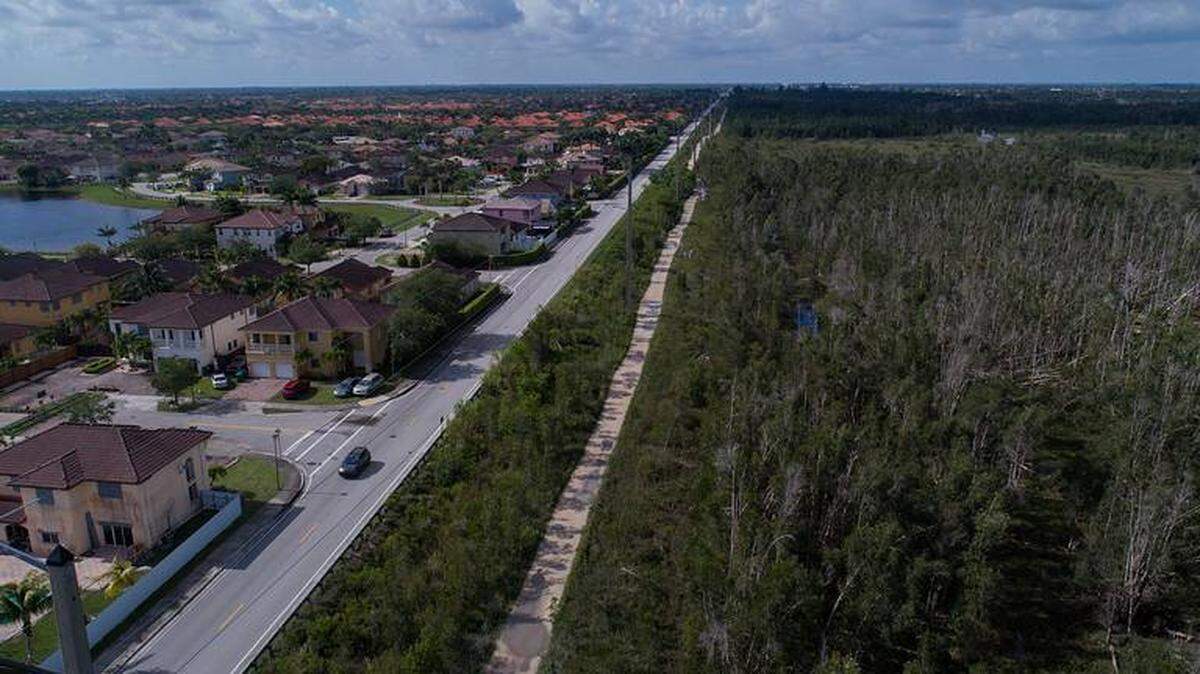
County commissioners on Wednesday will consider a change to growth management rules to allow developers more opportunities to pitch projects beyond the county’s Urban Development Boundary.
Environmentalists fear the proposal, which supporters say is simply designed to cut red tape, will help pave the way for more and faster development bordering the Everglades and other natural areas.
The UDB boundary is an imaginary line that is designed to prevent unchecked urban sprawl and protect farms and wetlands outside the county’s urban core. Currently, developers are strictly limited on when they can apply for adjustments in the UDB — applications can only be made during the month of May in odd years.
Under the proposal, UDB amendments could be made in January, May and October during odd years. However, the proposal also says that developers can apply for so-called “expedited” amendments at any time during odd years, as long as they pay expediting fees at a multiplier of 2.5.
“Expedited amendments may be either small-scale or standard applications,” reads the proposal. It’s not clear what exactly expedited amendments are, or if there are any restrictions to changes to the UDB filed as expedited amendments.
Friends of the Everglades, the Hold the Line Coalition and other environmental groups who advocate for stricter growth management say that the change may weaken protections to Miami-Dade’s farms and environmentally sensitive habitats as the Everglades, as well as the Biscayne aquifer and wetlands that recharge the county’s water supply.
“The UDB is the cornerstone of the county’s land use planning approach that is so necessary to protect its fragile and increasingly scarce farmland, Biscayne Bay and Everglades national parks and ecosystems,” attorney Richard Grosso wrote on behalf of Friends of the Everglades in a letter to Commission Chairman Jose “Pepe” Diaz.
Commissioner Rebeca Sosa, who is sponsoring the proposed ordinance, said the changes are not meant to weaken protections, but to make the process more efficient and transparent.
“We are not changing the UDB and we are not making it easier for builders; we are just allowing for a longer period of time for applications,” Sosa said. “Instead of having everyone apply in the month of May, we are giving them a bit more time, and giving county staff more time to work on those proposals too.”
But Grosso said the two-year application cycle that the county has followed for years has allowed the commission to take a more holistic and systematic approach to making changes to the UDB, rather than having to deal with scattered applications.
Environmentalists and urban planning groups consider the UDB crucial for the preservation of a greenbelt buffer area with farms, open spaces and wetlands that separate the highly developed urban core and Everglades National Park to the west and Biscayne Bay to the east.
The tool, intended to balance development and conservation, is part of Miami-Dade’s Comprehensive Development Master Plan, which contains several areas known as Urban Expansion Areas — land that the county may choose to develop at some point between 2020 and 2030.
The controversial proposal to build a $1 billion highway extension through wetlands in western Miami-Dade, for instance, involved discussions over whether the UDB should be breached. The project known as the Kendall Parkway would extend State Road 836 past the boundary to create a new commuting option to suburban residents. A judge last year rejected the plan, saying environmental impacts outweighed the small improvement in traffic congestion the new road would provide.
Environmentalists defend the deliberate, consistent approach for how and when decisions are made on development projects in those areas. They say that process provides a more complete picture of how that particular application for development fits into the general development plan for the county.
In the past, Friends of the Everglades has advocated lengthening the interval between amendment application cycles to 10 years.
.jpg)