
Evidence of the elusive giant squid and shark encounter? South Florida scientists think so
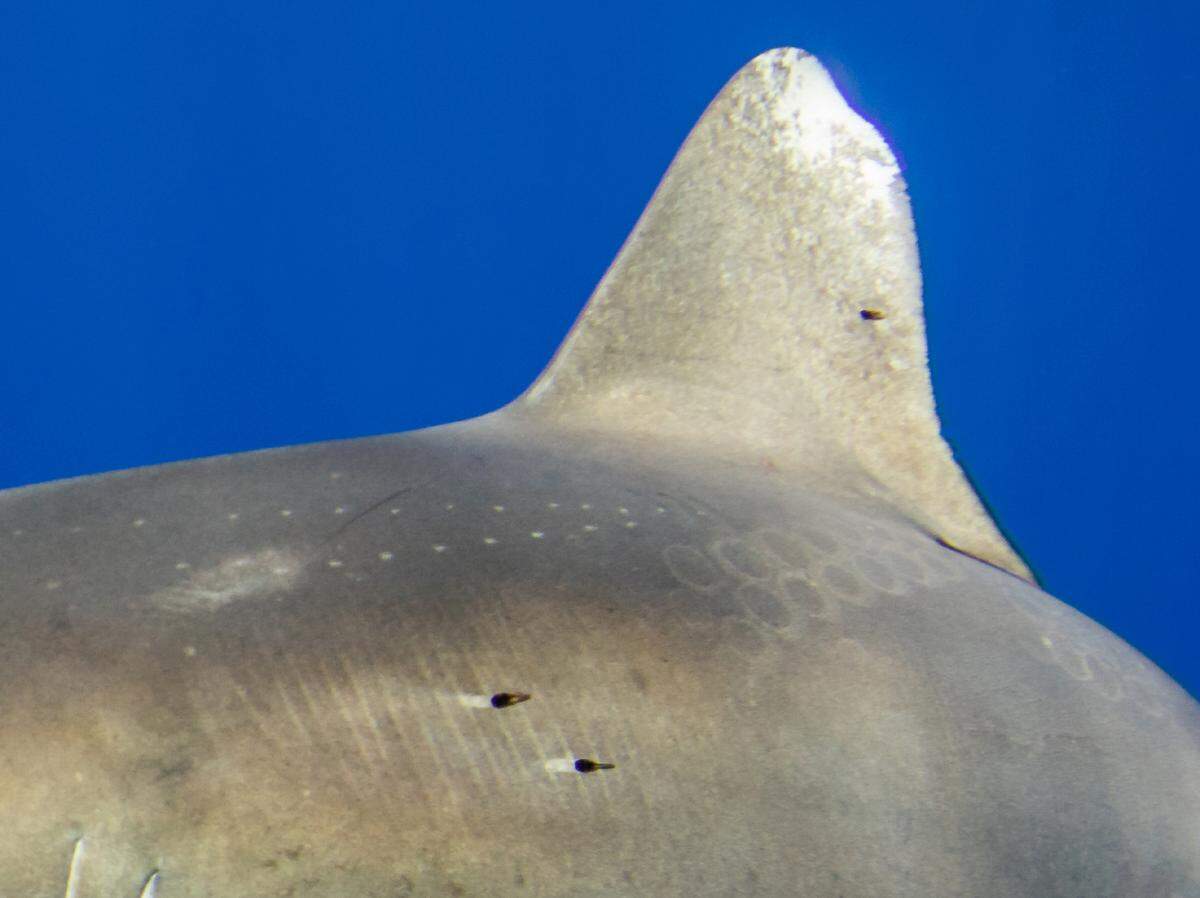
When Florida International University marine biologist Yannis Papastamatiou saw photos of an oceanic whitetip shark with golf ball-sized suction markings along its body, he immediately thought he had potentially come across evidence of a mythical creature. A monster. The ocean’s most mysterious legend.
“I just couldn’t believe it. I thought: ‘Could it be what I’m thinking?’ ” said the assistant professor who specializes in shark behavior.
The unusual track of circles and dots on the shark’s back were likely battle scars from a clash with a giant squid in the depths of the Pacific Ocean, Yannis and FIU colleagues said.
The photos, taken by underwater photographer Deron Verbeck in Hawaii, provide the first visual evidence of a shark encounter with what is possibly an Architeuthis dux, the elusive giant squid that can grow to 40 feet long and has puzzled scientists for centuries.
“We can’t say for sure it was a giant squid, but we know it was something big,” Papastamatiou said.
The shark expert showed the photo to colleague Heather Bracken-Grissom, an assistant professor at FIU’s marine science program who is among a group of scientists that captured the first images of a giant squid in U.S. waters last year.
Bracken-Grissom, Papastamatiou and Demian Chapman, a shark conservation expert and fellow assistant professor at FIU, analyzed the images taking into account the shark’s habits, the particular habitat — an area off the Kona coast of Hawaii — and the species of large squid that live there. They estimated the size of the mantle of the squid’s body, without including its eight arms and two long feeding tentacles, would have to be bigger than one meter, or 3.3 feet, to produce the suction marks seen on the shark. But that’s a conservative estimate, Bracken-Grissom said.
“We believe the three main contenders were the giant squid, or a large glass or flying squid,” she said. The findings were published last week in the Journal of Fish Biology.
Sightings date back centuries
The elusive giant squid is rarely seen, which has created an aura of legend around these cephalopods. They live at depths of more than a thousand feet in complete darkness, in what’s known as the ocean’s midnight zone.
Most of what we know comes from few live sightings or from dead carcasses that float to the surface and are found by fishermen. Body parts and intact specimens are sometimes washed ashore; squids have also been recovered in the bellies of sperm whales, its most common predator and one of the few marine species that can dive as deep. The giant squid’s huge eyes are believed to be among the largest in the animal kingdom, meant to help it spot the outline of a sperm whale approaching in the darkness.
The earliest records of very large squid date back to classical antiquity, as early as the 8th century BC, but there’s no conclusive evidence of sightings. Written records by Portuguese and Basque cod fishermen in the 1500s described giant squid carcasses in the waters of the Labrador Sea, off the coast of Newfoundland. The earliest confirmed specimens are from the 1600s, when dead animals were found in Sweden, Iceland, Ireland and other European countries.
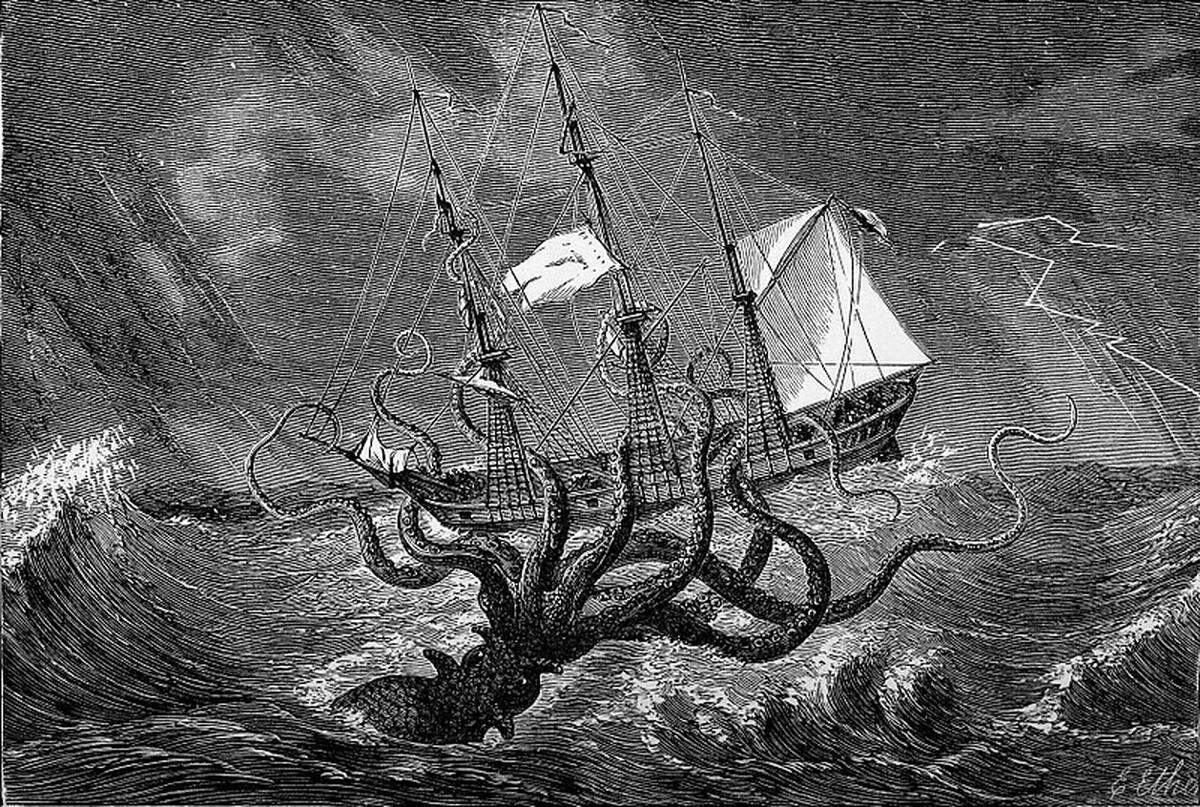
Tales of the giant sea monster and its terrifying tentacles dragging fishermen to their underwater doom have captured people’s imagination for hundreds of years. The legend of the Kraken, a gigantic sea monster in Nordic folklore, spread through Scandinavia and northern Europe starting in the late 1100s and persisted over the following centuries, appearing in early maps of the Northern sea and later in many fictional works such as Herman Melville’s “Moby Dick” and Jules Verne’s “Twenty Thousand Leagues Under the Sea.”
The Kraken was said to attack vessels off the coasts of Norway and Greenland, terrorizing sailors before dragging them down or crushing them with its beak. It would also swim around larger ships, creating powerful whirlpools that would engulf the entire boat.
But those brave enough to risk an encounter with the Kraken were in for a bountiful catch. Legend said that large schools of fish preceded the monster as it swam to the surface, creating a feast for skillful fishermen who were able to get in and out before the monster attacked.
In Japan, where multiple sightings have occurred in recent decades, popular belief associates sightings and beachings of giant deep-sea animals to signs that earthquakes or tsunamis are about to happen. An apparently curious 12-footer swam around a pier near the surface on Christmas Eve in 2015.
It was also off the Japanese coast that a giant squid was first photographed alive in its natural habitat, in September 2004. Another one was captured in a mesmerizing 2012 underwater video by a team led by Japanese zoologist Tsunemi Kubodera.
First time in U.S. waters
It was also off the Japanese coast that a giant squid was first photographed alive in its natural habitat, in September 2004. Another one was captured in a mesmerizing 2012 underwater video by a team led by Japanese zoologist Tsunemi Kubodera.
Another breakthrough happened last year, about 100 miles southwest of New Orleans in the Gulf of Mexico. FIU’s Bracken-Grissom joined a team of scientists on a 17-day research tour called Journey into Midnight, led by Sönke Johnsen from Duke University and supported by the National Oceanic and Atmospheric Administration. Toward the end of the mission, the phantom of the deep appeared, its graceful tentacles dancing around an electronic jellyfish used as bait in front of an underwater camera.
Technology made that sighting possible: A camera system called Medusa, developed by Edith “Edie” Widder, who founded the Fort Pierce-based Ocean Research and Conservation Association, captured the images. She was part of the team that got the first giant squid on camera in 2012 in Japan.
Because very little is known about the giant squid, evidence that they even exist in certain habitats is cause to celebrate, Bracken-Grissom said. And evidence of a potential interaction with a shark was even more exciting, even if the two don’t necessarily share a predator-prey relationship.
Fights between the giant squid and sperm whales have been documented, with evidence marked on the whale’s skin. When fending off predators, giant squids use their suckers and the pointy teeth along their long feeding tentacles.
Until now, nobody had evidence of a tussle between a large squid and a shark. That led to questions not only about the squid, but about the shark’s behavior, Papastamatiou said. Whitetips don’t usually hang out in the midnight zone, though they can dive deep, especially when looking for food like smaller species of squid.
In this case, the FIU scientists believe the squid was slightly larger than the whitetip, which Papastamatiou estimated to be about seven feet.
“The shark was probably going after the squid, and not the other way around; there are no visible injuries on the shark,” he said. Whitetip sharks have also been observed following pods of pilot whales in those waters, possibly eating scraps of food left behind, he added.
“This shows that there is still so much we don’t know about how these large marine animals interact, especially in deep ecosystems,” he said.
This story was originally published June 17, 2020 at 7:00 AM.
.jpg)