
Fort Lauderdale’s foul sewage spills have killed fish. There’s likely more damage
First, dead fish fouled the Tarpon River, alarming residents, boaters and fishermen. The next victims of Fort Lauderdale’s sewage mess may be a little less obvious.
Not far from the beaches of Broward County, coral reefs are also vulnerable to the raw waste that has spilled into the city’s waterways over the last few months. Sewage contains bacteria, viruses and other microorganisms that can set off infections and harm corals already struggling under a long list of stressors, from diseases to climate change.
“Exposure could be a risk because there are pathogens in human waste that are harmful to corals,” said Brian Lapointe, a professor and water quality researcher at Florida Atlantic University’s Harbor Branch. “Sewage is also full of nutrients, which can lead to algal blooms that can also suffocate corals.”
The recent discharges in Fort Lauderdale dumped an extraordinary amount of waste in the water in a short period of time, and the effects on corals could be long-lasting, researchers say.
Fecal bacteria can cause disease in corals, and disrupt the delicate relationship they have with the algae that live inside them; toxins, drugs and even heavy metals present in sewage can lead to bleaching, death, and reproductive problems. And nutrients — a key component of urban waste — feed algae and seaweed, which can block out the light corals need to produce energy through photosynthesis.
Over 211 million gallons of untreated waste have been dumped into Fort Lauderdale waterways and roads after a string of main breaks led to record-breaking spills.
While the latest leak was stopped last week, city managers have warned that things may get worse before they improve, as Fort Lauderdale scrambles to replace its aging infrastructure while the population keeps growing amid a development boom. In December alone, six large-scale sewer pipe breaks resulted in a cumulative 126 million gallons of raw, untreated sewage spilling onto the streets, lawns, and into the city’s waterways, the largest volume for a single month.
While the epicenter of the spills occurred in the Tarpon River and Rio Vista areas, the impact of the discharges spread far into neighboring intracoastal waters and into inlets leading to the Atlantic Ocean. As a result, the city issued several public health advisories, including warnings to avoid coming into contact with standing water near pipe breaks, boil-water notices, a precautionary advisory for recreational water activities and swim advisories at beaches. Florida Department of Health recommended treating all standing water as wastewater due to the health risks the spills unleashed.
Yet, nobody is analyzing the impact on reefs, or doing a wider environmental assessment of the sewage spills.
The city did hire two environmental services companies, E-Sciences and Wood Environmental and Infrastructure Solutions, to assess damage to the Tarpon River and George English Lagoon and to come up with a restoration plan.
Florida’s Department of Environmental Protection said it has been gathering information about the reported incidents to evaluate them from a regulatory perspective and to determine if there were any violations, but environmental impact assessments are up to the city. Last month the DEP slapped a $1.8 million fine on Fort Lauderdale.
Wildlife managers at the Florida Fish and Wildlife Conservation Commission didn’t reply to a request for comment on fish kill or potential reef impacts in the Fort Lauderdale area. Broward’s Environmental Protection office didn’t reply to questions.
But fishermen and water sports lovers can say one thing for sure: Fort Lauderdale’s poop mess is proof that the old belief that dilution is the solution for pollution is a myth.
Jeff Maggio, who built a career catching tarpon and snook in the city’s waters, said he saw large amounts of dead fish in several spots, including areas that were far from discharge sites.
“Pollution and water quality issues are nothing new here, but the magnitude of what we are seeing now is shocking,” he said. Maggio said the city did act quickly to clean up the dead marine life on the surface, but added that it’s hard to know how much pollution stayed on the bottom.
After a discharge of untreated waste, the immediate consequence for the environment is the lack of oxygen dissolved in the water. Bacteria in the waste uses oxygen to decompose organic material in wastewater, leaving the fish without enough to breathe. Solid material in sewage also makes the water murky and leads to suffocation. That’s why Fort Lauderdale placed aerators in the canal system to improve oxygen levels in the water.
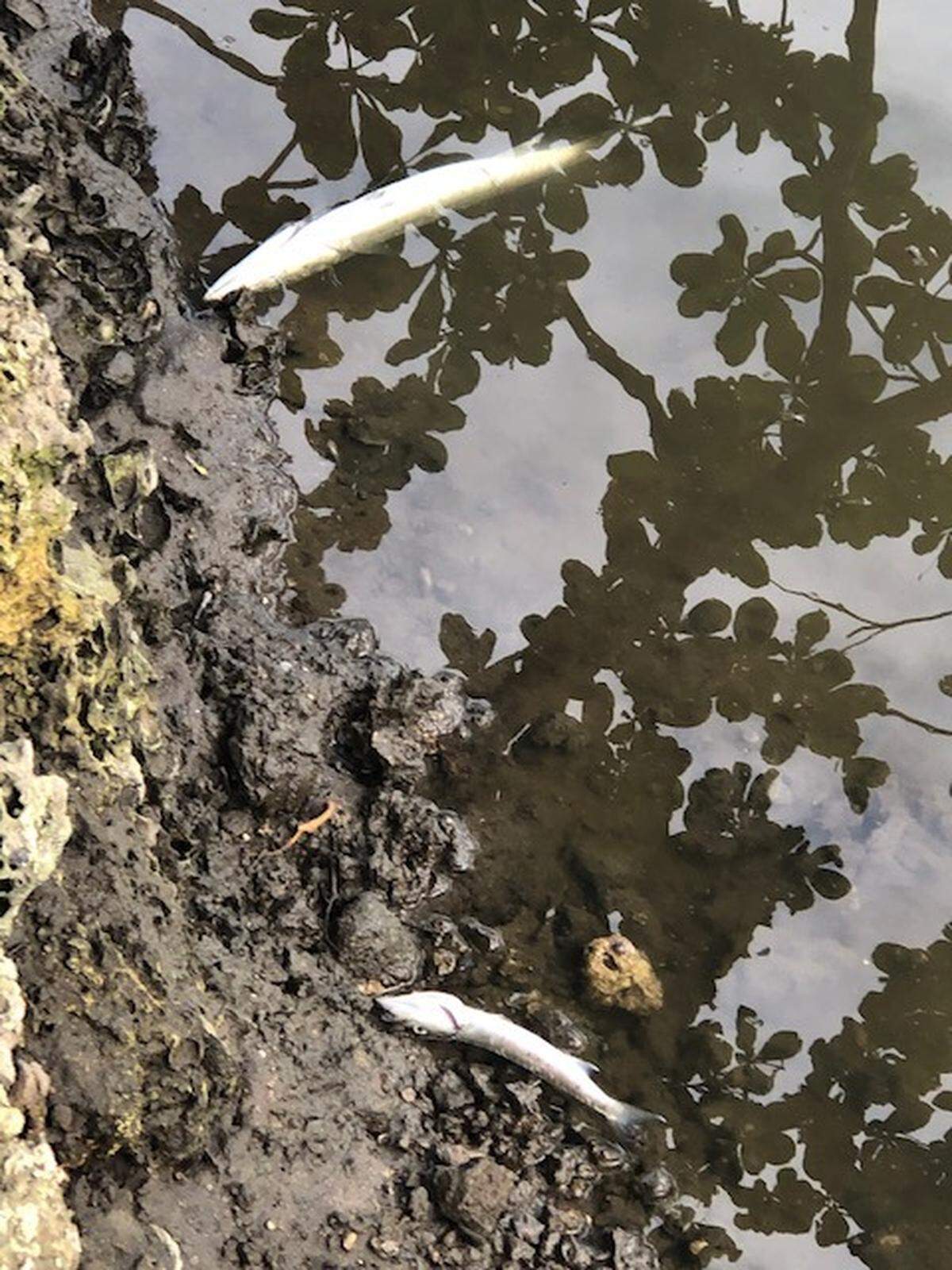
Fort Lauderdale confirmed it removed “marine life affected by the spills along with other floating debris,” but didn’t quantify the amounts, according to city spokesman Chaz Adams.
Maggio also said that residents are concerned about Fort Lauderdale’s testing and monitoring efforts, which appear to focus on areas around the sewer main breaks. One group of paddle boarders decided to take matters into their own hands and started to conduct independent testing on a weekly basis since early January.
“We got involved because we didn’t trust what the city was telling us,” said Timothy Myers, from 954 Paddle Crew, a group of 40 paddlers in Fort Lauderdale. The city is conducting water quality testing at eight sample points in George English Lagoon and in the Middle River, but Myers said his group is testing the water more broadly, and is finding alarming results.
“Polluted water moves around, so the impact of the spills is probably much more widespread than we imagine,” he said.
For Florida’s coral reefs, even a small dose of raw waste could have consequences because their immunity is already weakened.
A fast-spreading infection known as stony coral tissue loss disease has destroyed entire colonies, killing them within weeks of becoming infected. Dredging to deepen Port Miami stirred up mud and sediment, which clouded the water and smothered corals. Increased boat and ship traffic around the Florida Reef Tract has also taken a toll on these marine invertebrates, which are vital to protecting shorelines against storm surge from hurricanes.
Local reefs are also under pressure from increased pollution, development and more frequent bleaching events, which are associated with climate change. Warmer temperatures cause waters full of fertilizer to produce more seaweed and harmful algae blooms.
Even if some healthy specimens are able to withstand the waste deluge coming from Fort Lauderdale, the pollution is likely already affecting the overall resiliency of the colonies, said Christopher Sinigalliano, an environmental microbiologist at NOAA Atlantic Oceanographic & Meteorological Laboratory in Miami.
How they are being affected depends on a series of factors: the particular waste mix, currents and tides, water temperature, dilution, and the health of the colony before it was bathed in poop in a series of almost weekly discharges since December.
“In the long term, very large spills and very frequent spills can affect the health of coral reefs,” Sinigalliano said. “It’s a stress factor, whether it causes a disease or not.”
This story was originally published March 6, 2020 at 6:00 AM.
.jpg)