
Super Bowl-inspired snake hunters capture 80 pythons in Everglades competition
It wasn’t the touchdown that the Everglades needed to win the game against its fiercest enemy, but the 2020 Python Bowl did score some points in raising awareness about Florida’s most destructive invasive species.
Hunters in the special Super Bowl edition of the annual Florida Python Challenge captured 80 exotic snakes during the 10-day competition that attracted more than 750 people from 20 states. By tapping the hype surrounding the country’s biggest sports event, wildlife managers wanted to send a message to the world: pythons are decimating native wildlife in the Everglades and the state is doing everything it can to control them.
“We want everyone to know that the python is a very serious threat to our beautiful Everglades,” said Eric Eikenberg, chief executive officer of the Everglades Foundation.
Burmese pythons, which first appeared in the Everglades in the late 1970s, have no predators and reproduce very successfully, with each female laying up to 100 eggs every year. The Everglades provides an all-you-can-eat buffet for pythons: native populations of marsh rabbits, raccoon, deer and opossum have dwindled significantly as the voracious snakes continue to expand their range in South Florida. Pythons also eat wading bird eggs and even small alligators. Some researchers estimate there are between 100,000 and 300,00 pythons slithering around the marshes and tree islands.
Over the past few years, the Florida Fish and Wildlife Conservation Commission and the South Florida Water Management District have paid hunters to remove the snakes — the bigger the snake, the more money — with bonuses for egg-bearing females. The district last year doubled the number of python removal agents to 50, adding to FWC’s python removal contractors. Another hunting effort, the Python Challenge, used to happen every three years but will now take place annually.
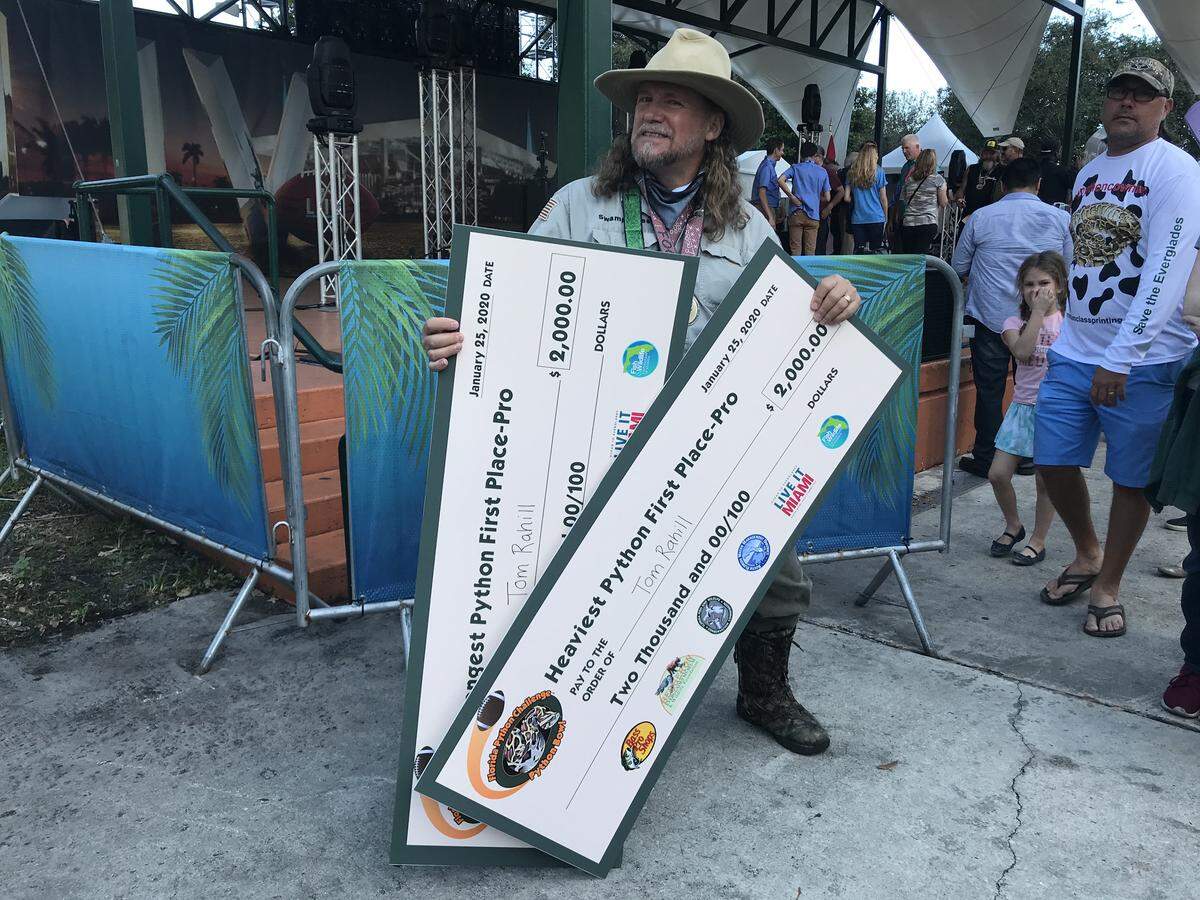
Winners in the 2020 Python Bowl included seasoned snake wranglers like Mike Kimmel, known as the python cowboy, and Tom Rahill, who runs Swamp Apes, an organization that takes war veterans to the Everglades. Kimmel, a professional bounty hunter who in March last year caught the landmark 2000th python for the District, bagged eight pythons during the Super Bowl challenge. He won an all-terrain vehicle as the grand prize. Rahill scored top prizes for the longest (a 12 footer) and the heaviest python caught (62 pounds), winning a total of $4,000.
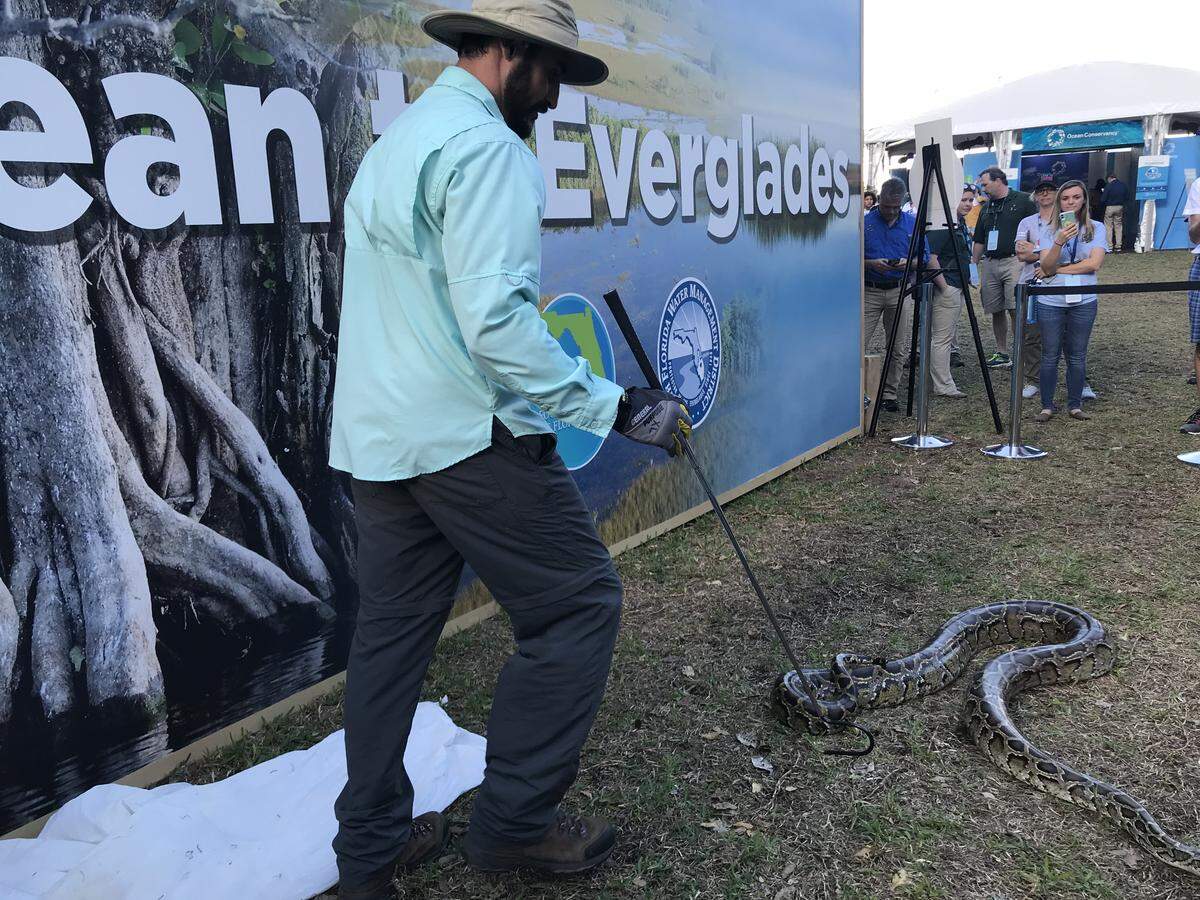
The awards ceremony during the opening of Super Bowl Live, a weeklong fan fest event at Bayfront Park, was followed by a demonstration of a huge female python.
Eric Suarez, a FWC conservation biologist, released the frisky python on a grassy area next to the agency’s booth at the festival’s Environmental Village. The audience of about 100 visitors gasped as the angry snake moved to strike Suarez, who quickly caught it with the help of a snake hook. The python squirmed and wrapped its body tightly around the biologist’s left leg.
But visitors also got a chance to touch a baby python at the FWC’s booth, which also included a tank with lionfish, another invasive species that’s devastating native reef fish populations in South Florida.

Here are the official 2020 Python Bowl results:
Most Pythons
- Pro grand prize winner Mike Kimmel won a TRACKER 570 Off Road ATV for removing eight pythons
- Rookie grand prize winner Kristian Hernandez won a TRACKER 570 Off Road ATV for removing six pythons
- Pro second prize winner Lindsey Floyd won $750 for removing six pythons
- Rookie second prize winner Ethan O’Neil won $750 for removing four pythons
- Active service member or veteran winner Barry Offenburger (U.S. Army) won $1,000 for removing three pythons
Longest Python
- Pro grand prize winner Tom Rahill won $2,000 for a 12-foot, 7.3-inch python
- Rookie grand prize winner Kristian Hernandez won $2,000 for an 11-foot, 6.5-inch python
- Pro second prize winner Amy Siewe won $750 for a 10-foot, 7-inch python
- Rookie second prize winner Dave Mucci won $750 for an 11-foot, .08-inch python
- Active service member or veteran winner Dave Mucci (U.S. Air Force) won $1,000 for an 11-foot, .08-inch python
Heaviest Python
- Pro grand prize winner Tom Rahill won $2,000 for a 62-pound python
- Rookie grand prize winner Dave Mucci won $2,000 for a 49.4-pound python
- Pro second prize winner Dustin Crum won $750 for a 9-pound python
- Rookie second prize winner Kristian Hernandez won $750 for a 1-pound python
- Active service member or veteran winner Dave Mucci (U.S. Air Force) won $1,000 for a 49.4-pound python
Follow Adriana Brasileiro on Twitter @AdriBras
This story was originally published January 26, 2020 at 1:12 PM.
.jpg)