
Artsy Wynwood about to get an innovative jolt. FPL installing a battery the size of a building
What will iPhones and Wynwood soon have in common, other than the famous murals winding up in countless Instagram photos?
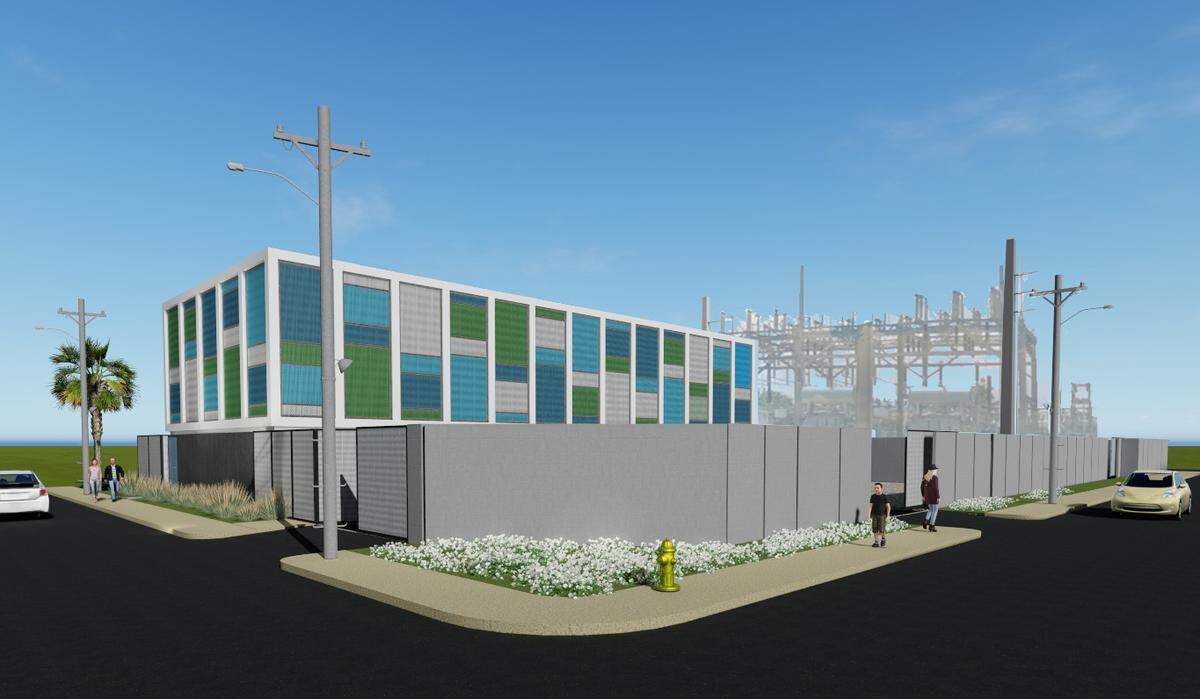
The surprising answer: They both are going to run on batteries. In the case of Miami’s artsy Wynwood area, however, the battery in question is going to be massive — as in entire block massive, as in 33-foot-high building massive, generating juice equivalent to 5 million iPhones and big enough to power 7,000 homes for four hours.
Florida Power & Light is installing the mega-battery as part of a project to explore ways to store electricity — a key to expanding solar power across the state.
“It’s a gigantic battery in an urban setting, enough to power several buildings for hours,” said Matt Valle, FPL’s vice president of development. The battery, located on the corner of Northwest 23rd Street and First Avenue, is scheduled to go online next month, he said.
Because this is Wynwood, labeled one of the country’s coolest hipster neighborhoods by TripAdvisor, the battery building would not be complete without a huge mural on the wall around it. This one will have a Florida panther and other native animals painted in shades of yellow, green and blue, blending in beautifully with all the art around it.
Figuring out ways to store power for later use is crucial for solar projects because solar panels only produce energy when the sun is out, and not at night, when consumers need it the most, or when it’s cloudy.
A battery works by drawing power from the grid and storing it for use when demand for electricity in the area is high. For example, the Wynwood battery could be charged in the middle of the night, after bars and clubs close, and then deliver power back to the grid when it’s needed most, like on a hot summer afternoon when air conditioners are running at full blast.
FPL says the battery will also help restore power faster after outages. Automated switches placed along the grid can isolate an issue, such as a wire downed by a tree during a storm, and direct the battery to provide power for customers who would otherwise be left in the dark for hours.
The Wynwood battery is one of several experiments with power storage that FPL is working on as part of a “30-by-30” plan to install more than 30 million solar panels by 2030, and to expand solar to 20 percent of its grid from just over 3 percent currently.
That’s a lot of panels: if they were laid out end to end, the panels would wrap around the Earth one and a half times. FPL says it’s an ambitious plan that could place Florida among the world’s top producers of solar energy, and finally allow the Sunshine State to live up to its slogan.
Solar power generation has been around for decades. Why did it take so long for this renewable energy source to take off in Florida? Despite Florida’s abundant sunshine, it lags behind states like North Carolina, New Jersey, New York and even Massachusetts in solar power use.
Critics have accused FPL and other Florida power utilities of lobbying to keep heavy regulations in place to discourage competition, and of hindering potential rivals who seek to offer solar systems for residential customers. Florida electric utilities backed a ballot measure in 2016 to impose more fees on solar users and to prevent solar companies other than utilities from operating in the state.

Valle said the criticism was “a tough time” for the company, which at the time of the ballot measure also faced scrutiny over failing cooling canals at its Turkey Point power plant in south Miami-Dade. But he said there were mostly technical reasons why FPL didn’t jump on the solar bandwagon sooner. Solar only became cost-effective for the company in recent years, as FPL had to keep rates low while making considerable investments in solar infrastructure.
And even if Florida is the Sunshine State, it’s still not an ideal location for solar, he said.
“It’s a perfect place from one of the three or four dimensions that matter,” he said. “Florida is not as perfect as Arizona or Nevada or most of California, where there are no clouds in the afternoon.” Humidity is also an issue that detracts from production in Florida because it makes solar equipment less efficient, he added. And then there are the hurricanes, which mean that solar systems must be designed for 130 mile per hour winds.
Plus Florida is growing like crazy.
FPL is using batteries like the Wynwood project to learn how to better power urban areas where development is at full speed and fast population growth poses a challenge for utilities. More than 900 people move to Florida every day, meaning that more than 300,000 new Floridians settle in the state every year. That’s basically adding a new Orlando every single year. Batteries can also help defer the need for new electrical infrastructure to bring more power into the neighborhoods.
FPL says it has already invested millions in what is says will be the world’s largest solar-powered battery, four times bigger than the largest system currently in operation in California.
The future Manatee Energy Storage Center will have 409 megawatts of capacity — the equivalent of approximately 100 million iPhone batteries — when it begins serving customers in late 2021 and will be charged by an existing FPL solar power plant in Manatee County. The battery will have enough power to replace two aging natural gas-fired plants.
Energy from the battery will be deployed when demand is higher, offsetting the need to run other power plants, which will save customers money and reduce emissions of carbon dioxide.
This story was originally published January 15, 2020 at 9:59 AM.
.jpg)