Army Corps may dredge popular Haulover sandbar to revive Bal Harbour’s depleted beach
On any given weekend through Miami’s long summer, a flotilla of pleasure boats can be seen clustered around the broad sandbar near Haulover’s bay side.
Tourists and locals love the sandbar as a destination for partying, but the U.S. Army Corps of Engineers is eyeing the beloved boater spot for a different reason — the naturally occurring sand washed in with every incoming tide.
The Corps is considering dredging the sandbar and dumping the sand on nearby Bal Harbour beach. It’s unclear how much sand they would take from the sandbar itself, but it could be a few feet, said Project Manager Laurel Reichold.
The project would renourish Bal Harbour’s sand-starved beach and help protect the area from storm surge, but engineers don’t know how long it will take the sandbar to recover to its current height. The last time the Corps scraped the Haulover sandbar was in 1998.
“The sandbar is not going to magically disappear if we dredge three feet. It may be deeper but the spot will remain,” she said. “It may not be available for the duration of the project, but it will be there.”
On dry days, the center of the Haulover sandbar occasionally rises out of the ocean, prompting games of beach volleyball.
If this project happens, Reichold said, “that probably won’t exist for awhile.”
At two sparsely attended public meetings at the Northeast Dade Aventura public library on Wednesday, the Corps laid out its choices. It can use sand from the northern end of the sandbar, the southern end, a deposit on the ocean side or from the middle of the state.
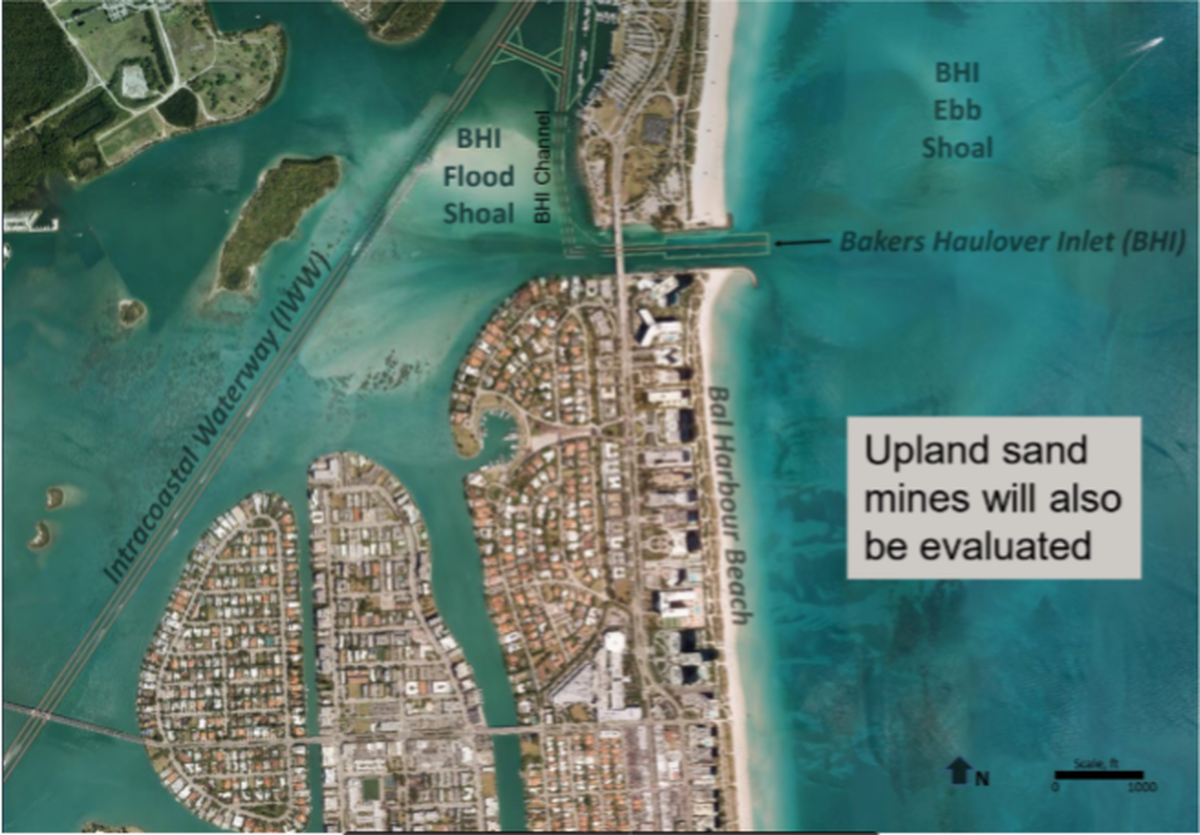
Using this local sand is cheaper than the other option, trucking it in from Central Florida sand mines. Much cheaper.
The Corps estimates it will need 250,000 cubic yards of sand to renourish Bal Harbour’s beach from 96th Street to the Bal Harbour Inlet. Using sand from nearby sources like the sandbar costs about $15 to $20 a cubic yard, Reichold said. Trucking it from the center of the state costs about $55 per cubic yard.
At those prices, using local sand could save the federal government around $9 million
Reichold expects the Corps could get more than half the sand from the Haulover sandbar alone.
Another benefit to dredging the sandbar, she said, is it helps clear out the adjacent Intracoastal Waterway. Dredging that waterway every few years is expensive, and the nearby sandbar tends to bleed into the waterway.
“It saves the federal government and the taxpayers millions of dollars,” Reichold said.
If the Corps did choose local sources, it would likely take several feet of sand. Anything less isn’t economical, she said. It can cost a million dollars just to get a dredge in place.
Bal Harbour Mayor Gabriel Groisman called the local option the best choice from “a practical perspective and an ecological one.”
Diane Schwartz, who’s worked at the marquee food boat on the sandbar, D’s Sandbar Munchies, for 22 years, said she’s not concerned about the dredging affecting her income.
“This time of year people don’t want to get in the water because it’s too cold. And the tourists don’t know how shallow it’s supposed to be,” she said. “We haven’t even had shallow lately because of the king tides.”
The Corps estimates the work will take about four to six months to complete and could get started as early as Summer 2020.
Unlike the controversial Port Miami dredge project by the Army Corps, this project would just be scraping heavy beach sand off the ocean floor, not powdery limestone. Reichold said the sand won’t cause the same kind of issues with cloudiness the limestone did.
The Corps also just completed a survey of the seagrass in the area and would do another one when it finished. If there were less seagrass after the project, Reichold said the Corps would be required to replace it.
This project is a part of a $158 million pot of money Miami-Dade received after Hurricane Irma to replace beach sand. Surfside is already being renourished with sand trucked in from Central Florida, and some “hot spots” in Miami Beach will get their trucked sand soon. After the Bal Harbour project, Sunny Isles is up for fresh sand.
This is happening alongside a bigger Army Corps study to examine creative ways to keep the expensive sand where it belongs, on the beaches. Engineers are considering more artificial reefs, like Miami Beach has, or breakwaters and nearshore berms.
“The current plan of filling in sand when needed — while helpful and we appreciate it and keep asking for it — doesn’t seem sustainable,” Groisman said. “Obviously the most important thing we have to do as a region is protect our beaches. It’s the lifeblood of our cities.”
It’s all meant to keep South Florida safe from stronger storms and sea rise for a little longer. Sand berms provide a buffer between the strong waves and the communities behind them.
“I like to say it’s the first line of defense,” Reichold said.
You can submit comments through December 24 by emailing kristen.L.donofrio@usace.army.mil with the subject line “Bal Harbour Scoping Comments.” More information is available at www.saj.usace.army.mil/BalHarbour.
This story was originally published November 21, 2019 at 4:30 AM.