FPL’s troubled cooling canals are about to get a new permit. Some say that’s a problem.
Nearly 10 years after the last one expired, Florida environmental regulators are poised to issue a new pollution permit for Florida Power & Light’s nuclear plant and its troubled cooling canals tucked between two national parks along the shores of Biscayne Bay.
But rather than ease pollution, a significant rewrite of a permit that had gone virtually unchanged for decades could instead do something else, critics say: Make it worse.
“The draft permit will allow the pollution from the cooling canals to continue unabated,” Marshall Wishnack, chairman of the affluent Ocean Reef Community Association, wrote Department of Environmental Protection officials this month.
Miami-Dade County, which helped launch a $200 million cleanup after confirming canal water had leaked into Biscayne Bay, also worries proposed monitoring may fail to detect pollution if canal water continues to spread.
“The department made it very clear in our comments that such impacts are not acceptable,” said Wilbur Mayorga, chief of the county’s pollution control division. “That’s a simple sentence but it goes to the core of our concern: no impacts on groundwater or surface water is acceptable.”
The draft permit, now open for public comment, comes at a critical time for both the health of Biscayne Bay and nuclear operations in South Florida. FPL has asked nuclear regulators for the second time to extend the operating licenses for its two aging reactors to the early 2050s, even though sea levels are expected to rise more than two feet. Without a valid pollution permit for the canals, which provide water that circulates through condensers to cool the reactors’ cores and back into the canals, nuclear regulators may be reluctant to extend the licenses.
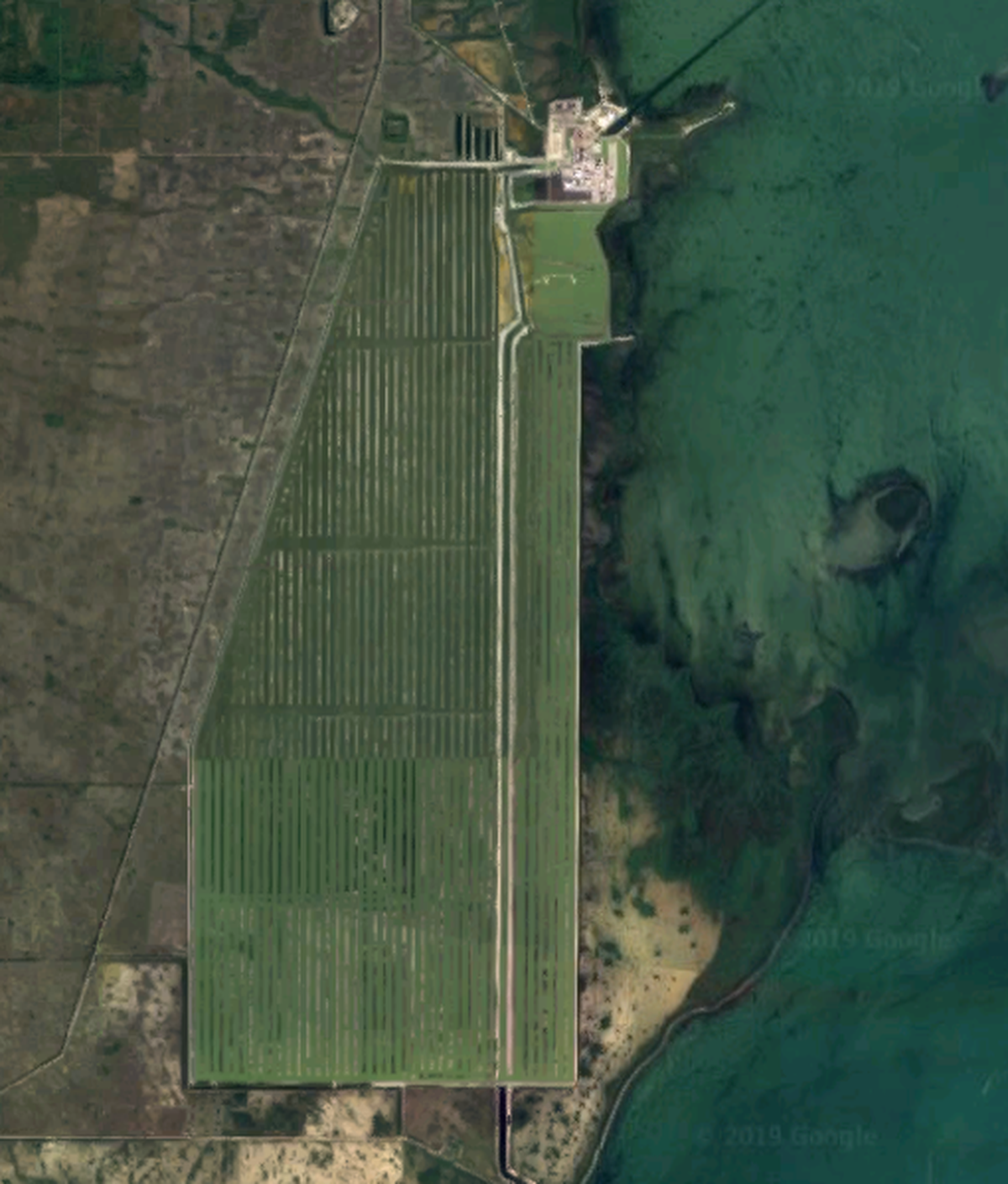
The canals are also being considered as a solution, championed by Mayor Carlos Gimenez, to a tricky pollution problem for Miami-Dade County. The county is under orders to stop piping sewage offshore by 2025. FPL originally planned to use the wastewater in cooling towers for two new reactors. But the utility postponed those reactors after the company that builds them went bankrupt. Gimenez and FPL now want to instead dump the treated sewage in the canals to help cool them, even though county commissioners voted in 2016 to retire them.
This week, the U.S. Supreme Court also agreed to hear arguments on federal water protections. The case will decide whether the Clean Water Act, which now bans dumping pollution directly into bays, lakes, rivers and other protected waters, should also ban pollution spread from groundwater. The revised Turkey Point permit would allow seepage from the canals.
“They’re essentially taking an industrial wastewater facility and saying, ‘Yeah, the entire bay and surrounding wetlands are also industrial wastewater facilities,” said Rachel Silverstein, executive director of Miami Waterkeeper, a nonprofit watchdog for the South Florida watershed.
FPL, however, said the change in language simply clarifies the existing permit and denies, as it long has, that the canals have leaked into the bay.
“Why is FPL being singled out?” said FPL’s senior director, Steve Scroggs. “You know all the points of pollution in the bay and if you can tell me the Turkey Point cooling canals rise to the level of even a bad septic tank in Cutler Bay, I’m telling you that stuff is putting out more problems than anything we’re even contemplating. So why is the focus on us?”
DEP officials also say the proposed permit includes groundwater protections and expands monitoring not included in the previous permit. Altogether, the permit requires nearly 100 monitoring sites.
But critics say the permit contradicts itself, requiring monitoring while also allowing seepage from the canals that fueled a massive saltwater plume and turned up in bay waters in the past. In comments to the state, county officials pointed out that when state officials warned the utility about the pollution two years ago, it specifically cited the “compelling evidence” that polluted canal water was reaching the bay.
“It is 100 percent confusing,” said Caroline McLaughlin, Biscayne program manager for the National Parks Conservation Association. “We don’t have a clear understanding of what the impacts will be and there’s contradictory statements within the permit that are leading to this confusion.”
Normally, obtaining a permit would be a mundane matter for an industrial waste facility. They are supposed to be issued every five years. But the Turkey Point canals are no normal dump site, doing double duty as both a drain for plant wastewater and supply for cooling water. Dredged out of nearly 6,000 acres of wetlands on the 11,000-acre plant property, the canals were constructed in the 1970s after the U.S. Department of Justice sued to keep water out of Biscayne Bay. FPL had wanted to pump and release water directly into the bay.
The original permit allowed for “internal discharge to an onsite closed-loop recirculating cooling canal system,” language that mirrors FPL’s own description of the canals as a self-contained radiator.
“One hundred and sixty eight miles of cooling canals make up a closed loop, re-circulating water system, which works somewhat like the closed cooling system in a car,” the utility said on a company web site.
While the web site makes no mention of surface water, spokesman Peter Robbins said the closed part of the loop only applied to that connection, not groundwater.
“The term ‘closed loop’ has been mischaracterized by many parties, including by the media,” he said. “The original intent was to describe a circulating surface water system, directly influenced by rainfall and evaporation, that has no direct interaction with other surface waters. “
The canals still fit that description, Scroggs said.
But soon after the company launched plans to upgrade the reactors to meet the growing demand for more power in South Florida in 2009, evidence started to mount that they were also seeping at an increasing rate.
While movement in groundwater was anticipated — a deeper canal was dug on the western side of the cooling canals, called an interceptor ditch, to prevent groundwater from moving west — monitoring wells required as part of the upgrade began turning up signs a saltwater plume had dramatically expanded. When the permit expired in 2010, state environmental regulators put off issuing a new permit while it got a handle on the problem, and instead allowed FPL to operate, issuing a operating plan that an administrative judge said was fundamentally flawed.
“The available monitoring data in 2010 raised issues that required further consideration,” state environmental regulators said in response to questions.
In 2014, problems reached a tipping point when the canals overheated, twice forcing FPL to partially power down units as smoldering algae blooms began to spread and caused conditions to worsen. FPL blames the problems on rising salinity between 1999 and 2005 that led to a seagrass die-off in canals, loading them with nutrients that fueled the blooms.
But county environmental regulators, backed by a University of Miami study, pointed toward the expanded power production. By January 2014, with the power turned up, salinity levels more than doubled. By 2016, algae counts were six times higher.
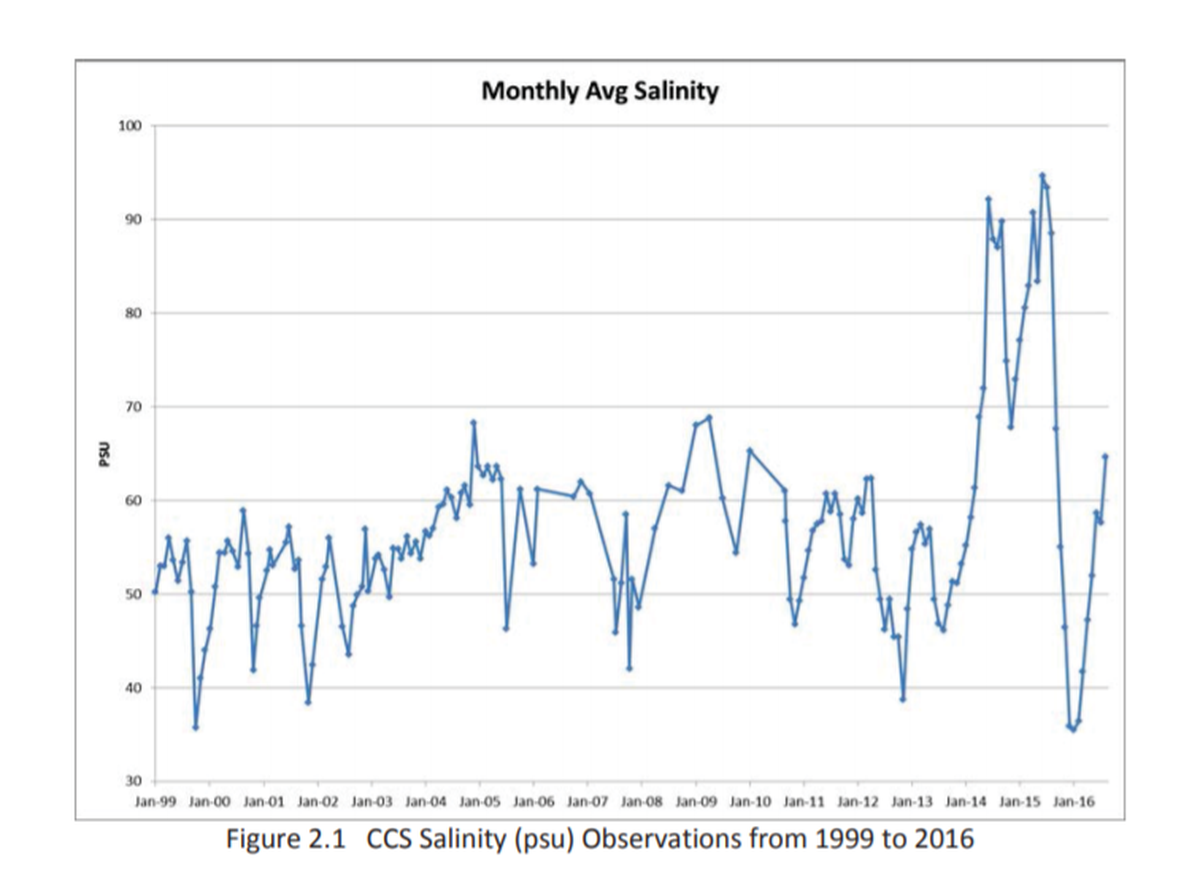
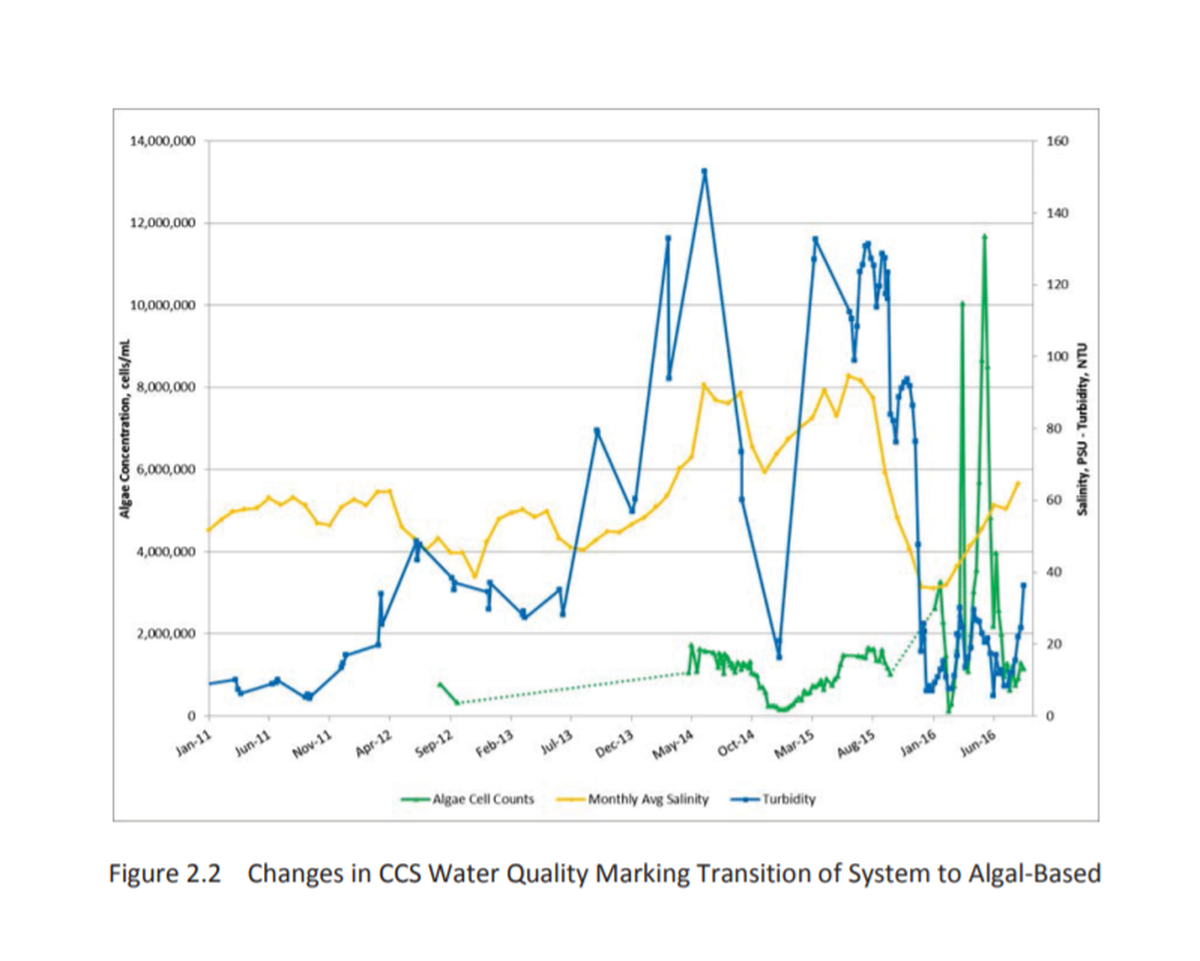
FPL is now in the midst of the massive clean-up effort to pump salty water out of the aquifer and shrink the saltwater plume. Deep channels in the bay where county regulators found ammonia and tritium, a radioactive element used to trace canal water, have been filled, Scroggs said. While the canals remain filled with algae, he said levels of nutrients that can harm the bay are down.
“The level of the nutrients maintaining algae is far below the surface water standards ever detected outside the canal system,” he said.
The clean-up is expected to take 10 years. FPL wants its customers to pick up the $200 million cost. But the state’s Office of Public Counsel, which represents ratepayers, says FPL should pay since it violated the pollution permit.
“So far, FPL has dumped nearly 7 billion pounds of salt into state waters beneath the eastern edge of the historic Everglades,” attorney Charles Rehwinkel told Florida Supreme Court justices earlier this month. “That violated not only FPL’s permit but the applicable rule and statute governing water quality in that area.”
Scientists who spoke on background because they were not authorized to comment said as written, the permit fails to either stop or adequately track pollution. Rather than provide new monitoring wells, it relies on a network installed after the upgrade, which are not located in the right places west of the canals to track groundwater. To the east, there’s no surface monitoring close to shore where pollution would first appear.
The permit also appears to allow canal water into wetlands targeted for Everglades restoration.
“It looks to be a paper tiger or worse,” one scientist said.
The permit also fails to take into account worsening conditions in Biscayne Bay.
“The concern most people have when they consider that is here comes another draft permit from the state that doesn’t recognize” the worsening conditions, another scientist said.
In 2015, the Environmental Protection Agency ordered the state to assign numeric limits for different kinds of pollution to better assess the health of water across the state. Parts of Biscayne Bay have been found impaired for chlorophyll-A, a measure of algae conditions. FPL and state officials say because waters near the canal are not impaired, it should not be a concern. Bay waters near the canal also have a higher level of protection because they are designated an Outstanding Florida Water. But because the designation provides a description, and no numeric limit, enforcing it is harder, scientists say.
“That’s a glaring inconsistency. How do you designate these problems and then you have this major facility that degrades the landscape in Biscayne Bay?” said Stephen Smith, executive director of the Southern Alliance for Clean Energy.
With a new governor, Smith said he hopes the state, which drafted the permit under Sen. Rick Scott’s administration, will reconsider and take a tougher stance. The public comment period has been extended to mid March and DEP has said it will hold a public meeting before issuing a final permit.
“We have a new sheriff in town,” Smith said. “So we’re hoping this will be an opportunity for the DeSantis administration to send a clear signal to DEP that this might have been OK for the Scott administration, but that’s not how we’re looking to do business going forward.”
A previous version of this story misspelled attorney Charles Rehwinkel’s name.
This story was originally published February 23, 2019 at 6:00 AM.