
Architects like Miami’s Rene Gonzalez could help builders cope with global warming
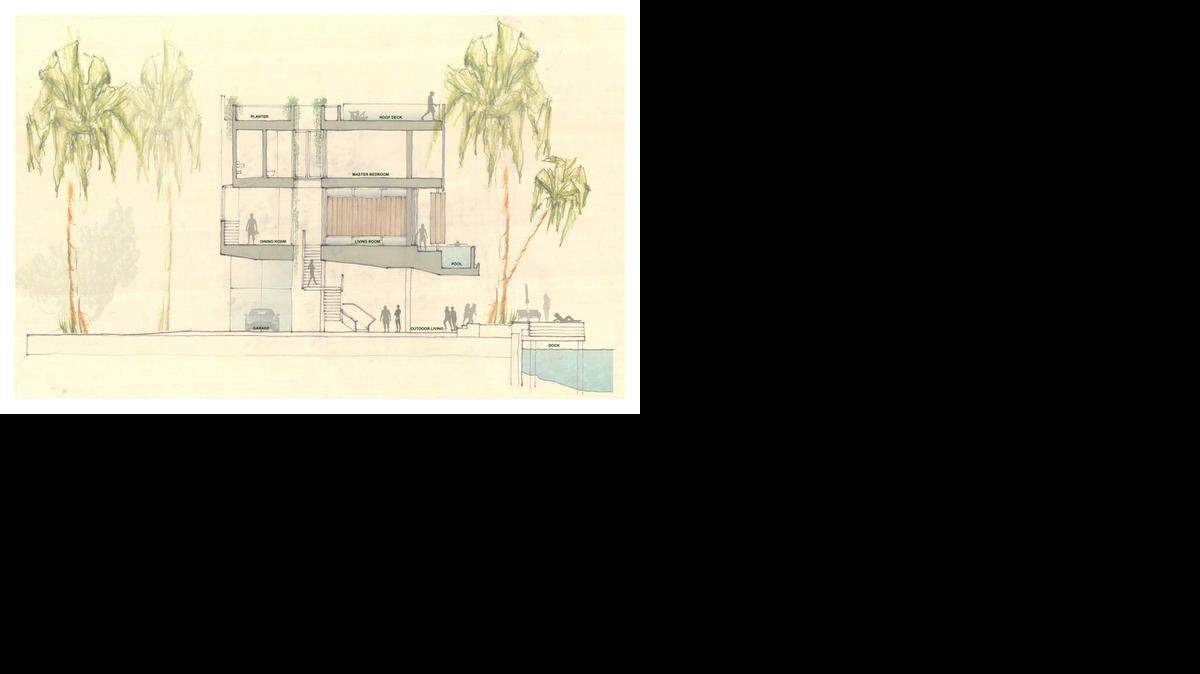
To meet the daunting design challenge posed by rising seas, prominent Miami architect Rene Gonzalez, whose spare, sensuous Modernist houses you wish you could afford, has embraced and refashioned a forgotten tropical approach to architecture: elevating the homes off the ground.
These are not boxy Keys houses perched awkwardly on stilts, as if they’d been hoisted up by a crane, nor McMansions plopped down on a mound. In five sophisticated new designs, including one for himself on one of Miami Beach’s Venetian Islands, Gonzalez is rethinking how dwellings might be reconceived in the face of dire threats from higher storm surges, swelling tides and rising water tables.
The elevated houses that Gonzalez has so far designed bear little resemblance to one another, testimony to the care the architect put into fitting each to its particular site.
But they do have elements in common: The ground levels, meant to allow floodwaters to flow through with minimal damage, are not merely leftover spaces but graceful, carefully thought-out outdoor living rooms, with private living spaces a level above. Gardens may have salt-tolerant native plantings to survive a soaking, with ground contoured to channel floodwater through or allow it to pool and percolate back down through the soil.
Gonzalez makes a virtue of problematic necessities like higher seawalls. In the plans for his own waterfront house on a tiny lot on Belle Isle, for instance, a high seawall becomes, instead of a barrier, the retaining frame for a sandy “beach” that takes visitors over the wall to an elevated dock on the bay. Gonzalez is even levitating the infinity-effect swimming pool: It occupies a second-floor balcony that overlooks the backyard “beach.”
At another elevated house, now under construction in mid-Beach, the main stair connecting house to ground is fully retractable, a security measure for when the owners are away, but also preparation for a day when a storm surge reaches deep into the city, turning the home into an ark.
“By default, I think we need to rethink the way we’re living,” Gonzalez said. “Rather than deny it, we’re working with it in what we think is an exciting way.”
That these are luxury custom homes for an elite clientele is undeniable. But Gonzalez says the templates he’s developing could easily work with moderately priced houses.
In fact, he says, we may have no choice. If sea levels rise by even two to four feet feet by the end of the century, the middle range of increases projected by scientific models, much of Miami-Dade will be inundated permanently or become prone to frequent flooding, Gonzalez noted.
And it’s not just beachfront construction that’s at risk. Low-lying western areas like Sweetwater and Doral, once part of the Everglades, and communities along the Miami River would be just as vulnerable as water rises through the porous limestone below. Aside from the obvious hazards, the cost of flood insurance for homes built at ground level in vulnerable zones could become prohibitive, Gonzalez said.
He has presented his designs to elected officials and a blue-ribbon panel appointed by Miami Beach Mayor Philip Levine to revise building codes and the design of streets and infrastructure to adapt to higher seas. Zoning restrictions on height in most single-family residential areas of the Beach means that houses with two floors of living space could not now be elevated as high up as Gonzalez believes they should be.
While federal requirements already mandate that new homes in shoreline areas be built several feet off the ground, with the precise minimum height depending on location, Gonzalez believes those in Miami-Dade don’t go up far enough to safeguard houses from higher tides and storm surge in the long term. (Houses in the Keys must be built 14 feet up, resulting in the well-known house-on-stilts effect.)
Besides, he notes, the requirements have already led to some unfortunate residential designs obvious to anyone who has lately visited Key Biscayne or some of the streets leading down to the bay in Coconut Grove — big houses built on large mounds, like giant layer cakes, or atop blank concrete platforms barely disguised with landscaping.
Instead, he proposes, houses vulnerable to inundation should be elevated at least 10 feet — enough to make the space below them useful for something more than storage or a crawl space, and giving architects something to elaborate on creatively, rather than hide. There’s another plus, he said: Elevated houses can restore long-lost views of the water to passersby on the street.
On Tuesday, Miami Beach’s design review board gave a unanimous thumbs-up to the plans for Gonzalez’s house. Though one neighbor expressed concern over the impact of the taller structure on the street, other residents welcomed it. Some board members suggested his designs could serve as a prototype for new homes in the city.
Building new homes high up presents issues of compatibility with existing, lower houses in single-family neighborhoods, said City Commissioner Joy Malakoff, who invited Gonzalez to speak to the sea-rise task force. But she said Gonzalez’s house plan proves it can be done sensitively.
And, in time, she believes, Miami Beach will not just inevitably build up, but also face the conundrum of what to do about historic buildings and homes as it goes about raising streets and infrastructure.
“I think over time the city’s homes will be higher. If you do that and you have older homes next door, of one story or two stories, that’s very difficult,” Malakoff said. “What I liked about Rene’s design is that it was so clever and environmentally astute. It doesn’t look like a stilt house. I think we need more architects like Rene.”
Gonzalez says the key is ensuring the houses remain firmly rooted to the ground even as they hover over it, much like the mangrove trees he has been inspired by since his student days.
The architectural devices he uses vary. The first house he designed after he set out to explore elevated dwellings, now nearing completion on Key Biscayne’s ocean side, is the most traditional of the group and is elevated only modestly, with an open entry courtyard leading to the interior. The house rises gradually on a series of platforms that float over a pool.
In a later design, for a large oceanfront home now under construction in Golden Beach, the ground floor is entirely open but sits within the frame of the house and is dedicated to elegant socializing and common spaces through which the ocean can flow. Above it, elevated rooms and private spaces are grouped in pavilions around an open atrium and behind an extensive brise soleil screen that unifies the house, shades the interior and lets natural breezes flow through the entire configuration. (To get the house in under Golden Beach height restrictions, the lot had to be shaved down.)
A house in a grassland preserve on a bay in the Hamptons, now in permitting, is startingly cantilevered over a single stairwell that rises from an elevated deck, recalling the rear annex building in the historic Bacardi complex on Biscayne Boulevard. On the deck, near the foot of the stairwall, several steps lead up, not down, to the edge of a slightly elevated swimming pool.
Two of Gonzalez’s new houses rise on stilts, one of them his own, now under review by the city.
His constricted lot, vacant when he bought it, sits at the end of a lane of charming concrete bungalows tucked behind the Standard Hotel and a condo. Gonzalez, who measured the tides there at different parts of the year, said the lot sits just 11/2 feet above the highest water line.
“My house belongs to Biscayne Bay as much as to the street,” he said. “It’s about reading a place and distilling it.”
Thus the decision to elevate his own 2,500-square-foot house, and design a ground level that would welcome, not fight, the water when it does come, was an easy one. He said his models, as with all his elevated designs, ranges from the simple raised houses of fishermen in the Pacific islands, of Seminoles and Miccosukees in the Everglades, to the houses of Stiltsville and the mid-Century tropical modern Florida home architecture of Paul Rudolph and Alfred Browning Parker.
His preoccupation with the South Florida environment goes back to his master’s thesis at UCLA in 1988, when he designed an elevated Keys vacation home explicitly modeled after the structure of mangrove trees — just as Swiss star architects Herzog & De Meuron would do more than two decades later in their design for the Perez Art Museum Miami.
The Keys project, like PAMM and Gonzalez’s subsequent elevated homes, all avoid the box-on-stilts effect by separating up the mass into pavilions, breaking up exterior walls into different planes and using expansive glazing.
Elevation is not the only way in which Gonzalez has sought to respond to the local environment. Like his mid-century predecessors, Gonzalez has designed his raised houses with open verandas, open patios and rooftop gardens, and equipped them with shady louvers and doors that slide open to encourage residents to turn off the AC.
He doesn’t pretend to be the first, or the only, architect exploring elevated houses. Others are starting to pop up along the Grove shoreline, for instance, and Miami’s Duany Plater-Zyberk designed some on Key Biscayne in the 1980s. Le Corbusier, the famed Swiss-French high priest of 20th Century Modernism, was raising homes and buildings on columns for aesthetic effect long before anyone ever thought of sea-level rise.
“Examples exist throughout the world,” Gonzalez said. “It’s nothing new. It’s just relevant. This is something we moved away from because we think we’re stronger than nature, but we’re not. It’s just become more and more important to me.”
But his growing national stature could entice others to take a second look at the elevated house type. Gonzalez, 51, has gained a reputation among the architectural cognoscenti for rigorous, elegant residential designs, which include an expansive, multi-layered home on Indian Creek island that set a record sale price for Miami, as well as his adaptation of an Overtown warehouse into alluring exhibition space for the Cisneros Fontanals Art Foundation (CIFO).
Gonzalez said he has not found the elevated house concept a hard sell with clients.
“It’s been an easy thing to convince a client because it’s so intuitive.” he said. “I think they love the idea that it’s so tied to place.”
That applied even in one case where the house is not on vulnerable shoreline.
Hany Boutros, a pharmacist, entrepreneur and art collector from suburban Detroit who was looking to build a vacation home in Miami Beach, contacted Gonzalez after attending an exhibition at CIFO, which he said “blew my mind” for the way it made an architectural statement from very little, during Art Basel/Miami Beach week.
He took the architect to a landlocked, narrow lot he had bought on Prairie Avenue just north of Dade Boulevard. The lot is sandwiched between a Mediterranean home and the pool deck of a condo.
Gonzalez and his associates quickly outlined an idea to make the most of the tight site: Elevate the house over a garden and break it up into sections joined by flowing open spaces with a pool at the center. Two pavilions, one a master bedroom for the single Boutros, and another with sleeping lofts for guests, would provide privacy.
“I was in love with the idea the second they presented it. I thought it was absolute genius,” Boutros, 40, said. “Their inspiration was the mangrove tree. It was very poetic and very beautiful. What really sold me on the idea is just the fact that I’m all about the outside space as well. In this house, at any given moment, you don’t know if you’re inside or outside.”
This story was originally published April 10, 2015 at 5:29 PM with the headline "Architects like Miami’s Rene Gonzalez could help builders cope with global warming."