Florida spends $4 million on new ‘ideology-free’ college accreditor
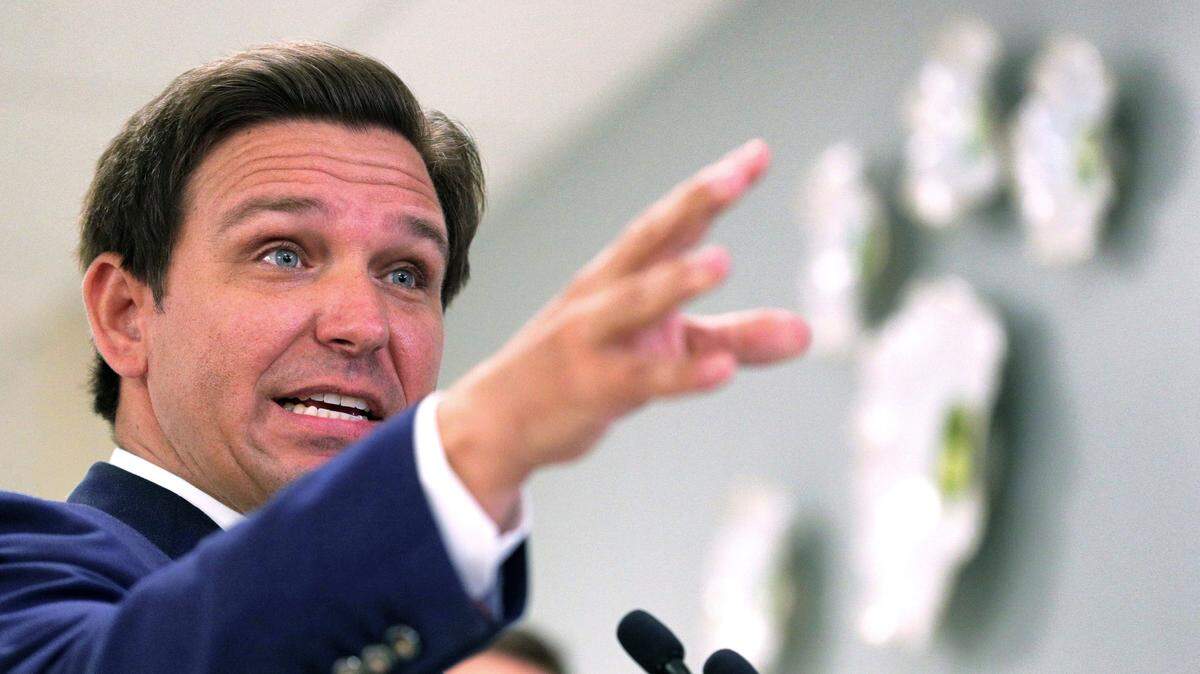
Florida’s higher education leaders are fast-tracking an ambitious, multi-state plan to form a new college accreditor — an effort which Gov. Ron DeSantis is touting as a way to subvert the grip of “woke accreditation cartels” on academia.
The State University System’s Board of Governors on Friday approved a roadmap for establishing the Commission for Public Higher Education, a new accrediting agency backed by university systems from five neighboring red states: North Carolina, Georgia, Tennessee, South Carolina and Texas.
Florida plans on launching a six-month test run of the new accreditation process with six universities this December, according to the agency’s business plan approved unanimously by the Board of Governors in the Friday meeting. The organization aims to secure the U.S. Department of Education’s stamp of approval for the accreditation by June 2028. The agency must have at least two years of experience operating as an accreditor before it can seek recognition from the U.S. Department of Education.
Florida’s GOP-dominated Legislature is backing the venture with a $4 million start-up injection. The agency is anticipating that participating university systems will dedicate similar contributions, per the business plan.
Accreditation, which colleges must obtain in order to receive federal student financial aid funding, is meant to act as a quality-control measure for institutions. But critics of the current system say the process is cumbersome and lacks mechanisms for universities to provide input on evaluation criteria.
Once a niche subject rarely discussed outside of academic policy wonk circles, accreditation is an increasingly hot topic among conservatives. Some Republicans say accreditors stifle innovation and force left-wing ideology upon institutions.
A ‘secret weapon’
Prominent GOP officials seeking to shake up accreditation are deploying wartime rhetoric. President Donald Trump has threatened to wield the accreditation system as a “secret weapon” to force schools to adopt policies favored by conservatives. When DeSantis announced Florida’s new accrediting agency last month, he said the accreditation establishment had colluded to form “juntas.”
For the governor, seizing control of accreditation is one of the final frontiers in his quest to reshape Florida’s higher education landscape, aiming to root out what he sees as rampant left-wing orthodoxy on college campuses. Republican state lawmakers under DeSantis have pushed for laws banning diversity, equity and inclusion spending at state universities and scrubbing “identity politics” from general education courses.
DeSantis’ has said one of his biggest gripes with accreditors is that they threaten to yank accreditation from schools without DEI initiatives. But the Southern Association of Colleges and Schools Commission on Colleges — the longtime accreditor of Florida’s 40 public universities and colleges — is the only one of the seven southern accreditation agencies that do not mandate DEI criteria.
Discussions between Florida and the University of North Carolina system began last year, Florida university system chancellor Ray Rodrigues told the Miami Herald in an interview, because of shared concerns over SACSCOC’s supposed political overreach. In 2023, the accreditor began investigating UNC-Chapel Hill to determine whether it violated accreditation criteria when it established the School of Civic Life and Leadership — an academic unit meant to promote civil discourse — without faculty input.
Florida’s beef with SACSCOC goes back farther. In 2021, the agency raised concerns after the University of Florida initially barred professors from offering expert testimony in a voting rights lawsuit against the state. (The university later reversed course.) That same year, SACSCOC dinged the Board of Governors for considering then-Education Commissioner Richard Corcoran — a sitting board member at the time — for the Florida State University presidency. (Corcoran has served as president of New College of Florida since 2023.)
For administrators, the accreditation process can be cumbersome. It involves hosting campus visits and filling out lengthy spreadsheets. Robert Shireman, a former Obama-era Education Department official, described the process as the higher-ed equivalent of filing taxes.
“If you feel like you’re a good college, it can be annoying,” said Shireman, who currently serves on the National Advisory Committee on Institutional Quality and Integrity, which advises the U.S. Secretary of Education on accreditation.
According to Shireman, accreditation critics across the political spectrum have raised concerns that accrediting agencies are sluggish and lack mechanisms for universities and colleges to have a say in how they are evaluated. SACSCOC, for instance, is overseen by a 77-member board that meets twice a year.
The CPHE’s board is far leaner, initially consisting of six members selected directly by participating university systems, according to the agency’s business plan — a composition that Shireman said may allow the agency to more nimbly make decisions.
Unusual structure
In terms of organizational structure, the agency will operate as a nonprofit with the Florida Board of Governors acting as its sole member. That’s unusual for an accrediting agency, Shireman said. Accreditors typically operate as nonprofits, but are rarely managed by state agencies and act independent of the institutions it holds accountable.
Whether or not the agency could maintain the independence necessary to be seen as legitimate emerged as a key concern during Friday’s board meeting. Kimberly Dunn, the board’s faculty representative, suggested barring the agency from accrediting Florida’s public universities until it had established independence.
Not everybody is on board with the accreditation overhaul. Robin Goodman, an English professor at Florida State University, told state board members on Friday they were pushing for “a solution in search of a problem.”
Florida’s current accreditation setup, Goodman said, was working perfectly fine and was helping universities climb national rankings. She called the DeSantis’ DEI concerns a “non-evidence based claim” and raised concerns about whether the governor would use CPHE as a Trojan Horse for injecting conservative ideas into curricula.
“That just seems like a bad decision and will make our universities not as great as they are now,” Goodman told board members.
Dunn, the faculty representative, said it was important to ensure the agency’s accreditation criteria didn’t impose or restrict certain content in curriculum. Rodrigues, the university system chancellor, responded that Florida can’t establish an accreditor that “removes left wing ideology and replaces it with right wing ideology.”
“The point of this is to have an accreditor that’s not involved in ideology at all,” Rodrigues said. “It’s completely focused on academic excellence [and] quality education.”
This story was originally published July 12, 2025 at 12:00 AM.