New FIU president continues Florida trend of political connections over academic experience
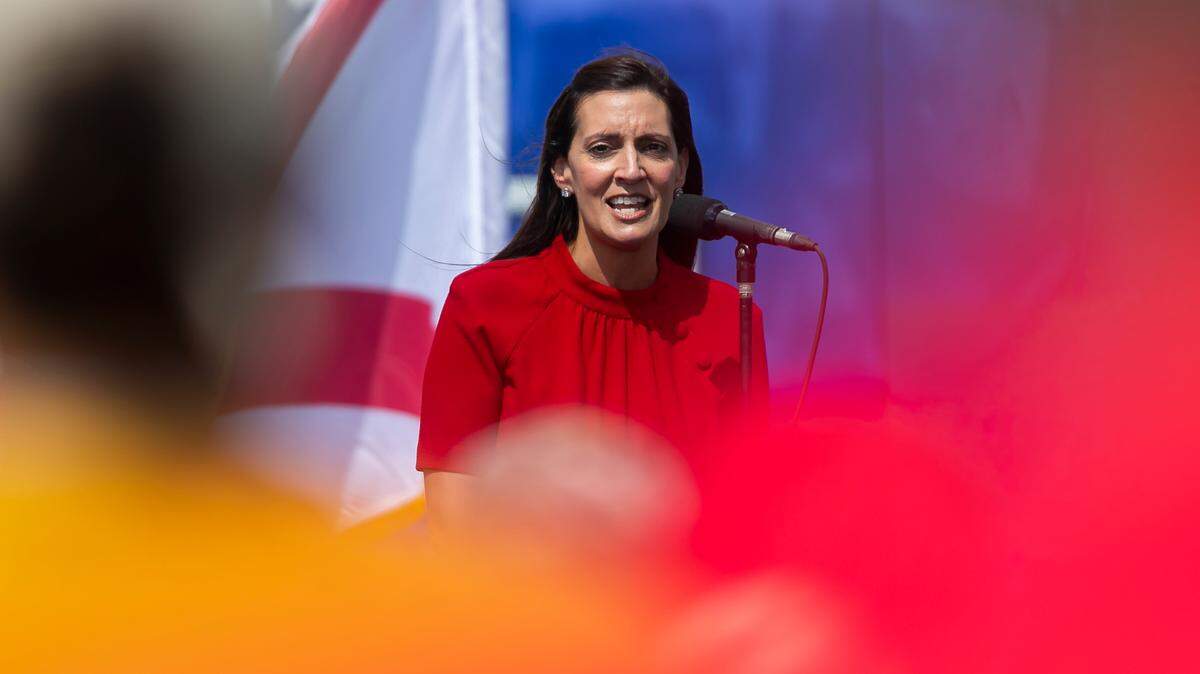
Florida International University naming Lieutenant Governor Jeanette Nuñez as interim president on Friday reflects the evolving criteria for selecting top leaders in Florida’s university system — one that favors political connections as much as academic credentials.
Jeanette Nuñez, who has spent her career in politics, has a resume that marks a departure from previous FIU presidents. Unlike the university’s past two presidents, Nuñez — who was selected without a search — does not have experience in education administration nor extensive experience in academia.
But she shares a lot in common with other presidents tapped to lead Florida universities in recent years. In Florida, the appointed trustees who lead the state’s public universities are increasingly turning to politically connected leaders with little experience in higher education administration to lead their institutions.
At the Friday meeting, FIU Board of Trustees Chairman Rogelio Tovar made it clear that Gov. Ron DeSantis recommended the move, which he and other trustees said would help the up-and-coming university bolster efforts to raise money and squeeze more dollars out of the state Legislature in Tallahassee. Tovar said FIU needs to triple its annual fundraising, increase its endowment and convince the state to increase its “low” per-student funding.
“The next president of FIU will be charged with accelerating our efforts around external funding,” he said.
Nuñez’s rise to the top job at a university doesn’t follow the typical path of a university president. According to a recent survey by the American Council on Education, more than half of university presidents came to that role after working within academia. The data also showed that only 9 percent of presidents came to the job directly from a position outside of higher education, and that about 80 percent of university presidents had a Ph.D.
The first FIU president to have graduated from FIU, Nuñez, 52, has spent her career in politics. She graduated with a bachelor’s degree in international relations and political science, and also has a master’s degree in public administration. She served in the Florida House of Representatives for eight years and worked in external affairs for several hospital systems in South Florida before being sworn in as lieutenant governor in January of 2019.
Nuñez, who currently makes $135,515 in her role as lieutenant governor, stands to get a major pay raise as president. FIU’s outgoing president—who will now become the university’s chief administrative officer—Kenneth Jessell, earned $650,000 plus bonuses which add up to almost $1 million yearly.
Jessell came into the position after serving as the university’s vice president and chief financial officer. Before that, he worked for over 25 years at Florida Atlantic University.
Jessell has a bachelor’s degree in political science from Florida State University, a master’s of business administration, and a doctorate in philosophy in finance from Florida State University.
His predecessor was even more entwined with academia. Mark Rosenberg, who served as the president of FIU for 13 years, was a professor of political science before he became the leader of the university. He holds a Ph.D. from the University of Pittsburgh and also served as a chancellor of the State University System of Florida.
Rosenberg stepped down from the position in 2022 after allegations of sexual misconduct surfaced.
Modesto A. Maidique, who preceded Rosenberg, holds a Ph.D. in electrical engineering from the Massachusetts Institute of Technology.
Politically connected presidents
There is a long history in Florida of universities hiring politicians as presidents. But a number of public universities in Florida have recently turned to politically connected leaders with unconventional resumes.
In 2023, Richard Corcoran, a Republican former Florida House speaker and state education commissioner, was hired to run New College of Florida. Corcoran’s hiring followed DeSantis’ overhaul of the Board of Trustees for the university, once seen as a non-traditional and progressive public liberal arts school.
A week ago, Broward College hired Torey Alston, who was the former chief of staff of the Department of Transportation under DeSantis, as its new president. Alston had previously been appointed to the Broward School Board by DeSantis but lost his seat in the election last summer.
In 2022, the University of Florida Board of Trustees hired Ben Sasse, a U.S. senator from Nebraska, to lead the university. Sasse’s hiring was controversial with students and faculty, though he holds a Ph.D. from Yale and had prior experience in academia, having served as president of Midland University. Sasse resigned in August.
Smaller schools, including South Florida State College, Northwest Florida State College and State College of Florida, Manatee-Sarasota, have all turned to current and former politicians to serve as presidents in the last year and a half.
The trend may continue.
At Florida Atlantic University, the board of trustees is considering one candidate who also has political ties to DeSantis and who critics say lacks academic and educational administrative experience. The candidate, Adam Hasner, is the former Republican Majority Leader of the Florida House of Representatives. Two other candidates are also being considered.
At the special meeting of FIU’s Board of Trustees, support for Nuñez was unanimous with the exception of the faculty representative, Noël C Barengo, who questioned what made the change necessary.
Others pointed out that nontraditional leaders have been finding themselves at the helm of major universities, giving University of Miami as an example. UM named Joe Echevarria as president in October. Echevarria previously was the CEO of the University of Miami, a position created in 2022, which expanded Echevarria’s job as CEO of UHealth, UM’s medical arm, to oversee the university. Echevarria does not hold a doctorate degree. Prior to joining UM, he was CEO of Deloitte
Having a politically connected president could come with certain benefits. Before the meeting, Barengo told the Miami Herald he acknowledged that Nuñez’s political connections could be helpful in fundraising, which would benefit FIU.
This story was originally published February 7, 2025 at 2:20 PM.