Will Miami’s school board maintain a conservative majority? We have to wait till November
Miami-Dade voters will have to wait until the November election to learn whether the school board in Florida’s largest school district will maintain, strengthen, or lose its conservative majority.
In Tuesday’s school board elections, school board member from District 9, Luisa Santos, kept her seat on the board. But Districts 3 and 7 will go to a run-off election. School board elections are non-partisan and winners must get 50 percent plus one vote to win the election outright.
The school board has become increasingly political in the past few years, as conservative policies related to race, gender, and religion have trickled down from the state to local school boards.
The results of the elections in District 3 and 7 will determine whether the board will maintain its conservative majority.
Currently, the board has five members who consistently vote conservatively, four of whom originally were appointed by Governor DeSantis.
In District 3, five candidates were vying to replace Lucia Baez-Geller, who left her seat to run for the House seat in District 27.
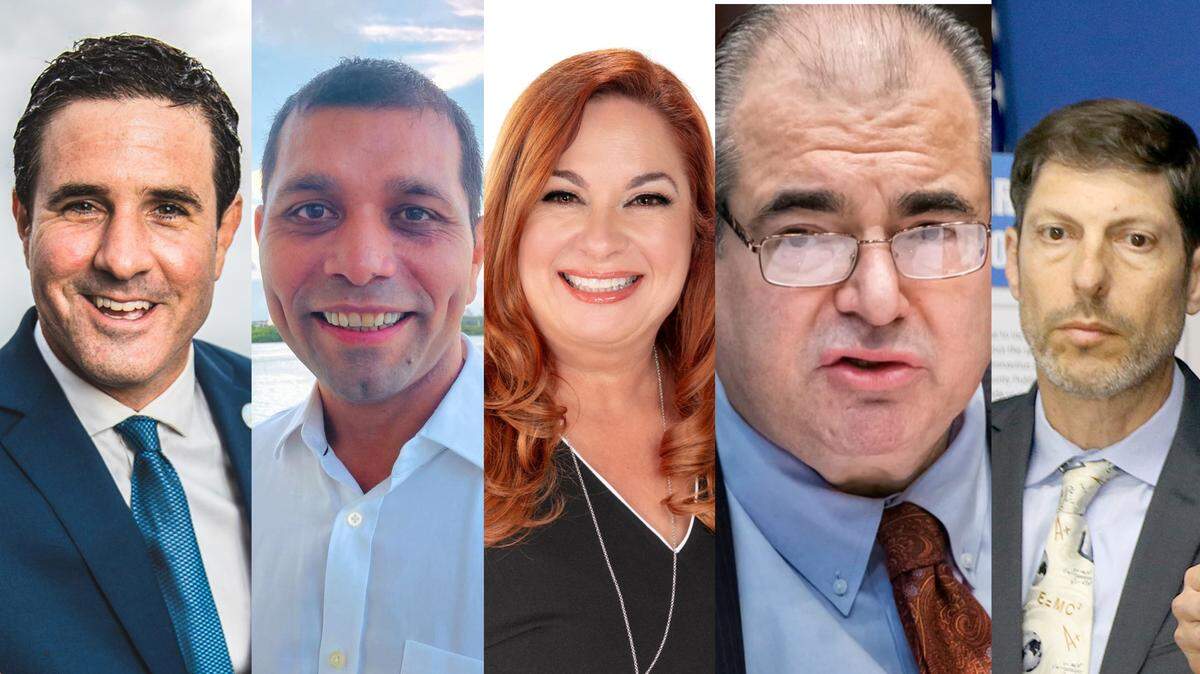
Joseph “Joe” Geller and Martin Karp were neck in neck in the District 3 race, which will send them to the run off in November. Geller ended up ahead, with 32.63 percent of the votes. Karp came in a close second with 31.93 percent. District 3 stretches from Aventura down to parts of Coconut Grove along the beaches and the bay.
Joseph Scott Geller is a lawyer, former state representative and former mayor of North Bay Village who has been endorsed by the teachers union. He is a registered Democrat.
Karp, who works as the dean of a consortium of private Jewish schools, donated $775,000 of his own money to his campaign. He previously served on the school board, during which time he was named in an Office of Inspector General report that alleged that his office was complicit in propping up a Jewish after school program that was operating in a public school facility while not paying rent. Karp was previously registered as a Republican, but changed his registration to no-party-affiliation at the end of May.
“This is such a victory for grassroots campaigning over big money; it shows that if you listen to the parents and to the teachers, then you can win notwithstanding all the money in the world thrown into it,” said Geller, upon learning that he had received more votes than Karp.
In contrast to Karp’s campaign which raised $795,558, Geller only raised $126,100.
On election night, Karp said that it was difficult for him during the lead up to the election because of negative texts and mailers that went out.
But, he said, “I worked very hard and stayed focused on the message about student achievement and education.”
Karp and Geller both agree that politics should be taken out of schools.
“I felt compelled to run for this seat because someone has to stand up to this attempt to inject right-wing politics into our schools,” said Geller.
Also on the ballot were Brent Latham, the current mayor of North Bay Village with a background in nonprofits; Gustavo Ortega, a long-time special education teacher; and Hayley Ross, a teacher.
District 7 is also poised for a run off. DeSantis appointee Mary Blanco wasn’t able to secure 50 percent plus one votes. She received 44.70 percent of the votes. She will face off against Maxeme Tuchman, a teacher and entrepreneur who was endorsed by the teacher’s union. Tuchman recieved 31.28 percent of the votes. Tuchman is a registered Democrat.
Blanco is a guidance counselor at a Catholic school in Miami. This was the first race for Blanco since being appointed by Governor DeSantis in January 2023 after school board member Lubby Navarro stepped down. Navarro was subsequently arrested for misuse of district funds. Blanco is a registered Republican.
“I will clearly contrast my values and vision for our students and school system against the extreme liberal agenda my opponents and her party are trying to impose upon us in school district 7,” said Blanco in a statement after learning that the race will continue to a run-off.
Max Tuchman was proud of the fact that she was able to challenge a candidate endorsed by the Governor.
“The fact that we put up a fight, that the Governor didn’t win this outright with his candidate, I think says a lot,” said Tuchman.
“We need to shift the school board back to non-partisan and take the control away from the Governor.”
Javier Perez, a district employee and former educator who was endorsed by the school police union, was also in the race.
District 7 encompasses Kendall, West Kendall, parts of Pinecrest and parts of Redland and Homestead.
The District 9 race was between the school board’s youngest member, Luisa Santos, and Kimberly Beltran. Santos won handily, securing the majority of votes by early evening. Luisa Santos has focused on trying to bring technological advancements to the school board and district, and was endorsed by the teachers union. Her opponent Beltran ran on a platform of eliminating “wasteful spending” by the school district and was endorsed by Moms for Liberty, the controversial conservative group that has advocated for “parental rights” and has publicly supported laws which limit how race can be taught in higher education institutions.
School board races may become political
Although school board races are still nonpartisan, this November voters can decide if they want candidates to disclose their party affiliations when they vote on Amendment 1 in the general election.
State Rep. Spencer Roach, a Republican from North Fort Myers, sponsored the resolution that pushed the proposed constitutional amendment onto this year’s ballot. He said the proposal aims to provide more information about school board candidates to voters. “It’s not about advancing the prospects of Republicans or Democrats,” said Roach. “If this becomes law, in some red counties it’s going to mean that more Republicans get elected and in some blue counties it’s certainly going to mean more Democrats get elected. My intention in filing the bill was not to put an advantage for one political party over another; rather I would say my motivation is transparency.”
If 60 percent of voters support the ballot question, it would return Florida to an era when school board candidates ran under party labels and would reverse a change that voters made a quarter-century ago that required candidates to run without party labels.
The year ahead for the school board
The District is still celebrating its fifth year with an A rating from the state, which was announced in July.
The top concerns mentioned by many of the candidates for the Miami-Dade school board races were school safety as well as teacher pay. According to the Florida Education Association, Florida ranks 50th in the nation for average teacher pay. Starting salaries for teacher in Miami-Dade is $52,000.
The year may present the district with challenges in terms of funding. As the Miami Herald recently reported, the increase in funds being spent by the state on voucher programs to support students attending private schools is beginning to impact the public school budget. Conversations around parental autonomy in deciding where their children should go to school, as well as the increasing number of students attending charter schools will likely come up in this school years school board meetings.
Over the past two years, the school board has been mired in politics, with concerns about book bans and questions about what kinds of content related to race and gender should be taught in schools. Since Governor DeSantis’ “Stop Woke Act” in 2022, which limited what educators can teach about race, gender, privilege and unconscious bias, schools have been the scene of an ongoing and heated discussions about “indoctrination” versus education. So far, courts have stopped most parts of the law from being implemented.
Many of the candidates in this year’s race noted that they want to focus less on these issues and more on problems facing students inside the classroom.
But controversial topics, such as bringing volunteer religious chaplains onto school campuses, may resurface this year. Miami-Dade is currently weighing the pros and cons of implementing chaplains in schools with a feasibility study.
This story was originally published August 20, 2024 at 8:30 PM.