Florida schools have new rules from lawmakers. What that means for Miami-Dade School Board
Florida lawmakers pushed through and passed a slew of education bills this Legislative Session that wrapped up Friday, underscoring Gov. DeSantis’ and Republican’s efforts to overhaul the state’s education system.
The measures significantly impact K-12 schools and universities and include:
▪ Expanding the controversial Parental Rights in Education law that went into effect this school year — dubbed by critics as “Don’t say gay” — to bar teaching about sexual orientation and gender identity through eighth grade.
▪ Making it possible for every school-aged child in Florida to get a taxpayer-funded education voucher or savings account, which public school advocates say could drain dollars from school districts across the state.
▪ Preventing the state’s 12 colleges and universities from spending money on diversity, equity and inclusion initiatives, making it harder for professors to hold onto tenure and giving university presidents the authority to hire and fire faculty, instead of deans and department chairs.
READ MORE: UM faculty joins FIU in fight against DeSantis-backed bills to overhaul higher ed
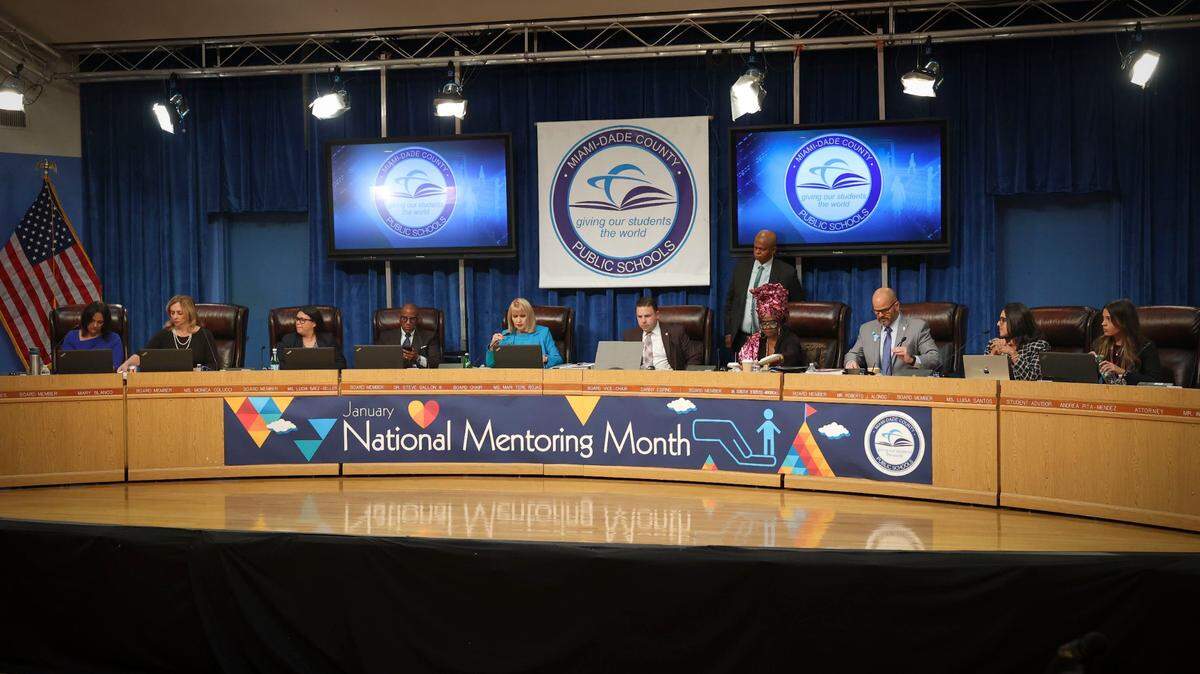
The GOP-led Legislature also passed bills affecting school boards in the state’s 67 districts Here’s how some of those could impact the Miami-Dade School Board, which governs the nation’s third-largest school district.
Term limits on a veteran-heavy school board
Last year, lawmakers passed a law to cap school board members’ terms to 12 years. On Monday, the Florida Senate successfully pushed to further limit terms to just eight years, following a House bill passed in March.
That means while board members would continue to be elected to four-year terms, they won’t be able to run again if they serve eight consecutive years — or resign in a period that would’ve added up to eight years. DeSantis is expected to sign the measure into law.
Five of the nine Miami-Dade County School Board members’ terms are up in 2024 — Mary Blanco, Lucia Baez-Geller, Vice Chair Danny Espino, Steve Gallon III and Lucia Santos — but how the measure impacts each varies.
READ MORE: Florida Legislature goes big for DeSantis — with record spending — and then goes home
For Baez-Geller, Gallon and Santos, for example, if reelected, the term count would begin after the 2024 election because under the bill, a member’s term of office that began before Nov. 8, 2022, won’t be counted toward the eight-year limit. Gallon was first elected in 2016, while Baez-Geller and Santos joined the board in 2020.
Espino and Blanco, both of whom DeSantis appointed and whose terms began after the November 2022 election, would have two years counted toward their eight-year limit under the bill.
Espino, who replaced Christi Fraga after her successful bid for Doral mayor, told the Herald midway through the Legislative Session that term limits are “healthy, as they ensure new perspectives and (bring) new ideas to the district.” Innovation, he added, is “critical to the future of education.”
Under the bill, the remaining four board members — Dorothy Bendross-Mindingall, whose tenure began in 2010 and is the longest-serving member; Chairwoman Mari Tere Rojas; Roberto Alonso and Monica Colucci — would be able to run for reelection once more, despite having different lengths of time on the board, as their terms began after the November 2022 election.
Rojas was first elected to the board in 2016, while Alonso and Colucci, both endorsed by DeSantis, won their elections in the August 2022 primaries.
Elected outside the district
Another House bill challenges a requirement that school board candidates live in the districts they seek to represent before taking office.
The move, in theory, would allow for a candidate who lives in, say, District 8, which represents West Miami to southwest Miami-Dade, to run for the District 9 seat, which encompasses Pinecrest, Palmetto and Cutler Bay and down to Homestead and Florida City.
If elected, though, the member would be required to live in the district by the time they assume office.
READ MORE: Florida Senate passes bill targeting pronoun preferences in school, restricting teachers
With five seats up for grabs in 2024 – and one board member already on DeSantis’ target list — the Miami-Dade School Board races could see candidates from different districts running to represent other areas. Santos, who represents District 9, was included in the DeSantis list, which targets current board members whom the governor and conservative groups hope to unseat in the 2024 election.
While a candidate’s residency hasn’t been an issue in Miami-Dade, DeSantis removed an Alachua County School Board member in 2021 when news broke that she didn’t live in the district she was elected to represent. Diyonne McGraw’s 2020 win marked the first time that the School Board had a Black female majority. McGraw reclaimed the seat from DeSantis-appointed incumbent Mildred Russell in a 2022 election.
Under the new bill, which goes into effect July 1, a board member wouldn’t be removed as long as they move to the district after being elected.
A partisan school board?
Following an election cycle that saw significantly more political influence — DeSantis being the first governor to endorse school board candidates — the Legislature approved a bill that would divide school board races along party lines by 2026.
The new requirement would not be in effect for the 2024 election for Miami-Dade board members.
Historically, school board races have been nonpartisan, as local property taxes fund public schools. But ahead of the 2022 elections, DeSantis endorsed more than 30 candidates across the state, including two in Miami-Dade County, Colucci and Alonso.
Both Alonso and Colucci ran on a platform that paralleled DeSantis’ education agenda.
READ MORE: DeSantis endorsed 30 school board candidates across Florida. They did very well
Changes to decision-making authority
Among the slew of changes, a bill passed by both houses that DeSantis is likely to sign also removes school boards’ authority to select and adopt instructional materials to teach students about reproductive health or any disease, including HIV and AIDS. That power will instead be given solely to the state Department of Education, which reports to the governor.
That bill also indicates that school boards will be responsible for all materials used in classroom libraries.
It is scheduled to go into effect July 1.
The change comes nearly a year after the Miami-Dade School Board’s contentious debate about the district’s sex-ed textbook adoption process.
The board initially approved the book, “Comprehensive Health Skills,” which offers research-based health education with topics such as nutrition, physical activity and sexually transmitted diseases, in April 2022. Then, after it was challenged by a group of parents who said the book was inappropriate, the board rejected the book.
Finally, after learning the district would be out of compliance with state statute, the board reversed its decision and eventually adopted the book.