‘Another slap on the face for faculty.’ UM hires a CEO as professors fight for raises

The University of Miami, with about 19,000 students and 17,000 employees, has announced it would hire a CEO, a move that has riled the faculty over bringing in a highly paid administrator when professors are struggling to get raises amid substantially higher costs of living in South Florida.
UM President Julio Frenk said in an April 14 email that in addition to its COO, CFO, provost and other top leaders, the Coral Gables-based private university would hire a chief executive officer who will report to Frenk. All administrative units, including athletics, will report to the CEO.
“This is certainly unusual. I have not heard of it before,” said Sally Johnstone, president of the National Center For Higher Education Management Systems, a nonprofit that has studied strategic decision-making in academia since 1969.
Frenk said he asked the UM Board of Trustees to create the position and then advanced Joe Echevarria, the CEO of UHealth, UM’s medical arm, as the candidate. Echevarria will stay on as UHealth’s CEO and expand his role to oversee the university come June 1, Jacqueline Menendez, a UM spokeswoman, wrote in an email to the Herald.
“As a senior executive, Mr. Echevarria was already CEO of 79% of the University’s labor force and revenue. This change adds the remaining 21% of our work to his portfolio,” Menendez wrote.
Menendez declined to make Echevarria available for an interview.
The university first hired Echevarria, a UM alumnus who previously served on its board of trustees for seven years, as interim CEO of UHealth in July 2020. In February 2021, UM made it permanent.
Menendez said UM hasn’t determined the CEO’s compensation yet, and said it does not disclose that data as a private university.
Frenk’s total compensation added up to about $1.75 million for the academic year ending May 31, 2019, according to UM’s filings with Guidestar.
For that same year, the then-CEO of UHealth, Edward Abraham, had a total compensation of $1.79 million, the Guidestar filing shows.
Scot Evans, a professor at UM and the president of the UM chapter of the American Association of University Professors, said faculty members are questioning why UM needs to create a new CEO position now.
“It’s just another slap on the face for faculty,” Evans said. “It just seems so out-of-touch with the people who are doing the work at the university. That they thought it was a good time to announce this high-level new administrative highly paid position when all of us are in need of a merit increase to deal with the increasing cost of housing and inflation.”
Pandemic triggered CEO decision, UM says
The move to add a CEO is the result of issues that came to the fore during the pandemic, Menendez said.
“The University of Miami sits at the intersection of two of the sectors most disrupted by the pandemic and its accompanying economic and social ramifications — higher education and health care,” Menendez wrote. “The decision to introduce a CEO was made to match the dramatic pace of change in our operating environment in every area of our work: the academic core, health care, intercollegiate athletics, and technological innovation.”
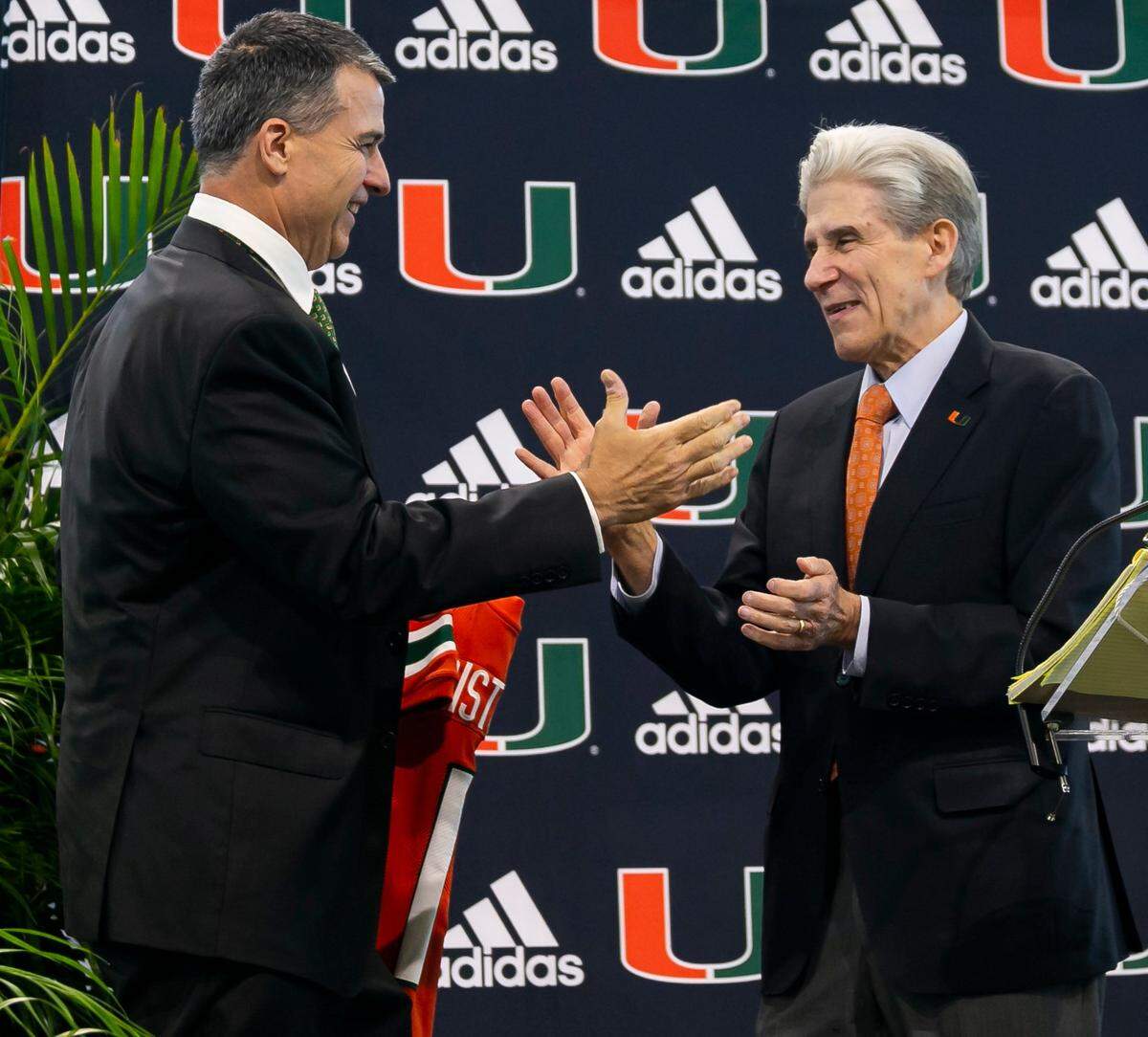
In December, UM hired a new athletic director, Clemson athletic director Dan Radakovich. Also in December, UM brought on as its head football coach Mario Cristobal, the former Oregon coach and two-time national champion Hurricane.
Menendez said other universities have also added leadership positions to face the new challenges.
“Some have called this a Chief Strategy Officer or Chief Operations Officer. Given our area of focus for the role is execution, President Frenk opted to transparently call it a Chief Executive Officer, despite the title being novel for academia,” she said.
Menendez said the COO will oversee “operations,” the CEO will oversee “execution,” and the president will oversee “strategy.”
“There is a continuum that begins with strategy, moves through execution, and is ultimately carried out in operations,” she said.
Said Johnstone, the higher education expert: “The only thing I could say is we have to wait and see. It’s not necessarily a bad idea; it’s just interesting.”
Seeing results will likely take about two years, she added.
This story was originally published April 23, 2022 at 6:00 AM.