
‘I never imagined this day going like this. But I’m so proud of you!’
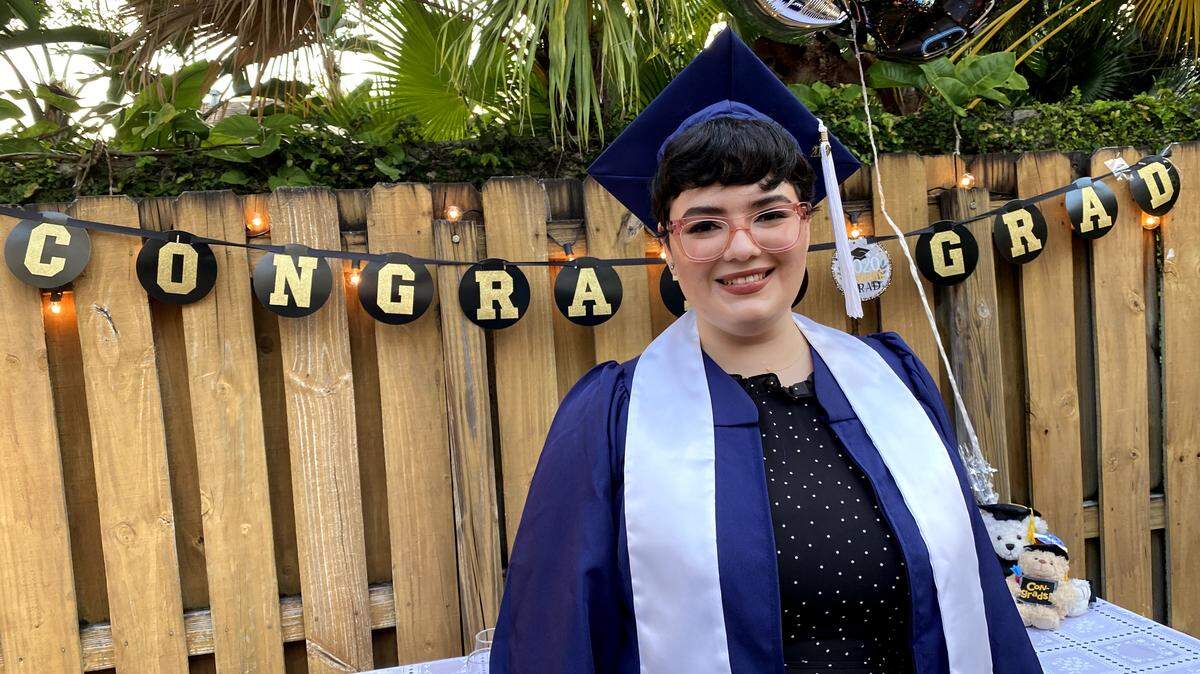
I never imagined I’d spend my graduation day in a Kendall backyard during a worldwide pandemic.
I’d pictured entering the Ocean Bank Convocation Center at Florida International University wearing a new dress. There would be goosebumps on my arms. I’d laugh at President Mark Rosenberg’s cheesy jokes and feel inspired by a big shot’s commencement speech. Then my name would blast through giant speakers while I accepted a diploma.
Instead, I put on my cousin’s FIU cap and gown from 2009. My family waited for me on the patio decorated with Class of 2020 paraphernalia, and my uncle prepared a paella. But even as they hugged and congratulated me, I felt hopeless. I couldn’t believe the day I’d dreamed about had been reduced to a family dinner. After five years of study, I’d enter a workforce with $45,000 in student loan debt and 15 percent unemployment.
“I can’t believe what’s happening,” my mom said as she hugged me tightly with tears in her eyes. “I never imagined this day going like this. But I’m so proud of you!”
Complaining about graduation might sound petty considering that more than 100,000 Americans have been killed by COVID-19. But it’s a sentiment I can’t erase. I moved to the United States from Venezuela six years ago to reach this day. Almost since I learned to walk, my identity has been tied to an American education. Yet the day designated to honor my hard work was taken from me.
I started learning English in a bilingual school when I was around 5. I grew up watching “Hannah Montana” and “Boy Meets World.” I remember the first time I saw “Toy Story.” I started talking to my toys with the hope they’d respond. My mom bought all the Disney movies in English and forced me to watch movies with subtitles so I could better learn the language. And my parents were obsessed with Madonna and Cindy Lauper. Almost everything I consumed was an American import.
We’d spend Christmas in Miami almost every year. We were regulars at Dadeland Mall, where we’d shop at Macy’s and scarf down vanilla bean frappuccino at Starbucks. We’d go to South Beach in the morning and finish the day with a ‘shroom burger at Shake Shack. It was our vacation routine.
In my senior year of high school, things started to look grim in Venezuela. Caracas back then ranked as (and continues to be) the second most violent city in the world. Nicolas Maduro was the new face of the dictatorship. Every day was more dangerous. Two years before my high school? graduation, someone stole my brand new iPhone 4S from my backpack as I walked through a mall. I was lucky. My cousin Cesar was shot around the same time when he refused to hand over a ring to robbers.
I applied to Caracas colleges, but my heart wasn’t in it. After a lot of convincing, my mom came around to the idea of me studying abroad. Then Miami International University accepted me into its fashion merchandising program.
I remember the day I got my student visa. It seemed my golden ticket to a new life. I’d feel safe, study what I wanted and earn a good living upon graduation.
I did everything right for the next five years, transferring to FIU in 2017. I went to school full-time, became a teaching assistant and worked part-time. I learned to be a reporter and an editor and learned to pitch a TV show to Netflix. I spent a semester working at Univision and covered President Trump when he came to our university. I squeezed in every possible learning activity so that when I graduated I’d be an appealing candidate for a job.
It wasn’t easy. I spent two years after my arrival in Miami living alone. I was homesick. I horribly missed my country, friends and family. Then in 2017, my aunt moved in. A year later, my mom and grandmother followed.
Weeks before I graduated from FIU and after the pandemic sent us to Zoom classes, stress sent me into a tailspin. My right arm went numb and lower back pain kept me from sleeping more than six hours per night. I felt anxious during the day and couldn’t focus. Who in their right mind would offer me a job in this crisis, I’d think. How am I supposed to pay my student loans?
As a Venezuelan international student, there is no plan B. I can’t just return to Caracas and build my career there. I have to find a job to pay that massive student loan debt. Until recently I never doubted my plan could work. But in the middle of a pandemic, when thousands of Americans file for unemployment every day, the dream started to seem like a fantasy.
So in April, when that “Congratulations Grad” banner hung in the background while we clinked champagne glasses and gobbled down the paella, I thanked everyone. But what was really going through my head weren’t thoughts of pride and joy. All I could think about was Was it all worth it?
This article is part of a collaboration between the Miami Herald and Florida International University’s Department of Journalism + Media.
This story was originally published June 3, 2020 at 3:00 PM.