
Miami-Dade schools wants to feed more students. Teachers union makes website to help.
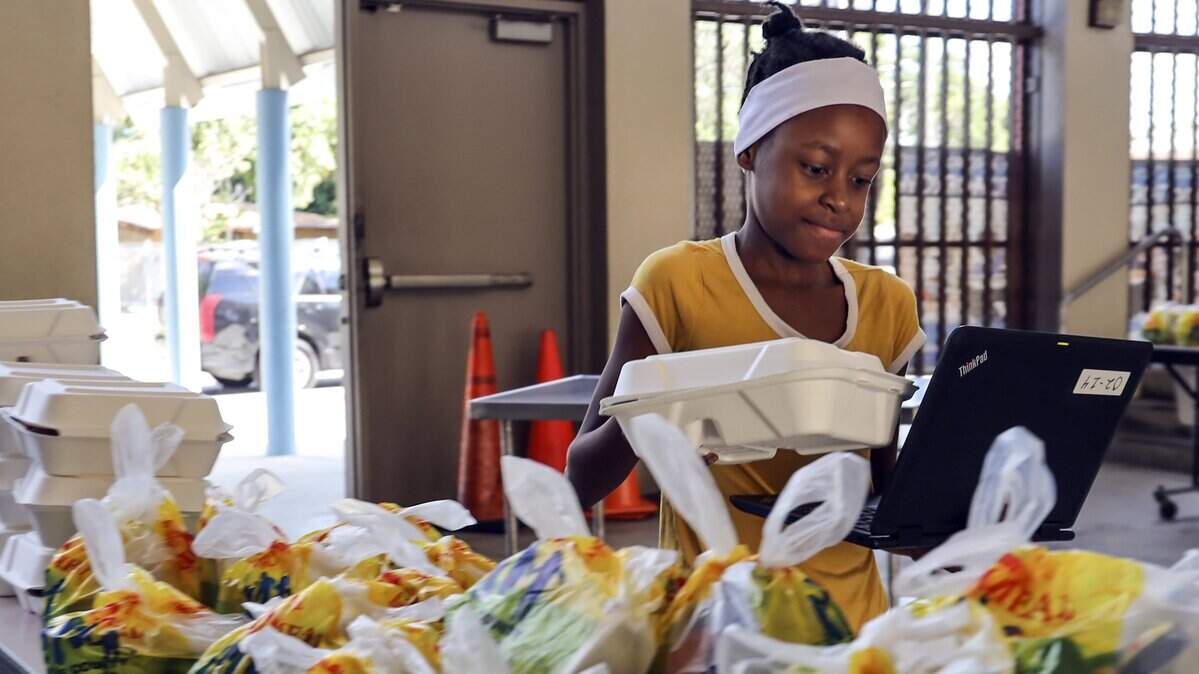
On national television, social media and email blasts, Miami-Dade County Public Schools and Superintendent Alberto Carvalho have been touting how many meals have been given to students and their families while schools are shuttered during the coronavirus pandemic.
The school district has led the way on providing meals to the community. On Thursday it was announced on Twitter that more than 1 million meals have been served since distribution began March 16. But in the fourth-largest school district in the nation with nearly three out of every four students — in an enrollment of 350,000 — qualifying for free or reduced lunch, that seemingly astronomical figure dwarfs in comparison to the need.
The math didn’t add up for United Teachers of Dade President Karla Hernandez-Mats.
“When I hear the superintendent and the numbers he’s reporting on meal distribution, it’s really startling to someone who knows the figures,” she said. “Those numbers are very small numbers compared to the actual need that exists in our community.”
If every child among the roughly 255,000 in need received a meal each day, the school district would give out 1 million meals in just four days. Those figures include students in charter schools; there are 275,000 students in traditional public schools. All public schools have been closed since March 16.
Hernandez-Mats said she thinks it’s an issue of communication and keeping up with the latest information. The district has made several changes to when and where families can pick up meals and downsized the number of schools providing meals from nearly all 350 to 50 campuses. The days meals will be distributed will change again next week.
To help families, UTD on Thursday launched a website that locates the nearest or most convenient school distributing meals. Plug in an address or ZIP Code into Freeschoollunch.info, which is available in Spanish and Creole, and the nearest participating school will pop up.
The school district was not consulted or involved in creating the website.
“Really what we want to do is amplify what the district is doing,” Hernandez-Mats said. “Children, a lot of them are connecting and some of them are not. We know that even as school teachers we can’t teach a child if the child is hungry.”
Beginning the week of April 20, those 50 designated school sites will distribute hot meals and groceries only twice a week on Tuesdays and Fridays from 4 to 7 p.m. Families can expect to receive several meals in bulk.
Hernandez-Mats said the website will update to reflect the latest information on meal distribution.
“It’ll create a sense of ease logistically based on how the district is able to handle food distribution,” she said. “We just want to help. We’re a helping hand. We want to make sure this info goes out to all communities, to all parents, to all students.”
Carvalho has broadcast information about meal distribution on radio, TV and social media. He has visited schools to distribute meals himself and tweets those photos from his personal Twitter account.
On Friday, he acknowledged that food distribution figures fell short of the need. He said changes in distribution were made to reduce social contact.
“We hit a very high number, but we are not hitting the average number of meals distributed in schools when schools are open,” Carvalho said, going on to defend the district’s efforts to get the word out.
Yet, he said, turnout for food distribution was greater than after a hurricane shutdown “by several orders of magnitude.”
“It’s the messaging through the online teaching, the online portal reminding students there are food distributions,” Carvalho said. “It’s the emails, it’s the fliers, it’s the knock on the door, it’s the website. It’s my constant appeal to the community every day on TV, on the radio in a multitude of languages.”
Spring break was included
For the first time, Miami-Dade County Public Schools also provided meals during spring break. The school district is now also handing out protective masks and gloves at meal distributions.
“We have publicized aggressively the food distribution sites,” Carvalho said. “We welcome anyone and everyone who want to amplify efforts to feed as many as possible in this community.”
Carvalho said on regular school days, the district serves free breakfast at schools to all students regardless of need, which amounted to 70,000 breakfasts. He said the district matched that figure this week in overall meal pickups, although it isn’t just traditional public school children picking up meals.
Carvalho said the district has received emails from private school parents requesting and asking for information on feeding sites. He said principals have reported that students attending charter schools have picked up food.
“We are going on a trust system here, and we know that we are feeding charter school kids and we are feeding private school kids as well,” he said, estimating that 10% to 15% of students picking up meals attend a non-district school.
School districts are reimbursed by the U.S. Department of Agriculture for meals served. The school district has asked for waivers to be able to provide meals to students’ families. Schools are not requiring students to show their school ID at meal pickup.
That leaves food distribution sites susceptible to fraud, as scammers in Hillsborough County picked up and sold free meals online as food ran out, leaving needy children with nothing.
Carvalho said he hasn’t received reports of selling or hoarding food, but said he has asked the schools police department to scan the internet for any postings as it could be illegal. No school, however, has run out of food.
Charter schools reach out, too
Lynn Norman-Teck, executive director of the Florida Charter School Alliance, said charter schools are regularly reaching out to parents to ensure that all students have access to devices for learning, internet connectivity and daily meals.
“During these difficult times, we appreciate that MDCPS is treating all students — whether they attend a public charter, magnet or district school — equally,” she wrote in an email. She said some charter schools are partnering with municipalities or local organizations to provide meals for their families.
Fernando Zulueta, president of local charter school conglomerate Academica and representative for the Florida Consortium of Charter Schools, in a text message commended the school district for identifying several school sites as hubs for meal distribution.
“They have been very supportive,” he wrote. “The district has also been helpful in connecting families to community food providers.”
Zulueta said some charter schools have provided meals for onsite pickup while others have partnered with local organizations to provide food for families.
WPLG Local 10 News reporter Madeline Wright reported that ground beef, onions and almond milk were part of the 800 free meals distributed at Mater Academy Middle/High Thursday morning. Zulueta said that school partnered with the City of Hialeah Gardens this week to provide food and water to families.
Zulueta also said that Gibson Charter School in Overtown will be providing pizzas for pickup for families next week.
This story was updated after it was originally published online to more accurately reflect the number of students in traditional public schools, that the days of meal distribution were changing but not times, and that the union did not consult with the school district in creating the website.
This story was originally published April 17, 2020 at 5:40 PM.