
Resource fair offers options for special needs adults ‘aging out’ of school
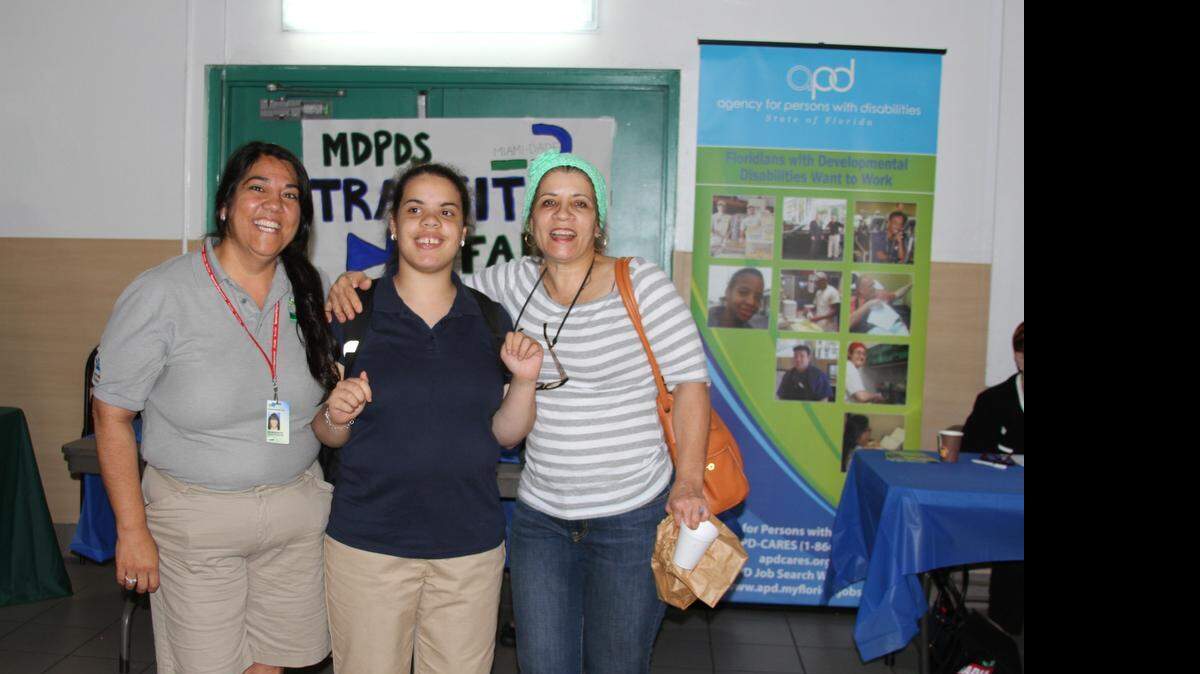
Parents of young adults with intellectual and developmental disabilities crowded A.D. Barnes Park’s Leisure Access Center on a recent Wednesday evening in southwest Miami to learn how to enroll their adult children in programs that will help them live, learn, and work in their communities.
For many parents, the time is fast approaching when alternative options need to be sought as their special-needs sons and daughters “age out” of high school and after-school programs.
The inaugural Transition Resource Fair hosted by Miami Dade Parks Disability Services Department, gathered just under 10 different South Florida organizations to fill the Access Center’s single room. There, representatives from special-needs outreach organizations helped parents sign up their adult children for programs that promote independence to help them better transition into the “real world.” Topics like post-secondary education, community programs for special-needs adults and employment and job placement were discussed.
“We want to be pioneers to help parents find appropriate programs for them,” says Tania Santiago, who works for Miami-Dade Parks Disability Services Department as a supervisor at Camp Matecumbe Park in West Kendall. The camp’s after-school program provides activities for those with disabilities, ages 6-21, six days a week and is funded by The Children’s Trust.
Parents have reason to become desperate about the future of their adult children once they’re no longer allowed to attend special education programs in public high schools due to their age. Federal law guarantees an education in certain public classrooms for those with developmental and intellectual disabilities until they’re 21. Once they turn 22, they’re on their own (if their 22nd birthday falls within the academic year they are able to finish that year of school.) It’s a term commonly referred to as “aging out,” which leaves parents or caregivers scrambling to find other options for their dependent adult children, which aren’t guaranteed and often come with long waiting lists that can span years.
“I’m anxious,” says Ashley Ortega of her 22-year-old special-needs son, Marco Gonzalez. “The time is approaching when he’ll be graduating.” She works full-time and wants him to be “safe, happy and learning” while she’s at work. Due to his age, he’s at that pivotal time where he may fall through the cracks unless his parent finds a way for him to productively spend his time. Marco, who’ll be graduating from Miami Killian High School’s special education program in two months, says he wants to do clerical work, like computer filing.
The resource fair is “great for parents to get information,” Ortega said. “Eventually I want him to be a productive citizen and find some sort of enjoyment in his work.”
Intellectual or developmental disabilities are a general term that refers to a range of conditions that restrict a person’s ability to function in everyday activities. Florida Statutes defines developmental disabilities as spina bifida, autism, cerebral palsy, Prader-Willi syndrome and intellectual disability. In 2010, Congress passed “Rosa’s Law,” which replaced the term “mental retardation” with “intellectual disability.” The change was spearheaded by the family of a girl with Down Syndrome, named Rosa, who was frequently called “retard” by people.
According to the National Alliance for Caregiving, all too often caregivers must identify and coordinate services provided by complex health and social service systems that are difficult to navigate. In navigating these systems, caregivers often find little or no information about services.
“This event is so needed,” says Lucy Binhack, the county’s Parks Disability Services Manager, “because the families need to be educated on the opportunities for their children with intellectual disabilities.” She adds, “The young adults need to be educated on their opportunities and start thinking about work and understanding that school is going to end. Our staff needs to be educated on who to refer where.”
More than 80 percent of families raising someone with a significant disability are single-parent households. “It’s very stressful,” she says. More than two-thirds of caregivers are women.
Participating exhibitors at the resource fair included: the Agency for Persons with Disabilities (APD), Center for Autism and Related Disabilities, Miami-Dade County Public Schools J.R.E. Lee Baling Program, Hope for Miami, Nature Links for Lifelong Learning, Baptist Health South Florida Office of Diversity and the Division of Vocational Rehabilitation.
Each organization offered information on subjects such as independent living, community engagement to build social skills, continuing education and vocational training, career and employment, health and safety, recreation, fitness and adaptive sports.
Part of the motivation for the county’s Disability Services Department to host the Transition Resource Fair was to help families whose adult children were aging out of the parks’ after-school programs. During weekdays and on Saturdays, Miami Dade Parks, Recreation and Open Spaces Disability Services Department offers free after-school programs to 150 kids, teens and young adults 21 and younger with disabilities at six county parks. Their only Adult Day Training program, held weekdays at A.D. Barnes Park, is for those 22 years and older, but is currently at its cap of 40 with a growing waiting list.
For those with severe developmental disabilities, who have the mentality of a toddler or young child, employment simply isn’t an option but continued learning programs, like Nature Links, are. The local nonprofit connects special-needs adults to nature through teaching them how to garden, exercise and practice healthy eating habits. For those who are at a higher level of learning, they’re taught how to cook what they’ve grown in the garden at J.R.E. Lee Education Center in South Miami.
Videography is also taught so that the young adults can practice storytelling to share what they’re learning while becoming more self confident, learning communication skills and increasing their connection with their community. With these learned skills: gardening, cooking, restaurant management (Nature Links runs a food truck), the track to employment becomes more feasible as new abilities are learned.
For more information
For more information about Miami Dade Parks Disability Services Department and to learn more about special needs outreach organizations, contact recreation therapist Gisel Prado at 305-665-5319 or email giselp@miamidade.gov; or call Parks Disability Services Manager Lucy Binhack at 305-755-7848 or email binhack@miamidade.gov.
To learn more about Miami Dade Parks Disability Services Department log on to: www.miamidade.gov/parks/leisure-access-foundation.asp.
This story was originally published April 16, 2015 at 6:21 PM with the headline "Resource fair offers options for special needs adults ‘aging out’ of school."