3 family members accused of smuggling gold into Miami from Colombia
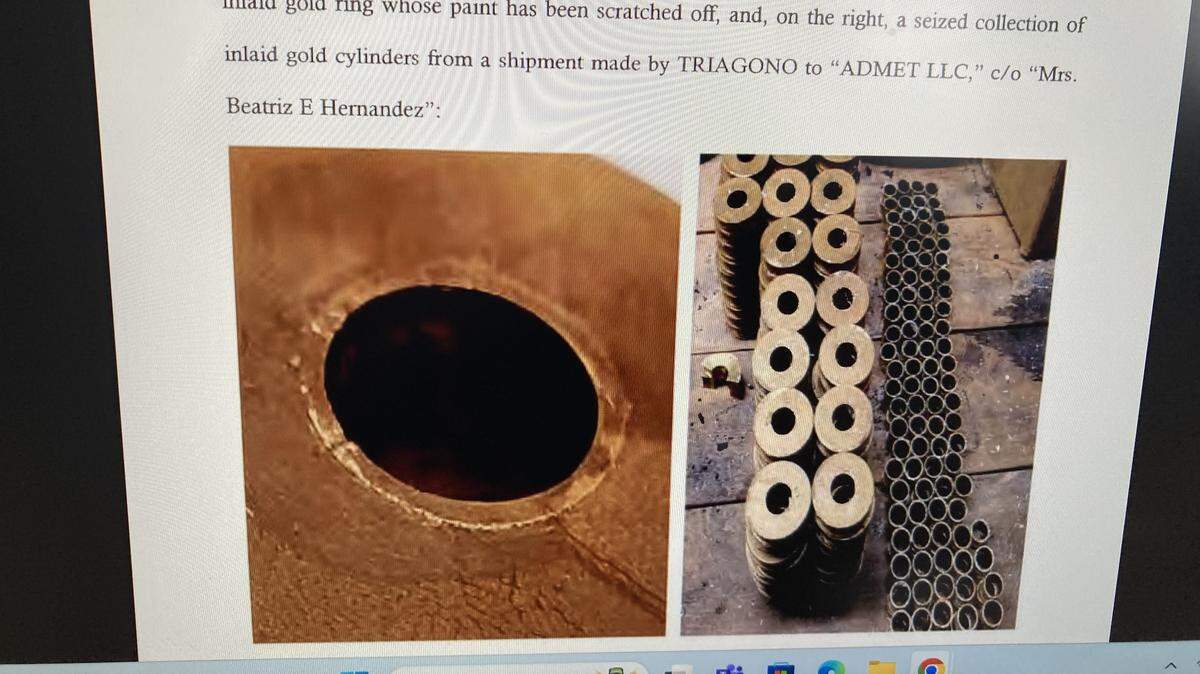
In 2018, Miami-Dade businesswoman Beatriz Eugenia Hernandez came up with a novel way of importing gold from her native Colombia: packing cylinders of the precious metal inside donut-shaped copper widgets.
But federal authorities say she ran afoul of the law when she falsely labeled the shipments as “electrical connectors” and painted over the gold cylinders in bronze to disguise them during Customs inspections at Miami International Airport.
This summer, Hernandez and two other members of her family were charged with smuggling gold into the United States and selling it for millions of dollars before sending the money back to a shipping company in Colombia. They’re accused of wiring about $24.6 million from the gold sales through Miami and Colombian bank accounts between December 2018 and May 2022.
In July, Hernandez, 57, her son, Carlos Mathias Gonzalez, 26, and her brother, Esteban Hernandez, 47, pleaded not guilty in Miami federal court to an indictment alleging they conspired to defraud the United States while smuggling the gold. The mother and son also pleaded not guilty to money laundering and related charges. The brother was not charged with those additional crimes.
Their defense lawyers, who are working as a team, say prosecutors in the U.S. Attorney’s Office have wrongfully turned a potential regulatory violation into a criminal case, asserting that the Hernandez family obtained legal advice from both South Florida and Colombian lawyers before embarking on the venture to import gold in this manner from Colombia.
“Our clients are completely innocent,” attorneys Sidney Fleischman, William Zloch, Walter Reynoso and Dennis Kainen said in a statement provided to the Miami Herald on Friday.
“They relied on advice from attorneys both in the United States and abroad confirming that the importation of the gold was lawful,” the lawyers wrote. They said that the new U.S. Attorney in Miami should “reconsider this prosecution” in light of an executive order issued by President Donald Trump that they note “expressly discourages criminal enforcement of regulatory issues.”
Given the recent history of gold smuggling from South America to South Florida, their quest to get the case dismissed will be a long shot.
History of illegal gold mining
Over the past decade, federal agents with Homeland Security Investigations have led efforts to plug the pipeline of gold illegally mined in Peru, Colombia and other South American countries in the Amazon region that ends up being used for making jewelry, coins and smartphones in the United States.
In 2018, the Miami Herald published a series of stories, “Dirty Gold, Clean Cash,” that spotlighted a ring of Miami brokers who bought and imported billions of dollars of gold from South American suppliers with drug-trafficking and other criminal connections.
In August, a Washington, D.C.-based nonprofit group, the FACT Coalition, issued a report titled “Addressing Illegal Gold Mining in the Western Hemisphere: New Approaches for U.S. Policy,” that examines the harmful effects of illegal gold mining in South America and how the U.S. financial system spurs the laundering of illicit gold profits.
“Illegal gold mining is a regional crisis that undermines the rule of law, damages the environment, and fuels organized crime,” said Julia Yansura, program director for environmental crime and illicit finance at the FACT Coalition. “With significant gaps in our anti-money laundering regulations and trade policies, the U.S. has become a hub for the proceeds of this crime, empowering criminal networks and authoritarian regimes in the process.”
In the Hernandez family’s case, however, federal agents and prosecutors have not alleged that the source or mining of their gold is illegal. Rather, authorities say in the indictment and other court records that the mother, son and brother intentionally mislabeled the gold shipments from a Colombian company, Triagono SAS, to their Miami-Dade business, Admet LLC.
The indictment accused them of smuggling “pure gold packaged, disguised and labeled as, among other things, electric connectors, electric items, parts and accessories for hydraulic pumps and electric plug-ins.”
According to the indictment, the owner of Triagono and a company employee — described as “co-conspirators” — sent “multiple packages” to the Hernandez’s business, Admet, with “some of the packages falsely labeled as containing electric connectors that were made of ‘auricupride alloy.’ ” Auricupride is a naturally occurring alloy that combines copper and gold.
But “the packages did not contain metal components that were made of auricupride alloy as claimed on the attending documentation,” the indictment says. “Rather, the boxes contained donut-shaped metal components with high-purity gold cylinders that were fitted into the center of the component, often painted bronze to conceal that the gold cylinder was separate from the larger piece of metal.”
After receiving the shipments, Hernandez, her son and her brother removed the inner gold cylinders from the so-called electrical components and then consolidated them into gold bars
“Neither Triagono nor Beatriz Eugenia Hernandez ever declared the gold in the packages shipped to [her] by Triagono,” according to the indictment. “Once the gold was melted down, Beatriz Eugenia Hernandez and her conspirators, including [her son] Carlos Mathias Gonzalez, sold the resulting gold through Admet and [another family business] The Binomial Company to gold merchants and refiners” in Miami.
Intercepted at MIA
The “clandestine” gold operation came to a halt when Customs officials intercepted Triagono’s shipment of six boxes with “electrical connectors” at Miami International Airport in May 2022, the indictment says.
“There’s a hold,” Beatriz Hernandez messaged her son and other co-conspirators on WhatsApp on May 10, 2022. “They didn’t release it yesterday.”
Two of those co-conspirators, Luis Villanueva Perdomo, the owner of Triagono, and Andres Calero Castro, a company employee, were charged three months later with smuggling gold into the United States after they were both caught bringing gold necklaces and bracelets valued at about $25,000 on a commercial flight from Cali, Colombia, to Miami International Airport.
In 2023, both men pleaded guilty to smuggling charges, including admitting that they used their company, Triagono, to ship about 120 packages of gold to the United States between December 2018 and May 2022. They were sentenced to one year in Miami federal court.
“To disguise the gold, the packages were declared primarily as ‘electronic connectors,’ among other names,” according to factual statements filed with their plea agreements. Both men “knew the gold must be invoiced and acted willfully to defraud the United States when the gold was not declared and shipped from Colombia to the United States.”
This story was originally published August 30, 2025 at 2:28 PM.