Coral Gables killer denied request to pull guilty plea. Judge calls it ‘buyer’s remorse’
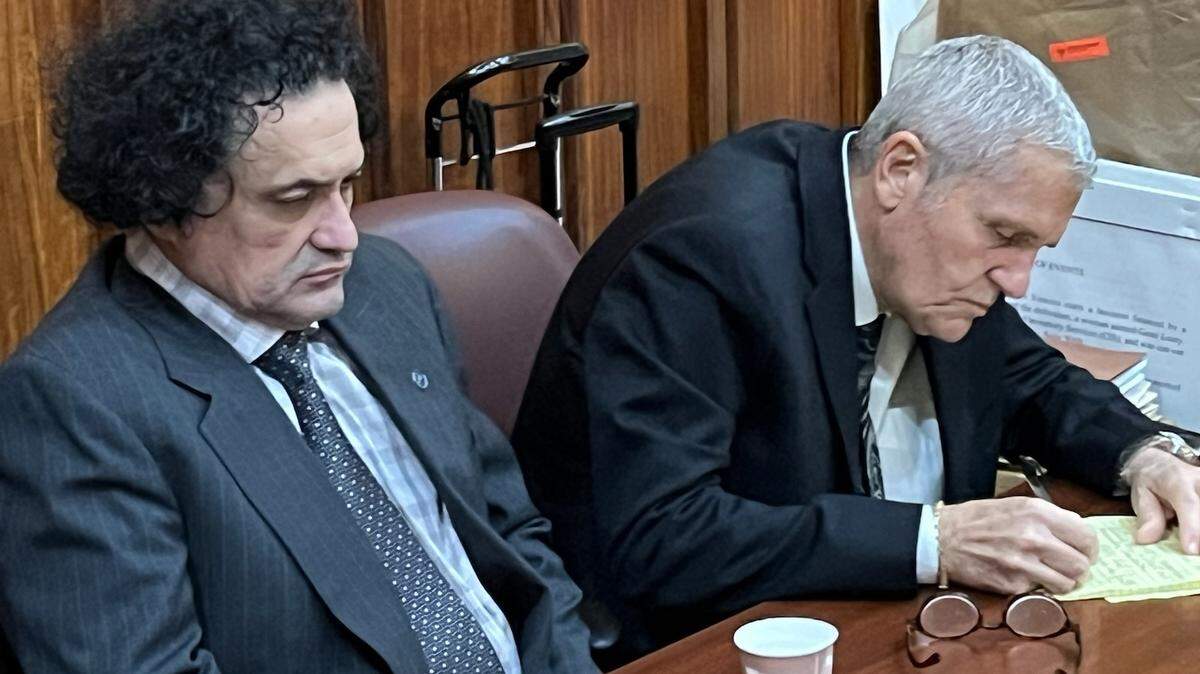
A former computer technician charged with torturing and murdering two Coral Gables co-workers over a decade ago, stunned onlookers only two days into the trial when he stood before the judge and admitted to the crime, putting him a step closer to death row.
That was last month. Now, he’s changed his mind.
On Thursday, Jose Rojas’ request for a new trial due to ineffective counsel was denied by Miami-Dade Circuit Court Judge Miguel M. de la O. The judge’s decision came after a rare and bizarre all-day court proceeding that had attorneys for the defendant sparring in open court and a senior state prosecutor heaping praise on a veteran defense attorney she’d argued against for decades.
Rojas’ hearing was sparked by a pair of letters he wrote in jail, one two nights before his Dec. 8 guilty plea. The other afterward. In the first letter — after devastating evidence was produced at trial that outlined an embezzlement plot as motive for the murders — he said he’d had enough and wanted to die quickly, “to make it easy for all.”
Then, a few weeks after the guilty plea was accepted, Rojas reconsidered and forwarded a new draft to the court saying he was coerced into a hasty decision by Dellaferra and that his counsel “jeopardized me with detrimental and erroneous advice” and “put his [Rojas’s] life in danger.” Judge de la O assigned independent counsel Auyban “Tony” Tomas to investigate and argue Rojas’s claim.
Thursday, the judge quickly sided with Assistant State Attorney Abbe Rifkin’s argument that the evidence was overwhelming and that it was too late for Rojas to change his mind.
“Motion denied,” said de la O. “I do believe it’s buyer’s remorse.”
Before the day in court ended, Rojas, 55 — who claimed insanity and said he had no recollection of the murders — also lost Dellafera, a respected defense counsel who in August got jurors to declare a mistrial in the case of a man accused of stabbing, burning, strangling and drowning a woman. Dellafera told the court his relationship with Rojas was irreparably broken.
Then, despite objects from co-counsel Richard Houlihan, the judge said would continue to represent Rojas through the sentencing phase of the trial in which 12 jurors could decide if Rojas is to be the first person sentenced to death in Miami-Dade County under a new law that now only requires an 8-4 jury vote, instead of a unanimous one. The sentencing phase of his trial, which will determine whether he spends the rest of his life in prison or dies, is set to begin March 11.
Earlier complaints about lawyers
Rojas, who killed business owner Frances Venezia and Robert James in a Coral Gables office in 2012 as part of a plot to cover-up an embezzlement scheme, began complaining about counsel weeks before opening statements in early December. It was learned during Thursday’s hearing that Houlihan and mitigation attorney Samantha Lopez visited him in jail late one night without Dellafera and suggested he write a letter to the court outlining his complaints about the lead defense attorney.
When de la O brought up the issue before opening statements, Dellaferra said Thursday he didn’t believe it and said it bolstered his case that Rojas was “delusional.” Rojas eventually told the judge he didn’t want to file the claim and was ordered to see a doctor about his competency. The doctor said he was well enough to stand trial.
The juicy tidbits and legal wrangling made public during Thursday’s hearing had Rifkin defending Dellaferra, a rival she has opposed at trial for decades.
“It almost seemed like this was a gang up on Mr. Dellaferra,” Rifkin told the judge. “Mr. Dellaferra didn’t tell the defendant what he wanted to hear.”
Houlihan told the court that though he and Dellafera had different takes on several issues in the case, they were veteran professionals who could work through their disagreements.
Brutal killings
Rojas, who has two children, was charged with two counts of first-degree murder, two counts of kidnapping, and single counts of attempted armed robbery and of credit card fraud for the 2012 murders of James and Venezia, who owned the small insurance adjustment firm where Rojas worked as a tech and did mostly odd jobs.
Rifkiin explained to jurors early in the trial that times were tough and that Venezia was struggling financially, often paying Rojas late, if at all, before she was killed. Desperate, Rifkin explained, Rojas used a company credit card to embezzle about $3,500 in gift cards and merchandise. When Venezia learned she’d been swindled and Rojas found out, he created a plan to save himself from prison and kill his co-workers, the state said.
On the day of the murders, he filled a bag with a ski mask and extra clothing, then picked up duct tape, dish towels and a mop from a local Winn-Dixie. He got to the office before Venezia and James did, subdued them with a BB gun, tied them to chairs, then beat them to death with several hard objects.
Covered in his victim’s blood, Rojas ran out of the building and past police into an alleyway. There, he was tackled and taken into custody. He was questioned for more than 17 hours before admitting to the crime. His decision to plead guilty came shortly after jarring pictures of Venezia and James were shown in court, pictures so gruesome he told his parents to leave.
Confused under questioning
Dellafera argued his client suffered life-long depression and had a brain condition called chronic traumatic encephalopathy, or CTE, from years of head blows playing soccer, where he starred at Miami Senior High and beyond. He also said Rojas had no recollection of the murders.
Rojas, in a red jumpsuit, handcuffed and seated alone Thursday in a jury chair, had a difficult time articulating his argument when questioned by de la O. Even after claiming Dellafera pushed him into a hasty and wrong decision, Rojas told the court he wasn’t certain which of his attorneys had been more helpful in his defense.
His main complaint about Dellafera was that he didn’t attack Rifkin’s early arguments while the state was making its case. Since his client had already admitted to committing the crime, the defense attorney’s goal was to get through the first part of the trial as quickly as possible, so jurors could hear from doctors about his client’s brain injuries - something Rojas didn’t seem to comprehend.
“Jimmy was the only one talking to me. I had to listen to somebody. He told me several times he thought it [pleading guilty] was a good idea,” Rojas told de la O. “But I felt everything was going bad for us, really bad. She’s [Rifkin] strong, so powerful. And my team is so passive. I felt we lost after the first five minutes.”