
Bail system hurts Miami’s poor. Controversial software could fix that but is public at risk?
Last spring, Miami nursing student Ingry Rivas found herself in a Miami-Dade jail in the middle of the night. As her boyfriend scrambled to find money to bail her out, Rivas spent an agonizing 14 hours in a crowded jail, freezing cold and crying.
She wasn’t exactly accused of the crime of the century. Police said Rivas, 28, failed to return a rented U-Haul truck. Rivas says she had rented the truck for a friend and had no idea he didn’t return it on time. Still, the bond was $5,000.
They didn’t have that and had to borrow $500 to hire a bail bond agent, who put up the rest. But they won’t get that $500 back — the agent got to keep that 10 percent fee. It was no small sum for a couple living paycheck to paycheck.
“We live with the very minimum. I barely work right now. I am a student,” said Rivas, who will soon have the felony charge dropped after entering a court program for first-time offenders. “My boyfriend, he’s the one supporting us. For us, it was rough. That’s $500 less in our pocket and we have to pay bills. Now, we’re behind.”
Sometime later this year, people who find themselves in Rivas’ shoes may not have to open up their wallets, call a bondsman or endure a stint in jail for small-time offenses.
Under a proposed new bail system in Miami — based in part on computer software that aims to predict who may break the law in the future — people accused of low-level crimes will likely get released immediately, without having to shell out money or wait long hours to see a judge.
There’s general support for that part of Miami-Dade’s long-planned bail-reform effort. But the wider plan has opened political and legal rifts over the potential ripple effects of the overhaul, which is expected to be adopted this year, though no firm date has been set.
Some police, politicians and media pundits have latched onto the prospect of bail reform as a social wedge issue. With scant evidence, some suggest that the new system is too soft on suspects and that dangerous criminals will leave jail with no strings attached, echoing concerns that have become political flash points across the country and dogged bail reform in places such as New York and Illinois. City commissions in Miami Beach, Doral and South Miami already have passed resolutions opposing the overhaul.
On the flip side, reform advocates fear more minorities could end up behind bars under the proposed system, in part, because that “risk assessment” software — developed by a group founded by a Texas hedge fund manager turned philanthropist named John Arnold — has been criticized for using racially biased data.
Whether it’s a human judge or a computer algorithm, the process of predicting future violent crime is “still a crapshoot,” said Colin Doyle, a Loyola Law School professor who studies how risk assessment programs intersect with race and the law.
“It really just is a blind guess,” Doyle said. “It’s a weak guess that disproportionately harms certain communities.”
The judges, prosecutors, defense attorneys and jail authorities who have spent years planning Miami-Dade’s “Pretrial Justice Improvement” project say they aim to strike the right balance — maintaining public safety while preventing poor people who pose no risk from languishing in jail.
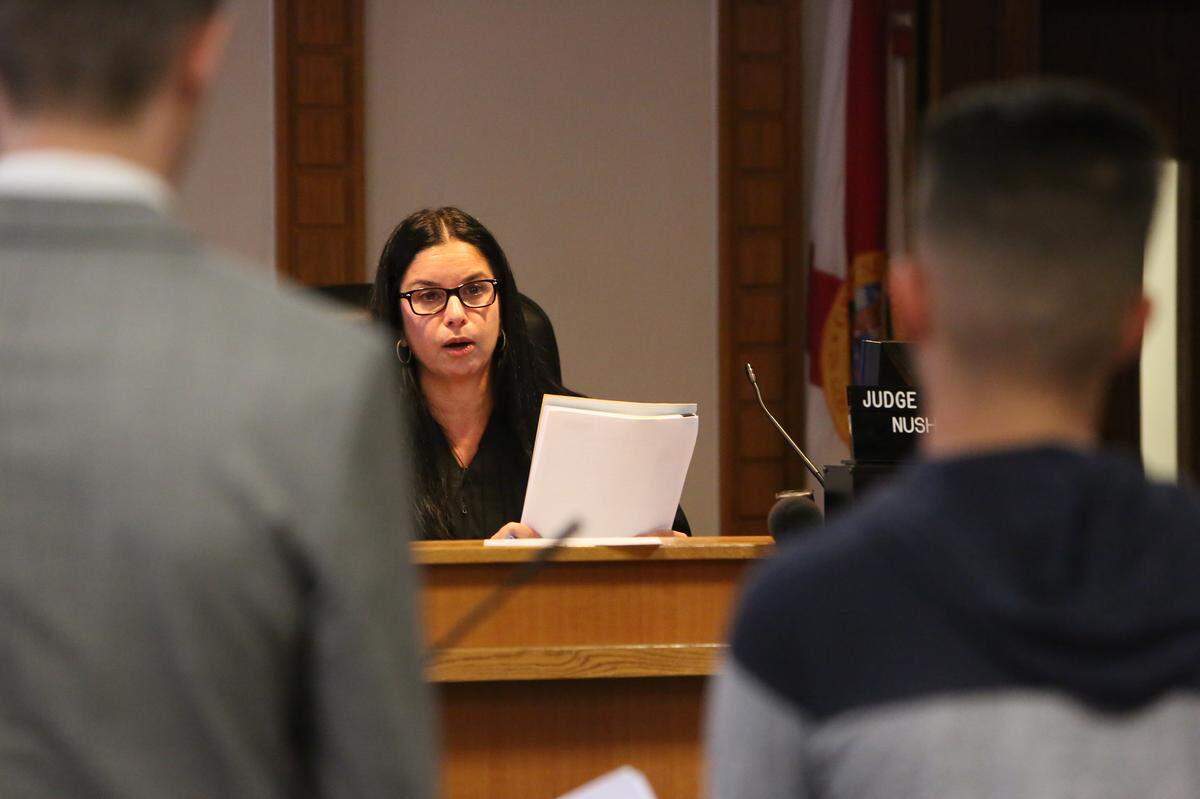
Miami-Dade Chief Judge Nushin Sayfie, in an interview, said more people will actually appear in court and may still need to post a bond under the new system. She’s also mindful of criticism of human behavior prediction software — the Arnold product is called the “Public Safety Assessment” tool or PSA for short — but stresses nothing about the process is set in stone.
“We are giving it our incredibly best shot,” Sayfie said. “But we recognize that a few months in, we might see that, ‘Wow, we’re keeping way too many people in.’ We recognize in perpetuity we’re going to be going back to the drawing board and modifying the PSA and modifying our practices to make sure that we are constantly keeping the public as safe as we can keep them and making sure we’re not incarcerating people unjustly.”
A flawed system
No one argues that the bail system in Florida’s most populous county doesn’t need updating.
Adding to the need for change: Miami-Dade’s corrections system, which remains under federal oversight because of shoddy conditions and medical treatment for inmates, has long been criticized for putting and leaving too many people behind bars. After dipping during the pandemic, the population behind bars in Miami-Dade’s jails now hovers around 4,300 on any given day.
The bail system adds to those numbers. Once a person is booked into jail, some can afford bond. Many can’t. In Miami, the system has worked the same for decades, so long in fact that nobody knows exactly when the standard bond amounts were set or why. Here’s how it works now:
If you’re charged in Florida with certain violent crimes — like murder, armed robbery or armed kidnapping, to name a few — you’re not entitled to an automatic bond. But for the vast majority of charges, you’re eligible to put up cash to stay out of jail. Misdemeanor battery? That standard bond is $1,500. Sudden-snatch robbery? That’s $1,000. Charged with vehicular manslaughter? That’s a $7,500 bond.
You can put up the whole amount and if you skip town, you’re out all that money and in deeper legal trouble. Hire a bail bondsman and you pay only 10 percent — but the bond agent keeps that as a fee while putting up the rest and ensuring you show up to court.
If you can get the money quickly, you can post bond and leave jail immediately on many charges — without ever seeing a first-appearance judge within 24 hours. But defense lawyers say many defendants, especially those charged with felonies, can’t get their hands on bond money that fast.
Miami-Dade began its latest push on revamping its system in late 2019 amid Black Lives Matter protests pushing for criminal justice reform. The concerns aren’t new, however. Justice experts have long argued that the country’s cash bail system unfairly keeps the poor behind bars and isn’t an effective way to ensure people show up for court.
The agencies involved in Miami-Dade’s bail overhaul include the Public Defender’s Office, the State Attorney’s Office, Miami-Dade’s Homeless Trust and Miami-Dade Corrections and Rehabilitation, which received training and technical support from Advancing Pretrial Policy and Research (APPR), a nonprofit justice reform group.
How it will look
The APPR is where billionaire philanthropist John Arnold comes in. The group is a partner with Arnold Ventures — founded by Arnold and his wife, Laura — which created and provides the new data-driven “risk-assessment” software that will underpin the county’s new bail system. This is how the “Public Safety Assessment” software works:
It builds an assessment based in part on data involving decades of crimes across the country, and in part on your personal history: age, prior convictions for violent or nonviolent crime, current or pending charges and any history of skipping court dates.
Scores gauge how likely you are to show up for a court date and how likely you are to stay arrest-free. You could also be flagged as a risk for possible violence.
If you’re a first-time offender charged with something minor, like nursing student Rivas, your score will likely be low enough that jailers may grant you “delegated release.” No need to front any money for bond. No having to wait in jail to see a judge. But a higher score — maybe you are young and have a previous conviction — might spur jailers to still send you to bond court.
But many charges, more than 700 specific offenses, are flagged as “excludable” and will require a judge to oversee any bond decision. Those include many serious felonies, such as aggravated battery, occupied burglary or even trafficking in certain amounts of or marijuana.
In those cases, the judge can consider the score in setting a bond amount and adding other restrictions, like house arrest or a GPS monitor.
“The bond will still be in the toolbox for the judge to use,” Judge Sayfie said. “Many more people are going to end up being required to see a judge before they get released.”
The “excludable” list is meant to serve as a guard rail to prevent dangerous people from being freed with little or no judicial review. But some Miami-Dade defense lawyers bristle at the length of the list — and the fact that it includes some crimes that were previously allowed instant release on bond.
Miami attorney Robert Reiff, for one, believes people charged with drunk-driving traffic deaths — DUI manslaughter carries a $7,500 bond — should not be forced to see a judge.
“It is ridiculous to hold for a magistrate traffic offenses, even serious ones,” Reiff said. “After all, they are called accidents for a reason.”
Attorney Michael Davis, president of the Miami chapter of the Florida Association of Criminal Defense Lawyers, called the part of the plan to hold more people for video-recorded public hearings a “poison pill.”
“People who used to be able to immediately bond out of jail will be forced to endure the humiliation of a video court appearance while dressed in an orange jail suit. That recording will haunt these citizens forever, even when their case is dismissed,” he said.
Davis also suggested that judges may be inclined to hike up bonds based on skewed risk scores. The system may generate high scores for homeless people, who may have long histories of arrests for petty crimes and skipping court because they don’t get notices to appear in the mail.
As part of the overhaul, Corrections is hoping to create a smartphone app that will allow defendants to check in and get crucial reminders on their upcoming court dates — an addition that could help itinerant people, including the homeless, stay better informed.
Still, Davis said, “There is a real danger that vulnerable members of our society will face unnecessarily high bonds.”
Controversial algorithms
The use of “risk assessment” software to predict criminal behavior isn’t new, but has become increasingly common across the United States. Florida counties like Broward and Volusia have used versions to gauge the risks of releasing newly arrested people awaiting trial.
For years, some criminal-justice reform groups championed the tools, which use historical data and other information to create algorithms designed to predict the risk someone poses if freed before trial. The Arnold system taps into decades of data, churning out its statistical analysis from 750,000 historical criminal cases from around the country, the company says.
Arnold Ventures’ assessment tool has become one of the most widely used in the country in part because it is largely free for jurisdictions to use. Supporters say the scores are transparent, with each person’s individual report given to all the parties in a case.
The thinking goes that with more accurate, impartial data, judges can make fairer decisions on pretrial release.
“It’s a piece of information that a judge uses to help make the decision they can at that pivotal moment in a time in a hearing that usually takes very little time,” said Alison Shames, the co-director of the APPR program working with Miami-Dade courts.
But reform groups have grown skeptical, arguing that criminal history records can heavily weigh against historically marginalized communities of color. Tools from other companies or institutions can even include ZIP codes, length of employment and whether someone rents their home.
“We know people of color are more likely to get arrested. We know communities of color are more likely to be over-policed. No matter what statistic methodology is used to develop those risk-assessment tools, if they have that criminal history in them, there is going to be some racial bias,” said Meghan Guevara, an executive partner with the Maryland-based Pretrial Justice Institute, which in 2020 stopped its support for risk-assessment tools and now opposes them.
Shames, who is also a co-director of a justice group called the Center for Effective Public Policy, acknowledges criminal data can have built-in racial bias. But even with that, she argues the software will do more good than harm, helping show judges that most people are low risk and should be released.
“The use of a tool can help minimize that very unfair use of money that is unfairly hurting people of color and poor people,” she said.
But previous studies and reports raise questions on the results of similar computer-guided justice programs,
A 2016 ProPublica investigation, for example, found that in Broward County, similar software used pretrial from a company called Northpointe wasn’t particularly accurate and was more likely to flag Black defendants as future re-offenders.
Critics like Doyle also contend that research showing the programs’ effectiveness is limited, or shows their effects are minimal — like one study of Kentucky that found only a “small increase” in pretrial releases after the implementation of risk assessments, and the “changes eroded over time as judges returned to their previous habits.”
“It used to be, if you’re going back maybe 5 or 10 years, there was a lot of talk of these risk assessments being the answer to bail reform,” said Doyle, the Loyola law professor.
But, he noted, in recent years “the advocacy tide has turned against risk assessments, for the most part.”
Concerns about Crime
There may be some lessons for Miami-Dade from the experience of other places that have rolled out the Arnold tool.
New Jersey, for instance, implemented it in 2017 as part of a broader bail reform with bipartisan support. The reform was lauded for keeping poor people from languishing in jail, with few people who were released getting rearrested for more serious crimes.
But five years later, the state is now mired in tough-on-crime politics that have emerged nationally as crime rates in some cities have soared in the past couple of years. With the mayor in next-door New York City railing against bail reform, New Jersey Democrats are seeking to undo some of the bail reforms.
In some states, the Arnold program also was criticized for giving low-risk scores in high-profile cases or violent crimes.
In New Mexico, one district attorney has ripped its use, saying the tool recommended release of 80 percent of felony defendants his office sought to keep jailed. Last year, a teen accused of two murders in Albuquerque, New Mexico, was freed on house arrest after scoring low on the tool; the state’s supreme court later reversed the lower court’s decision and the teen was put back in jail.
A case like that would never happen in Florida, where by law someone charged with murder can’t get released immediately and the Arnold score wouldn’t matter.
Still, backlash is already brewing in Miami-Dade, where officials prefer to call the overhaul the “Pretrial Justice Improvement” project rather than the politically charged “bail reform.”
Miami-Dade State Attorney Katherine Fernandez Rundle supports the project, and her office has been heavily involved in planning. But she also has expressed some concerns, chiefly that people charged with non-domestic assault and battery won’t be automatically held for a hearing.
“Also, when the program is rolled-out, I hope it will be as a pilot, initially, with low level offenders,” she wrote in an October public statement on the project. “This suggestion is so we can avoid any unintended detrimental impact to the public’s safety.
Others want to paint the software as a digital get-out-of-jail card.
The editor of Miami’s Community News in November published a scathing op-ed ripping Judge Sayfie, invoking New York and proclaiming “violent criminals should not get a pass.” Sayfie responded in a letter that the headline was “highly inflammatory and utterly false” aiming to sow fear by wrongly suggesting bond was disappearing all together.
Last month, the Miami Beach city commission — which has created its own prosecution office in an effort to crack down on nuisance crime in South Beach — unanimously approved a resolution “opposing” bail reform. A press release noted “city officials fear the proposed changes may put dangerous offenders back on the street.”
“It’s going to have a major impact on our prosecutions and will lead to more crime, including violence crimes,” said Miami Beach Commissioner Steven Meiner, echoing comments also made by political leaders in Doral and South Miami.
And while the Dade Chiefs of Police Association voted to support Fernandez Rundle’s vision for bail reform, not all high-level police officers agree. South Miami Assistant Police Chief Charles Nanney said that while most cops support cashless bail for many misdemeanors, he believes anyone charged with any felony needs to see a judge and put up cash to leave jail.
“We cannot allow Miami-Dade County to become like New York and this is the pathway if not contained,” he said.
Too late for some
The new system will come too late for Rivas, the nursing student who was arrested over the late U-Haul.
She still tears up when remembering her hours in jail, first packed in a waiting area alongside a bawling pregnant woman, then in a cell where she could finally lie down and gather her thoughts. “It was my first time in a jail and I remember thinking, ‘How did I get here? All for returning a U-Haul late.’ “
Her life has gotten tougher since her arrest. As part of her deferred prosecution program, Rivas says she has to pay back $3,000, and she’s only paid a third. She’s had to explain to her nursing school her situation, and has had trouble getting permission to do clinical rotations because of the open felony.
After her experience, Rivas likes the sound of the overhaul of the bail system.
“I wouldn’t wish this upon anybody,” Rivas said. “It was the worst experience of my life.”
This story was originally published January 22, 2023 at 5:30 AM.