
‘Heinous, atrocious and cruel.’ On day one of trial, state details Parkland school massacre
More than four years after the Parkland school massacre shocked the nation, a jury finally heard the story of gunman Nikolas Cruz’s attack on Marjory Stoneman Douglas High — and were spared no excruciating detail.
The lead prosecutor, in unflinching and exhausting detail, recounted Cruz’s gleeful cellphone videos before the shooting promising carnage, his methodical rampage through the halls of the freshman building with an AR-15 rifle, and each of 17 murdered victims — including how many gunshot wounds they suffered.
“The murders, all 17, were heinous, atrocious and cruel,” Broward prosecutor Mike Satz said during his opening statement. “All 17 were cold, calculated and premeditated.”
And surviving students took to the stand to recount the moments of terror, cowering as gunshots thundered through the classrooms that afternoon of Feb. 14, 2018. “We were like sitting ducks,” former student Danielle Gilbert testified. “We had no way to protect ourselves.”
Jurors saw video clips filmed by Gilbert and another student. Her videos were shielded from public view, but the horrific sounds — including the bloodcurdling moans of a wounded student — nevertheless left relatives in court reeling.
One family member in court rocked forward and shielded her ears. She was escorted out. “Shut it off,” another woman gasped when the state played another video, featuring loud gunshots, filmed by a student inside a classroom where two students were shot dead.
The details, while disturbing, were crucial for prosecutors who hope to convince jurors that Cruz, 23, should be executed for committing the worst school shooting in Florida history.
Monday marked the first day of the “penalty phase” of the trial, which began after attorneys spent three months selecting the 12-person jury. Cruz’s guilt has long been settled — in October, Cruz pleaded guilty to 17 counts of murder and 17 counts of attempted murder.
Cruz, a former MSD student wearing a brown and blue sweater and thick glasses, mostly slumped forward during Monday’s trial. At times, he rested his hands dejectedly over his short-cropped reddish hair.
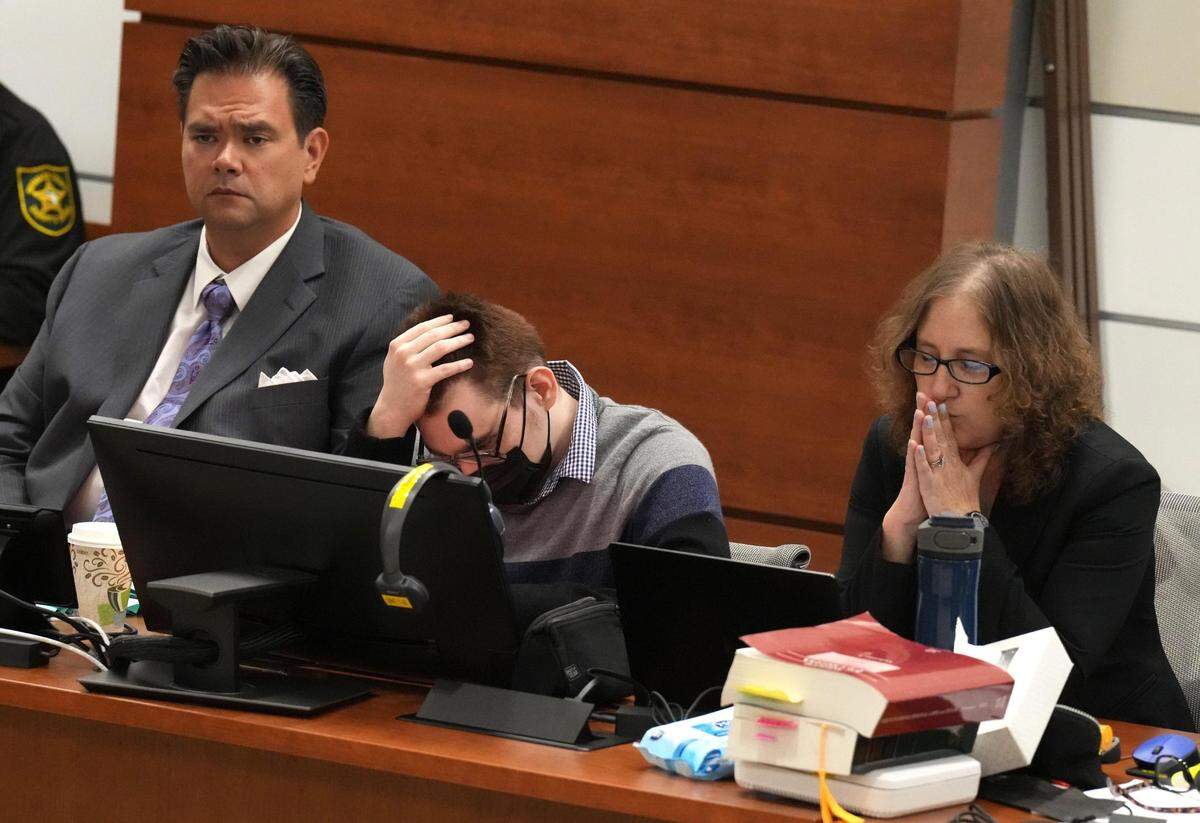
The jury will eventually decide whether prosecutors have proved “aggravating factors,” such as the massacre being “heinous, atrocious and cruel,” outweigh the “mitigating” details of Cruz’s tumultuous upbringing, purported brain damage and mental-health woes.
The Broward Public Defender’s Office on Monday declined to make an opening statement.
“It’s risk/reward,” said Miami death penalty defense attorney Philip Reizenstein, who is not involved in the case but watched in Broward court on Monday. “The jury is left now with only the version of the case that will stay with them for at least a month. The reward is that closer to their case, once the state rests, they get to tell the jury their side and get right to their witnesses.”
Also, the defense’s case may not be totally crystallized. Future hearings are still scheduled over whether certain “brain-mapping” testimony and certain experts can be presented to jurors during the defense’s case.
The Public Defender’s Office is also asking for a delay in putting on their case because one of their witnesses, an expert in alcohol fetal syndrome, has fallen ill.
The first day of the long-anticipated trial was marked by the dramatic retelling of that terrible day.
Satz, the retired elected State Attorney who remains the lead prosecutor on the case, told jurors about the three cellphone videos made by Cruz days before the shooting. In the clips, he promised to kill at least 20 people in becoming “the next school shooter.”
Then, jurors heard, Cruz took an Uber to the sprawling campus, carrying a black bag. Inside a stairwell, he readied his AR-15, telling a student who happened by to leave because “something bad” was going to happen.
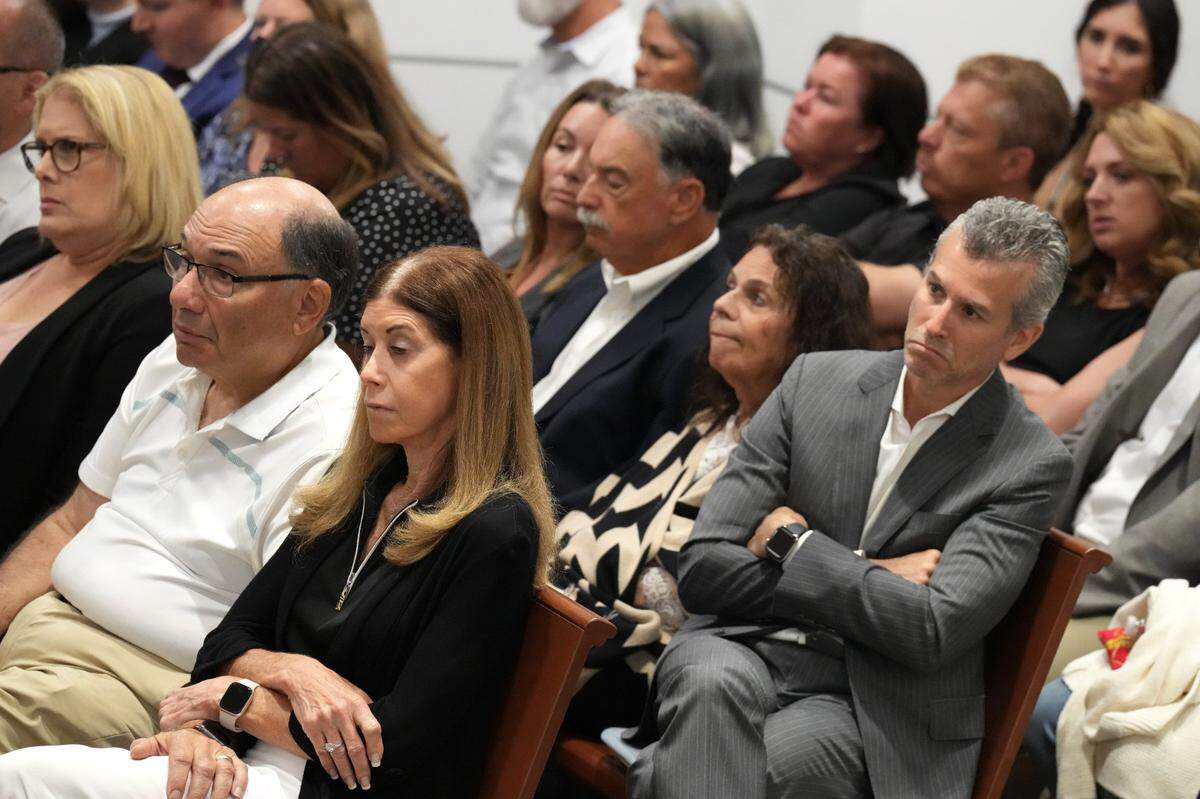
As relatives in the courtroom dabbed their eyes with tissues, some looking distraught, Satz recounted that killing spree with precision: the dimensions of the windows, each classroom number, the subjects taught by each of the teachers, the percussion of the AR-15 rifle sparking the fire alarm.
He recounted the name of every victim, how many times each was shot, and where they died, most on the campus, two at the hospital. Some victims Cruz targeted again, even as they lay on the ground, mortally wounded. “One hundred and thirty nine rounds were fired,” Satz said.
The state’s witnesses were all survivors of the carnage who helped memorialize their experiences.
The first one, English teacher Brittany Sinitch, was in her class as students made Valentine’s Day cards. She called 911, a recording of which captured some gunshots and was played for jurors. “The loudest noise you can ever imagine,” she recalled.
Former students Gilbert and Dylan Kraemer testified about their videos — one of which sparked the outburst by a relative of murder victim Helena Ramsay. The defense asked for a mistrial, saying the outburst would inflame jurors and add to “anger toward the client.” Circuit Judge Elizabeth Scherer refused.
Jurors also heard that Cruz, after the onslaught, ditched his tactical vest and rifle, then escaped among the students he had terrorized.
Satz recalled the nonchalance in which Cruz fled, blending into the fleeing crowd, before grabbing a frozen drink at a nearby Subway inside a Walmart. “He sits on a bench and drinks his Icee,” Satz said.
Not long afterward, unable to get a ride away from the scene, Cruz was arrested by a deputy just a few miles from the school.
This story was originally published July 18, 2022 at 12:22 PM.