Efforts by mom, cops didn’t matter. Violent husband still found, killed Miami woman.
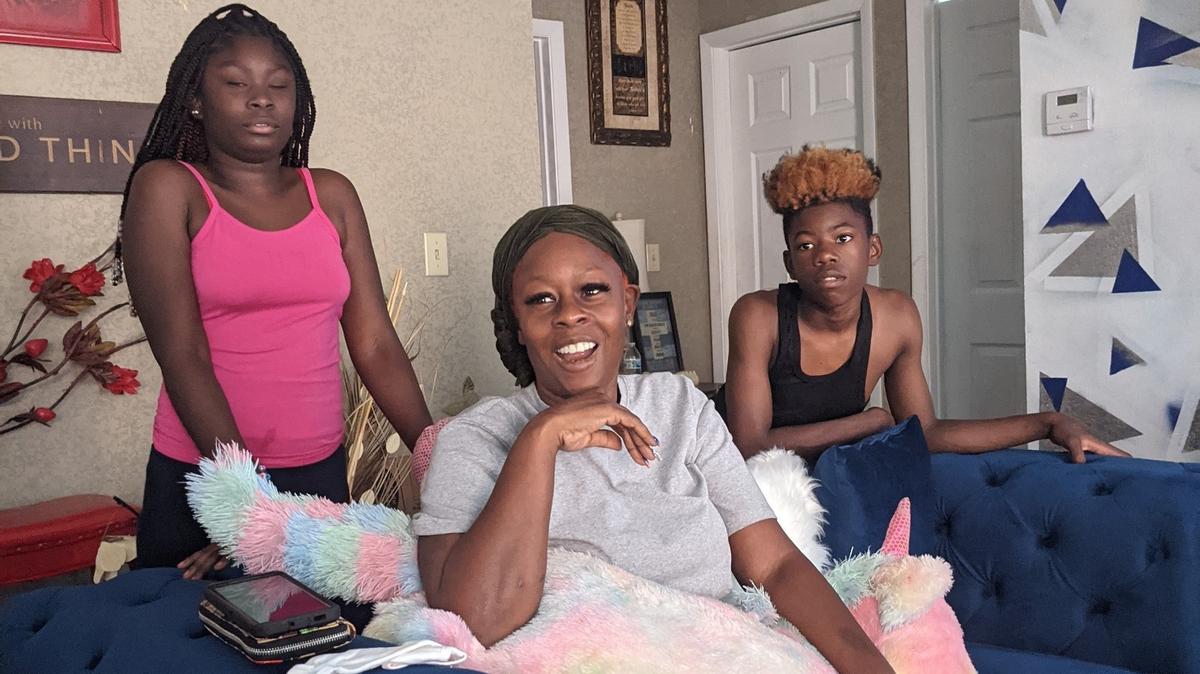
Dulcinea Harris said she did everything she could to protect her daughter Shandell from a violent and unhinged husband who had stabbed her six times with a knife.
In a frantic phone call with her daughter, she schemed to get Shandell safely into her own home in Miami. After her son-in-law agreed to bring the wounded woman over, Dulcinea Harris locked him out and called police. When an officer arrived eight minutes later, she raced outside pointing at a vehicle that Shandell’s husband, Carl Monty Watts Jr., was driving away. She then drove her daughter to the hospital, met for hours with a domestic violence detective and then took Shandell back home just before dawn.
But less than one day later, just after 2 p.m. Sunday, Watts tracked them to what the family thought would be a safe space — a public pool at the Michael-Ann Russell Jewish Community Center, where Shandell’s daughter could swim. Harris, and others at the crowded pool, watched in horror as Watts emptied his gun into her daughter after offering her a stack of cash not to press charges for the knife attack. He continued to fire as he stood over Shandell’s bleeding body.
“I saw him first. I stood up and grabbed her arm. All he said was ‘how much can I give you to make this go away?’ He said it twice. Then he shot her,” Dulcinea Harris recalled in an emotional interview on Tuesday with the Miami Herald. “He had money in his hand.”
Shandell, just 30, died in her arms — the latest victim in an extreme example of all too common cases of domestic violence.
Watts, 45, has been charged with the killing. A former garbageman with a long history of felony charges and domestic violence arrests, he has also now emerged as a potential suspect in unresolved cases involving two previous girlfriends — one murdered in Miami in 2009 and another who vanished in 2014.
In an initial review of the timeline of events, law enforcement and domestic violence experts said it appears that the family and police from two departments, the city of Miami and Miami-Dade County, took the right steps once Shandell had made it to her mother’s house. Miami-Dade police responded to Dulcinea Harris’ home eight minutes after her 2:41 p.m. Saturday call, according to department records. A few minutes later, a Miami-Dade Fire Rescue crew arrived to tend to Shandell’s wounds, which were not life-threatening.
Because the initial attack was in Miami, a city domestic violence detective arrived later to take over for the county cops who had first responded. Miami police say that detective spoke with the family at home but also went to the hospital with them, and even offered a safe place to spend the night. Police issued an alert for Watts while Shandell was still at the hospital.
Domestic violence experts said cases like Shandell’s are extremely difficult for family and police to deal with because they’re personal, passionate and unpredictable.
“I think they did all they could. They just couldn’t find him,” said Dave Magnusson, a former police chief in North Carolina and El Portal, and a former Miami police officer. “The question I always ask is, ‘What more could have been done?’ And I’m not so sure in this case. They seemed to do everything as quickly as possible and there was even good communication [between police departments].”
Alex Piquero, a criminologist who chairs the department of sociology at the University of Miami, said domestic violence is hard to prevent and almost impossible to predict.
“Domestic violence offenders are very different from traditional offenders. It’s very instantaneous and offenders are much more emotional and violence prone,” he said. “It’s almost like lighting a match or snapping your fingers. That’s why it’s so hard from a policing perspective.”
A family mourns lost mom and daughter
Tuesday afternoon family members gathered to remember Shandell at her mother’s Brownsville home, a single-family unit filled with art deco-colored retro furnishings, not far from the neighborhood’s industrial center. Some of her five brothers and sisters were there, as was her 11-year-old daughter Simiyah, who didn’t want to talk about her mom’s death and who said she went to Sunday pool lessons to “learn how to stay safe in the water.”
The family said it didn’t know Watts well and that Shandell rarely if ever spoke of problems. Shandell’s younger brother Isaiah said Watts had at least three cars, one of them a black Challenger and another, a white Nissan SUV that he sat in outside the home Saturday night as he stalked Shandell the day before she was killed.
A Friday night argument sparked rage
The events that led to her death began late Friday night with a fight over cellphone messages, in a small Shorecrest apartment on the edge of Biscayne Bay she shared with Watts. Shandell was so upset, her mother said, that she didn’t sleep well and by 7 a.m. announced she wanted a divorce.
Police reports recounted Watts’ violent response. Shandell told police that her husband punched her on the left side of her face before using a kitchen knife to stab her six times on her left forearm, hand and thigh. Then he held a gun to his head and said he couldn’t live without her.
She told police she talked her husband down by telling him she loved him. Watts cleaned his wife’s wounds with some “crude” form of first aid, then bleached the bloody apartment and gathered and burned her bloody clothes in a field about a mile away. That was followed by a trip to the Dollar Store and Walgreen’s, where Shandell told police she managed to sneak in a cellphone call to her mom and devise an escape plan.
When Shandell told Watts they needed to pick up her daughter and take her to her mom’s home, he agreed. Once there, Shandell and Simiyah raced into the home and secured it before Watts could get to them.
The first call to a 911 Miami-Dade operator, according to police, was at 2:41 p.m. Before an officer arrived eight minutes later — the family said it felt much longer — they called police again after seeing Watts standing outside the kitchen window with a black gun in his hand.
“It was the same black gun,” Dulcinea Harris said, thinking back to her daughter’s death. “I jumped back.”
The only complaint the family had with the police was with the first Miami-Dade officer who arrived. Dulcinea Harris said he came to a stop just a few feet from Watts’ SUV and that she ran out to tell him after Watts drove right past the patrol car at a very slow speed as he headed away. Watts was still within view, she said, when she told the officer, who by then was out of his vehicle.
“He walked toward the house. He just completely ignored us,” she said.

Miami-Dade police said the officer called paramedics at 2:58 p.m., and they arrived within seven minutes, treating Shandell’s wounds and offering her a ride to the hospital. Shandell turned it down. Some of the wounds were superficial, others required stitches.
Not long after that, Miami-Dade police were relieved by a Miami domestic violence detective who provided pamphlets, hotline numbers and the offer of safe shelter that night. When Shandell said it wasn’t necessary, the officer drove with them to Jackson Memorial Hospital and stayed with them for a while.
“She was awesome,” Dulcinea said of the detective.
Miami police records show the detective filed her incident report by 6:55 p.m. Saturday night and that two hours later a probable cause message was issued to other police agencies in Miami-Dade to watch for Watts. Miami Assistant Police Chief Armando Aguilar Jr. said the probable cause message would have alerted police to the vehicle Watts was driving and his criminal history. Also notified that night was the agency’s domestic violence apprehension unit.
Trying to elude an angry husband
Dulcinea said she left her daughter at the hospital with a sister and returned home to be with other children. She returned to Jackson after 4 a.m. to pick them up. She believes she was followed by Watts — probably in a black Challenger he owns — to and from the hospital. Though she said she finally lost him when she pulled alongside a group of police cars on the way home.
Early Sunday morning Miami’s apprehension team pulled up to the Shorecrest home where Watts lived. He wasn’t there and neither were any of his vehicles. Then the team searched a grid of places he would most likely be based on information from Shandell and information they gathered.
Dulcinea stayed home with her daughter through Sunday morning and into the afternoon. At about 2 p.m., she headed to the community center pool at 18900 NE 25th Ave., with Shandell and Simiyah. Watts found Shandell there, unfortunately, before police found him.
Shandell’s younger brother Tyrel Harris, 29, said the family really didn’t know all that much about Watts. Watts met Shandell about three years ago and Dulcinea said she was aware Shandell was preparing for the couple’s first anniversary.
Tuesday, outside of his mom’s place and just before she got home and after running errands with a child, Harris recalled how he and his sister were planning on making a mixed-tape, his rapping overlaid by poetry Shandell had written.
He said his sister never spoke to him about any problems she might have been having with Watts, but since the murder he’s realized friends and family may have missed clues, like when she asked someone if they’d take care of her daughter if something happened to her.
“They just didn’t read between the lines,” he said, before lowering his head and saying he thought they were safe inside the home. “I didn’t want them to go to the pool. I thought they were safe here. My mom called me and said they left the house and they were on the way there. I was worried because he knows her schedule. The next time I talked to her, my sister is dead.”
This story was originally published April 5, 2022 at 8:22 PM.