
Will Florida’s anti-riot law change police posture? There’s a wide range of opinion
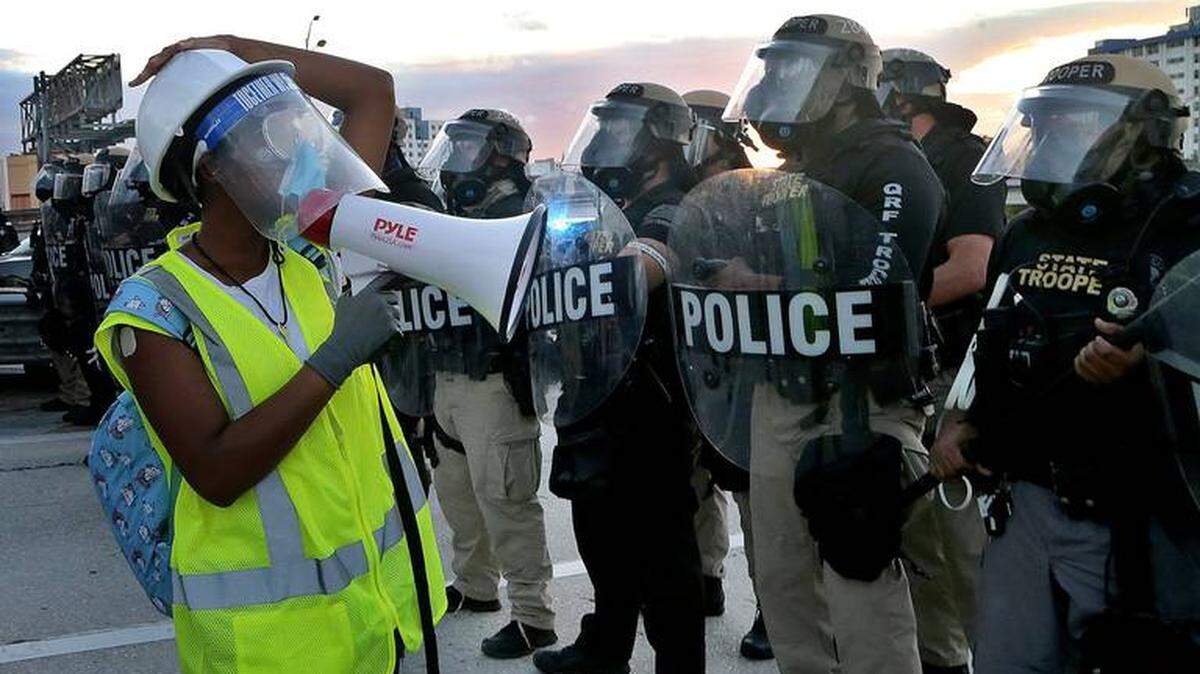
Like most major U.S. cities, Miami was the scene of weeks of protests last summer after the police killing of George Floyd in Minneapolis sparked a national reckoning over race and law-enforcement treatment of minorities. There were sporadic clashes, one night of looting, dozens of arrests and plenty of tension, but Miami-Dade County was largely spared the widespread unrest that hit other states.
But while local police departments were credited for avoiding the escalation of tensions, civil-rights activists worry that Florida Gov. Ron DeSantis’ controversial “anti-riot” law could spur officers to take a more heavy-handed approach during future gatherings.
In addition to enhancing criminal penalties for crimes committed during protests that turn violent, the bill allows business owners to sue municipalities if their property is damaged during a riot — something that critics fear may weigh on police departments when making strategy calls on how to respond to gatherings.
“If I’m a police chief, I’m going to be on edge,” said Miami criminal defense lawyer Michelle Estlund, who praised local police departments for acting with restraint last summer. “It’s going to make police a little more aggressive. It’s a shame. It takes the authority of the departments to govern or police the way they think is appropriate.”
The concerns were raised Tuesday, even as a jury in Minneapolis convicted ex-cop Derek Chauvin for Floyd’s death. No protests formed in Miami, although departments countywide had been on alert in case tensions mounted over a possible acquittal.
Art Acevedo, the new police chief in Miami, where most of the summer protests happened, couldn’t be reached for comment on Tuesday night. In comments to the Herald Editorial Board last week, Acevedo signaled he would want a cautious and “hands on” approach” — meeting with protesters himself to de-escalate tensions while “isolating” people who are acting violent.
“We will support everyone’s right to protest,” Acevedo told the Miami Herald, adding: “I do not like the widespread use of chemical agents, like tear gas.”
Miami-Dade Police Director Alfredo “Freddy” Ramirez on Tuesday sought to allay concerns about the bill, saying it won’t change “how we approach these situations.” He said the department, which played a supporting role as most of the protests were in downtown Miami, wants to “protect lawful protesters” and “bad actors will be dealt with accordingly.”
“We’re not here to suppress lawful protests. That’s not going to happen,” Ramirez added. “This is a very diverse, special community. We’re different from the rest of the state. You don’t have issues here.”
A bill of controversy
Critics say DeSantis’ bill is nothing more than a political ploy, a way to attack the Black Lives Matter movement and squelch peaceful assembly and free speech. DeSantis, a Republican, is widely expected to explore a presidential bid in 2024, and he’s running for reelection as governor in 2022.
The bill enhances penalties for some crimes committed during a “riot,” including burglary, theft, assault and battery of a law enforcement officer. It also creates the crime of “mob intimidation,” as well as prohibitions against pulling down or defacing a memorial or statue, at a time when cities around the nation have been removing Confederate monuments from public spaces.
The bill also allow authorities to hold arrested protesters until a first court appearance, and establish new felonies for organizing or participating in a violent demonstration. Florida’s GOP-controlled Legislature passed the bill, HB 1, by comfortable margins in both the House and Senate.
DeSantis signed the bill into law on Monday in Polk County, where he proposed the idea last September.
“I proudly signed HB 1 into law, which makes clear that rioting and violence have absolutely no place in Florida and provides protections for the brave men and women who keep our communities safe,” DeSantis tweeted Monday.
Miami Beach Rep. Michael Grieco, who serves as the Democratic ranking member on the Criminal Justice and Public Safety Subcommittee, said the bill’s language is “dangerously vague” and could implicate peaceful protesters who attend a rally that becomes violent.
“It unfortunately would empower law enforcement to cast a net over everybody and have them stuck in jail for a day,” Grieco said.
Last summer
In Miami-Dade, the most tumultuous night last year came on May 30, when some protesters clashed with officers outside the Miami Police Department, torching several patrol cars and looting some stores at Bayside Marketplace.
The law also stiffens penalties for people “for willfully obstructing” a roadway or highway. During the protests over the summer in Miami, it was not unusual for protesters to march up onto Interstate 95, which officials often shut down in anticipation of the maneuvers. Even with the new law, Florida Highway Patrol troopers, as do all police, have discretion on whether to arrest people who have assembled onto the highway, or persuade them to leave.
“Our approach won’t change. We’re going to do our best to not allow people to get on the highway,” Miami FHP spokesman Lt. Alejandro Camacho said Tuesday.
Miami police, by mid-July, began cracking down on smaller groups of protesters when they began obstructing roadways. Over the summer scores of people were arrested for minor crimes, such as unlawful assembly, obstructing roadways and breaking curfew, although the Miami-Dade State Attorney’s Office ultimately dropped the majority of the charges.
Detectives later identified and arrested people suspected of attacking police officers or torching patrol cars. Many of the cases did not result in major prison time. In one high-profile case, a rapper named Marco Antonio Lopez, who was accused of vandalizing a police car, this week was accepted into a “pre-trial diversion” program that, if completed, will see the charges dropped.
In another case, a City of Miami police officer became a mentor to the teen who hit him over the head with a skateboard.
A spokesman for the Miami-Dade State Attorney’s Office did not want to speculate on whether the new law might affect arrests and prosecutions.
“Every criminal arrest involves very specific circumstances and unique evidence,” spokesman Ed Griffith said in a statement. “It is the factual evaluation of those circumstances and of that unique evidence which determines whether a prosecution can or should go forward.”
‘Trying to rile up his base’
The passage of the bill nevertheless unnerved some in South Florida’s criminal justice community who fear how it may play out on the streets.
Rachel Gilmer, the co-director of Miami’s Dream Defenders, which organized various protests last summer in downtown Miami, pointed to the visual of the governor’s signing press conference — he was surrounded by uniformed sheriffs from upstate Florida.
“What’s scary is that DeSantis is really trying to incite police officers to criminalize protesters to the highest degree,” Gilmer said. “He’s trying to rile up his base.”
Still, some observers remained optimistic. Alexis Piquero, a criminologist at the University of Miami, said that while the bill has the potential to spur police to act more aggressively, he doesn’t think it’ll happen often.
“Police already are trained to deal with mass gatherings and for the most part do it well,” Piquero said. “What we saw last summer in just about every protest including here in Miami were peaceful protests with people exercising their right to do so and most of those individuals were not committing crime, especially when you compare this to the Capitol insurrection.”
Melba Pearson, the policy director at Florida International University’s Center for the Administration of Justice, said she was “cautiously optimistic” that the bill would not embolden local police to go overboard with protest crowds. Part of the reason: Tuesday’s verdict in the Floyd case.
Said Pearson: “In light of this bill passing, plus the verdict, departments may be less likely to bring out SWAT or heavy-handed tactics, especially because of the momentum for reform.”
Miami Herald staff writer Samantha J. Gross contributed to this report.
This story was originally published April 20, 2021 at 8:21 PM.