
Miami-Dade jury trials to resume March 1 though spread of COVID-19 variant a concern
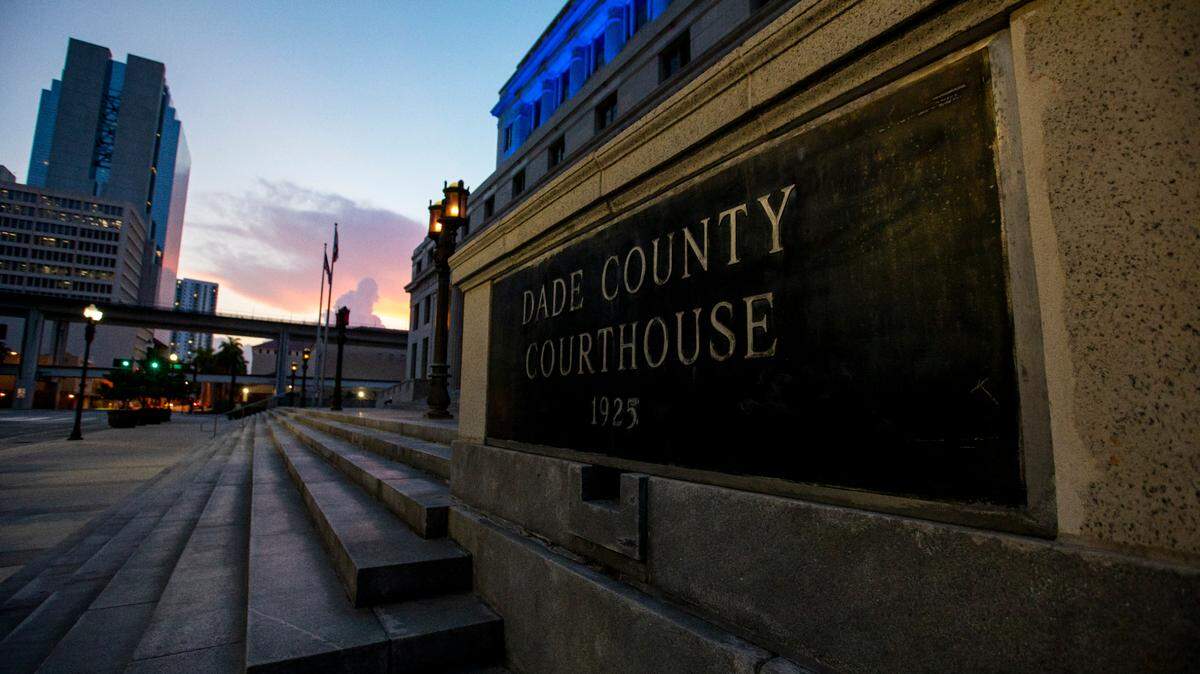
In-person jury trials in Miami-Dade County will resume March 1, officials announced, nearly one year after the courts shut down because of the coronavirus pandemic.
The announcement by Chief Judge Bertila Soto comes as the number of coronavirus cases has dipped and more people are being vaccinated — but also as the so-called “U.K. variant” of the virus, thought to be significantly more contagious, is taking an alarming hold in Florida. The new date for jury trials in Miami comes as the jails population has mushroomed back up to about 4,000 inmates, around the number from before the pandemic.
Soto, in an interview, said health experts consulted by the courts are confident that the positivity rate is low enough and safety precautions sufficient to start jury trials, despite the new strain. She cautioned that the civil and criminal courthouses will still be largely empty as remote hearings continue — and no more than three trials per building will take place at any given time.
“We decided it was time,” Soto said. “Plenty of people are waiting for their day in court.”
Hours after Miami-Dade’s announcement, Broward County’s courts said they would begin limited face-to-face jury trials on March 8.
As with other public spaces, Miami-Dade’s courthouses were largely shut down in mid-March as the highly contagious virus swept across the globe.c
The Florida Supreme Court on March 13, 2020, suspended jury trials and speedy trials, while the system contracted with Zoom, the now-ubiquitous video-conferencing service, to start holding virtual hearings. The Miami-Dade criminal justice building, which is notoriously cramped and aging, has remained largely closed to the public, although clerks and judges have been working there while conducting Zoom hearings.
Despite the proliferation of virtual hearings, the backlog of cases across Florida has been staggering.
Florida Supreme Court Chief Justice Charles Canady told the House Judiciary Committee last month that trial courts have about 1.1 million pending cases, and an additional 145,000 cases such as evictions and foreclosures are expected to be filed as a result of the economic downturn brought on by the pandemic.
Even in jurisdictions where jury trials have resumed, progress in reducing the backlog has been “very slow,” Canady said.
“While remote proceedings have been successful for a great deal of court activity, lawyers and their clients for a variety of reasons are less enthusiastic about participating in remote jury trials in whole or in part,” Canady said.
The backlog is particularly acute in Miami-Dade, the county’s most populous county. The State Attorney’s Office reported at the end of 2020 that its total criminal caseload jumped from 34,152 to 52,842 cases — a staggering 54.7% increase.
“With arrests trending upwards toward pre-COVID levels, we anticipate the caseload to climb even more rapidly during the next few months,” Miami-Dade State Attorney Katherine Fernández Rundle wrote in a letter to local lawmakers. “We will face crushingly high caseloads by the time the courts fully reopen.”
To try and chip away at the backlog, a task force of court and county officials, prosecutors, defense lawyers and health experts has been meeting regularly to plan how criminal jury trials might unfold safely in Miami-Dade.
Even as jury trials have resumed in other parts of the state, Miami-Dade court officials had hoped to resume jury trials in late 2020, on a limited basis. But no cases could be found to be tried — and the holiday surge of COVID-19 cases forced the courts to again suspend trials through Feb. 28.
Since January, COVID-19 cases have dropped about 50% from an average of about 16,000 per day. And the number of people being treated for the illness in Florida hospitals has declined by about 30%, from a mid-January peak of about 7,770.
But the more contagious B.1.1.7 variant, also known as the U.K. variant of the virus, is flourishing in Florida. Recent studies by private researchers and federal officials predict it will be the predominant strain of the COVID virus in Florida by March, and could accelerate illnesses and deaths before enough people are vaccinated.
In the Miami-Dade criminal division, officials have identified 30 cases that are ready to go to trial on March 1.
Potential jurors at the Richard E. Gerstein Justice Building will be asked to register online or by phone, to help select smaller pools who would be able to serve. Jurors will be selected from in-person pools of about 30 to 35 candidates.
Everyone in court will have to wear masks and regularly wash or sanitize their hands. To maintain social distancing, each trial will utilize three courtrooms — one for the proceedings, one for lawyers to meet with clients and witnesses, and one for the jurors to take breaks and deliberate.
“We know our jury rooms are woefully inadequate in our courthouses,” said Circuit Judge Nushin Sayfie, who heads the criminal division and will become the chief judge on July 1.
Some meals will be available for jurors through the building’s two cafeterias, and jurors will be encouraged to bring their own meals. Trials will also be live streamed on YouTube, court officials say, to comply with the public’s right to attend.
“There is certainly legitimate concern about beginning trials, but one thing we don’t do as criminal defense lawyers is run away from hard things,” said Jude Faccidomo, the president-elect of the Florida Association of Criminal Defense Lawyers, who is on the task force in Miami-Dade. “Provided that safety is the guiding principle, the effort to begin in March with at least a single trial is a laudable one.”
Despite the precautions, some members of the legal and health communities remain wary about jury trials starting back up.
Criminal court proceedings are considered a “relatively high risk activity” because they are held indoors and over extended periods of time, said Eric Toner, a senior scholar at the Johns Hopkins Center for Health Security.
Though officials may be basing their decisions on improving metrics in reported coronavirus statistics, Toner warned that it’s impossible to predict what those numbers will look like three weeks from now, especially given the spread of the more infectious variant.
“I can imagine that they are looking at the daily case counts, which in fact are going down nicely, but it’s also true that the percentage of cases that are due to the B.1.1.7 variant are increasing very rapidly,” Toner said. “I think it would be prudent for them to be very cautious and either delay opening a bit to give it more time, or be prepared to pivot 180 degrees if in fact cases start to rise again.”
Miami defense lawyer David Edelstein said he does not feel comfortable going back to trial.
“If you look at the advisories the courts are putting out, it seems like every other day another person who was working at the Gerstein building is testing positive,” Edelstein said. “It seems like it’s going to get worse with this British variant.”
Miami Herald staff writer Ana Ceballos contributed to this report.
This story was originally published February 10, 2021 at 12:32 PM.