
Judges can’t ban ‘nuisance’ criminals from being in parts of Miami Beach, court rules
Eric Freshman has spent years living on the streets of Miami Beach. Time and again, police officers have arrested him, accusing him of crimes such as trespassing, drinking in public, disorderly conduct and threatening cops.
After one arrest in 2018, he pleaded guilty to get out of jail — and a judge ordered him to stay away from a large swath of South Beach. The following year, he spent 57 days in jail after Miami Beach police officers caught him walking in that restricted area.
But an appeals court has now ruled that judges cannot issue such “stay away” orders banning people from the streets as part of their final sentences.
“There has to be stricter scrutiny on the government’s behavior when it comes to restricting someone’s right to movement, to go where they want to go,” said Miami-Dade Public Defender Carlos Martinez, whose office represented Freshman.
The ruling in Freshman’s case effectively ends what has long been a practice of punishment in Miami-Dade criminal court, and underscored yet another tension point between Miami Beach businesses and residents and the homeless population that often cycles in and out of the justice system.
Miami Beach, a city built on tourism, has long grappled with its transient population and so-called nuisance crimes. The issue was not lost on one of the judges who ruled in Freshman’s case.
“While victims of ‘nuisance’ or ‘quality of life’ offenses beg — no demand — that prosecutors and judges keep repeat offenders out of their businesses and communities, the judicial system is constrained as to how much it can do under the law,” Miami-Dade Circuit Judge Daryl Trawick wrote in a concurring opinion.
The Miami-Dade State Attorney’s Office, like its counterparts in many cities across the country, has moved away from seeking jail time for low-level offenses.
In response, Miami Beach two years ago hired a municipal prosecutor to crack down on public drunkenness and the rowdy atmosphere that often unfolds in the city’s entertainment district. Last year, a Miami Herald analysis found that the majority of those being arrested under the city’s new program were homeless people, not tourists.
In another controversy, the city this spring banned panhandling near businesses during the COVID-19 crisis, a move that outraged the Greater Miami chapter of the American Civil Liberties Union.
Exactly how many current “stay away” orders in Miami-Dade County are on the books is unknown.
In Miami Beach, Mayor Dan Gelber said the city had stopped seeking “stay away” orders over the past year. But he said officials are now exploring what else can legally be done to restrict repeat offenders.
“We need to address the revolving door of predators coming back to these areas to prey on visitors,” Gelber said.
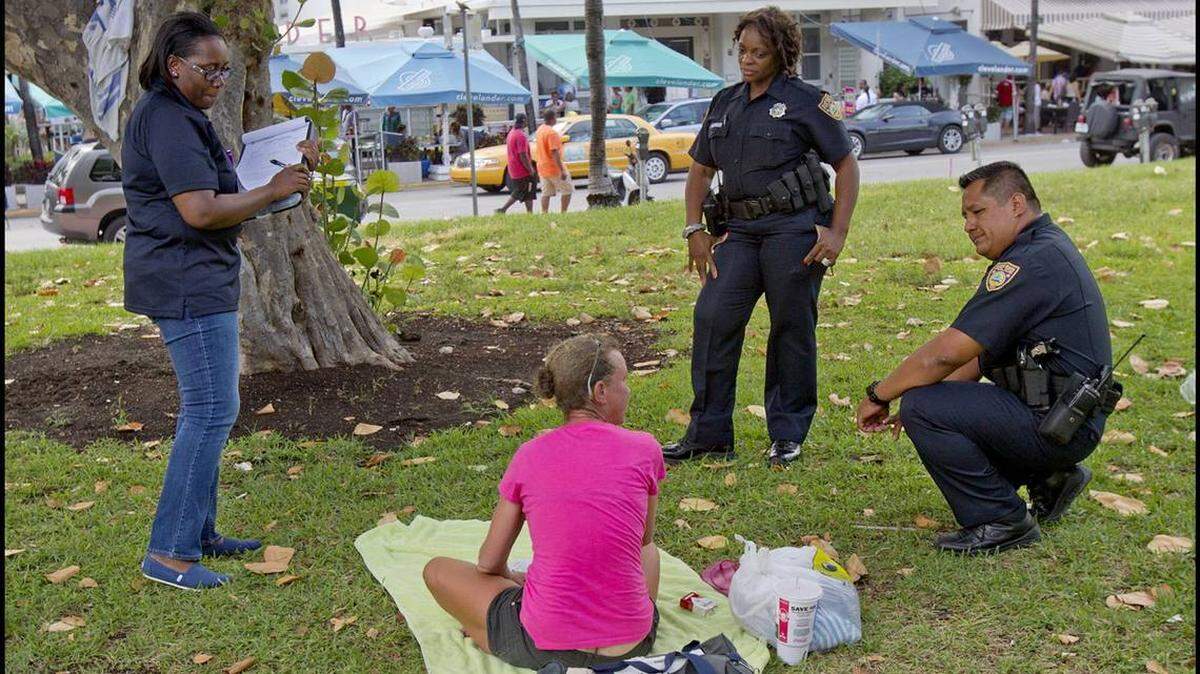
Miami Beach Police Chief Rick Clements said he does not believe the appellate ruling in Freshman’s case will change much for cops on the streets. A squad of Miami Beach police officers is dedicated to helping the homeless, and also works with groups to find them shelter. He said people who break the law will still be subject to arrest.
“Our strategy is not going to change,” Clements said. “We’re still going to go out and enforce the law. We always try to find a humanitarian course to take.”
‘Arch Villain’
Freshman, 49, is well-known on South Beach. Records show he’s been arrested dozens of times since the early 2000s for petty and at times violent crimes, generally trespassing, drug possession, loitering and prowling, disorderly intoxication and battery.
Mitch Novick, the owner of the Sherbrooke Hotel on Collins Avenue, has railed publicly for years about the raucous atmosphere on South Beach and called Freshman a “troublemaker.”
“He’s an arch villain. He’s a bad guy who continually goes through the wheels of justice and returns back here,” Novick said.
The case that earned Freshman a stay-away order happened on Oct. 28, 2018, when Miami Beach police said he began berating a vendor selling at a stand on the beach-side boardwalk at 17th Street. The vendor began video recording Freshman with his phone. Freshman struck the man’s hand, then ran off — only to be arrested a few blocks away.
While being arrested, police said, he began yelling that he would smash officers’ skulls with a rock. “Freshman began simulating with his fingers as if he had a rifle and began aiming at [officers] while stating ‘a bullet will crush you through your skulls,” according to an arrest report.
Freshman pleaded guilty and accepted 60 days in jail. At sentencing, Miami-Dade County Judge Joseph Mansfield ordered that he stay away from the area south of 17th Street, from the ocean to Biscayne Bay. Early last year, after Freshman requested the order be amended, the judge allowed him a “route of travel” along Alton Road and Collins Avenue.
Then, in July 2019, Freshman was arrested for trespassing after police found him on the 800 block of Ocean Drive “within the boundaries of [the] area from which he was enjoined to stay away.” Freshman pleaded guilty to contempt of court and got credit for the 57 days he’d spend in jail.
The Public Defender’s Office soon launched its appeal.
Judges in Miami have long issued “free-standing” stay-away orders for whole blocks or neighborhoods in cases in which defendants don’t take probation, but simply complete jail terms. Defense lawyers have argued that the restrictions are overly broad and often have nothing to do with a crime — a contrast would be when a stalker is ordered to stay away from his victim’s house.
“This issue is not a new issue. We have been dealing with this issue for at least 18 years,” said Public Defender Martinez.
The appeals court — made up of three Miami-Dade circuit judges — didn’t actually weigh in on whether bans of such large geographic scope are constitutional.
Instead, the panel ruled that Florida sentencing laws do not allow judges, in the case of someone getting convicted of a misdemeanor, to “fashion injunctive relief for a city troubled by a defendant who has become a nuisance,” Circuit Judge Lisa Walsh wrote in the 11-page opinion.
The problem of probation
There are other ways to keep problem defendants out of certain areas. Judges can, temporarily anyway, order a trespassing defendant to stay away from where they were arrested as part of their “pretrial release” from jail.
And prosecutors and courts can seek geographic restrictions as part of probation, which in misdemeanor cases can last up to one year.
State Rep. Michael Grieco, a defense lawyer and former Miami Beach commissioner, said he’s been telling the police department for years that stay-away orders are unenforceable unless a probation officer is assigned to actively monitor someone.
“The court can not maintain perpetual jurisdiction over a person to ‘stay away’ from places. This was a no-brainer for the appellate court,” Grieco said. ”The desired result, which is to keep bad guys away from Ocean Drive, can be achieved by putting them on probation.”

But there’s a legal Catch 22: One of the reasons these “stay away” orders have persisted for so long is that homeless people don’t have fixed addresses needed by probation programs.
“These people are not typically sentenced to probation because it’s not an effective sentence,” said Benjamin Waxman, a board member of Miami’s ACLU who has worked for decades on legal efforts to protect the rights of the homeless.
“Ultimately, you need people to be at a place where they can be checked in on. Having a place to reside is a way to hold people accountable to the conditions of probation.”
Judge Trawick went further, writing that the Florida Legislature needs to fix sentencing laws because repeat offenders know the stay-away orders can’t be enforced.
“Disregard of court orders should never be tolerated in a society of laws,” he wrote. “This is even more problematic when the orders are mean to benefit crime victims. The clock is running and the ball rests not with the judiciary, but in the hands of the State Legislature.”
Waxman, of the ACLU, believes lawmakers need to focus on finding jobs and shelter for the homeless, not giving judges more power to ban transient people from the streets.
“I think, in the end, any effort like that in the Legislature may run headlong into constitutional rights,” Waxman said. “I’m not so certain there is an easy or quick legislative fix. We need to deal with the social issue of homelessness.”