She was a city accountant about to retire. After 17 years, her suspected killer is on trial.
When he was done, the killer locked the door.
That simple act helped detectives immediately zero in on Eugenio Fariñas as the person who savagely beat his girlfriend, Gladys Jorge, to death inside the South Miami house they shared back in 2003.
Seventeen years later, Fariñas went on trial Wednesday, accused of murdering Jorge, a 57-year-old city of Miami accountant who had been on the verge of retiring.
“There is no sign of forced entry. The house was not ransacked,” Miami-Dade prosecutor Kim Rivera told jurors during opening statements., adding: “He never came home that day. He never went to her funeral. He never came back to that house to retrieve any of his belongings.”
But Fariñas was not charged until 2015, after advancements in DNA testing found his genetic material on bloody items at the crime scene, Rivera said.
Jurors, however, heard a different story from Fariñas’ defense team.
There were at least three other former lovers who could have been to blame, defense lawyer Brian Kirlew told the jury. One of them was “madly in love” with Jorge, who had him arrested after he stole her credit card and ran up debt in her name, he said.
“He showed up at the scene of the murder within hours of the body being discovered,” Kirlew said.
Kirlew said the DNA results are not precise enough to implicate Fariñas, and his genetic material was in the house because he lived there. “DNA doesn’t prove when it got there, how it got there,” Kirlew said.
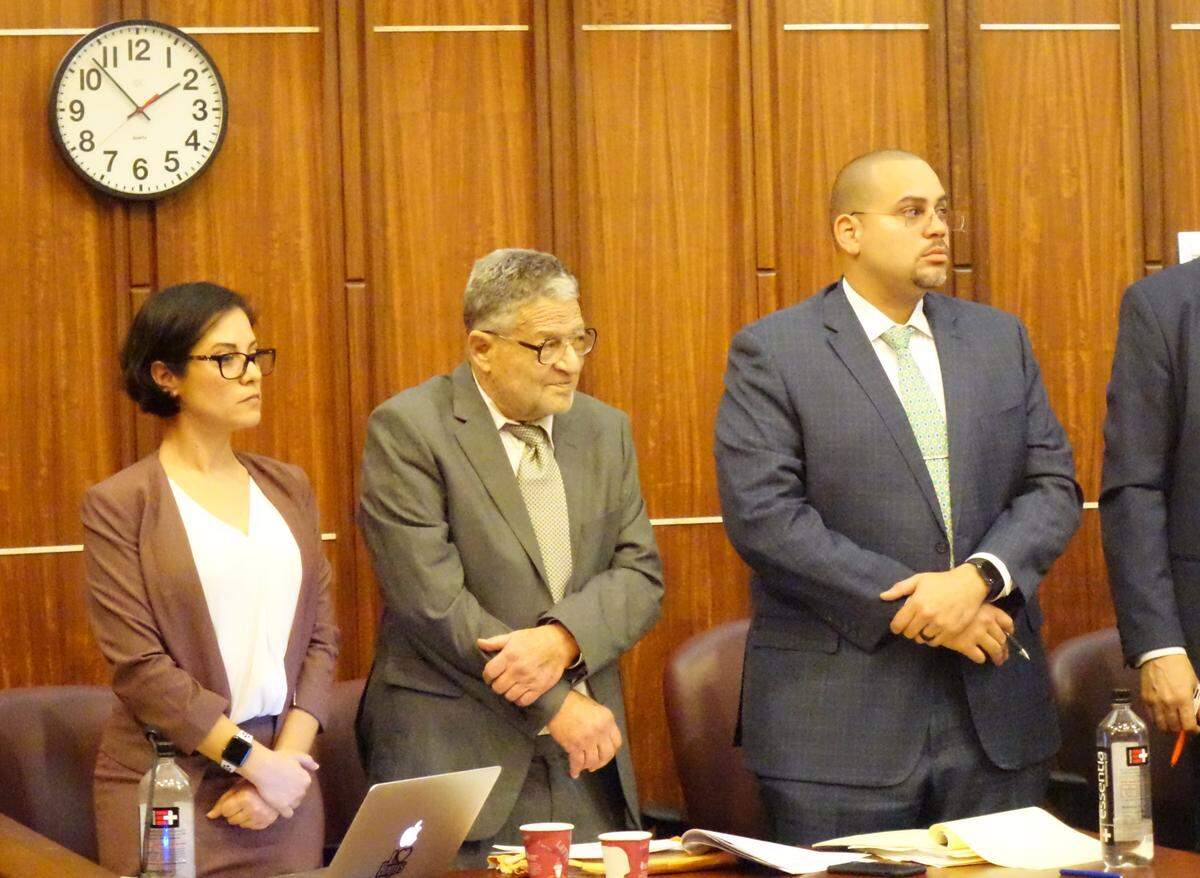
Fariñas is elderly now, 76 years old with thick square glasses. He faces life in prison if convicted of second-degree murder with a deadly weapon. Prosecutors suggested the weapon was a dumbbell found broken inside one of the bedrooms.
Jorge was a well-respected financial administrator for the city of Miami. Her daughter, at the time, was an assistant Broward public defender.
She had dated Fariñas for a couple years. He moved in with her. Jorge’s sister, Sylvia Ortega, told jurors they had a “rocky relationship” — a comment later stricken from the record because the judge ruled the woman did not directly witness any strife between the two.
Family in 2003 told the Miami Herald that Jorge had wanted him to move out.
Jorge’s mother lived next door and discovered her body on July 15, 2003, inside her South Miami home on the 3900 block of Southwest 61st Avenue.
From the start, Miami-Dade homicide detectives targeted Fariñas.
The killer had locked the door before leaving. Besides Jorge’s mother, the only person with a spare key was Fariñas, the Herald reported in 2003. When Fariñas was questioned by Miami-Dade detectives, he gave them the key.
Kirlew told jurors that there’s no evidence that he had the only other key.
The other key clue: Miami-Dade police got a 911 call the morning after Jorge was murdered. The caller said “someone might be injured” at Jorge’s house. Investigators traced the call. It came from the law office of Allan Knight, who had represented Fariñas in an earlier divorce, the Herald reported in 2003. The judge also ruled against jurors hearing that information.
Even though Fariñas remained the sole suspect, authorities did not have enough to charge him.
It was not until December 2014 that cold-case detectives ordered another analysis of DNA samples taken from bloody socks, underwear and a towel found at the scene, according to police.
The trial continues before Miami-Dade Circuit Judge Charles Johnson.
This story was originally published February 27, 2020 at 6:00 AM.