No signs, no gate, few guards: Are Mar-a-Lago intruders actually trespassing?
The lack of security infrastructure at President Donald Trump’s Mar-a-Lago club seemingly contributed Wednesday to the exoneration of a Chinese woman accused of trespassing.
Lu Jing, 56, told the court Tuesday that she understood club security “didn’t want me there” after she went through the open front gate of the private, members-only club in Palm Beach on Dec. 18. She left, only to return to the president’s primary residence through an un-gated service road accessible from South Ocean Boulevard. Prosecutors called Lu’s escapade into Mar-a-Lago a “calculated decision.”
But jurors seemed to have doubts as to whether Lu knew she was not allowed at the president’s primary residence. Lu’s public defenders pointed out that the members-only club did not post signs warning against trespassing or taking photographs. There was no guard at the service road either — which is actually a staff exit marked only with a “One-Way” traffic sign.
On Wednesday, Lu was acquitted of the trespassing charge, even as it became clear during a Tuesday trial that she had twice set foot on club grounds without permission. She was convicted of a single misdemeanor charge of resisting an officer without violence.
“The result here is understandable from the perspective of the criminal law, under which defendants enjoy a presumption of innocence and the government must prove guilt beyond a reasonable doubt, including that she knew she was trespassing,” said David Kris, a former assistant attorney general for national security in the Obama administration and founder of the consulting firm Culper Partners. “But it raises a different set of questions with respect to the adequacy of physical and communications security at the facility,”
Lu’s daylong trial Tuesday notably revealed details about security at Mar-a-Lago. At one point, a state prosecutor asked Mar-a-Lago security guard Murray Fulton to point out in open court the exact location of various security cameras guarding the property on an aerial photograph.
Also disclosed: the total size of the club’s security staff (13 guards), its apparent lack of a secure perimeter and the fact that staffers maintain daily lists of members and approved guests on digital tablet devices.
The Palm Beach State Attorney’s Office did not respond to the Herald’s questions about the national security implications of such disclosures. Prosecutors declined to comment as they left the courtroom. The Trump Organization did not immediately respond to a request for comment.
Trump was not at the club on the day of Lu’s incident. Secret Service handles security when the president is in town, significantly strengthening operations.
Lu, who police said was traveling in the country on an expired visa, testified that she just wanted to take photographs of the president’s estate late last year after being dropped off at the club by a Chinese tour guide she hired online. She said she wandered through the Palm Beach club’s open and unguarded driveway entrance and onto the property. Not speaking English, she said she did not understand why a security guard walked over from another part of the property and told her to leave.
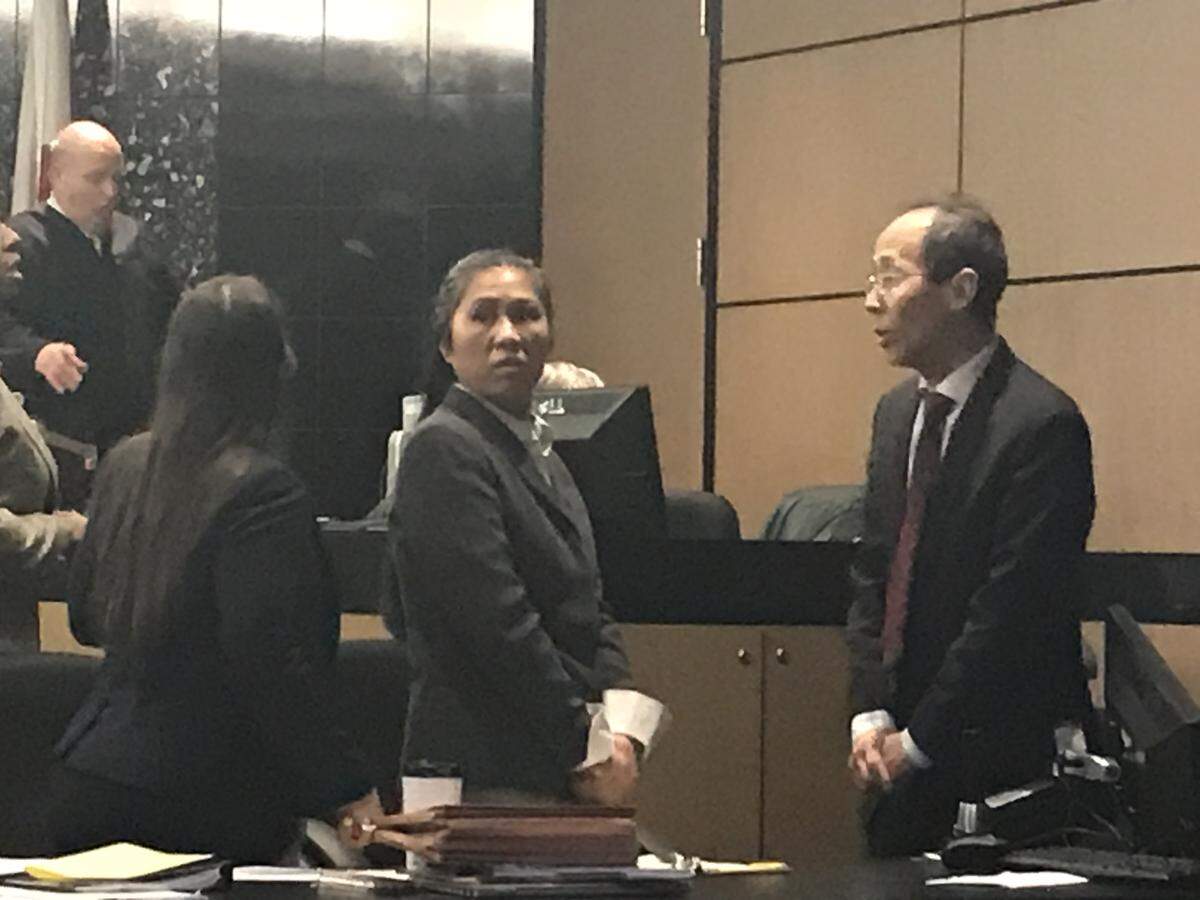
State prosecutors pointed out that Lu then came back through a side entrance, walked 125 yards onto the grounds and resumed taking pictures. Staff called police.
After leaving the club a second time, Lu’s tour guide drove her to Palm Beach’s Worth Avenue shopping district, where she was stopped by Palm Beach Police Department officers. In testimony, the cops said she would not consent to being questioned and then resisted when one tried to handcuff her.
Hampered by a language barrier, she said she was scared when the officers approached her for questioning after she left the property and did not understand what they wanted.
Lu faces up to a year in prison on the count of resisting, a misdemeanor. She continues to be held in the Palm Beach County Main Detention Center, where she has been confined since her Dec. 18 arrest. She likely faces deportation.
Her sentencing is scheduled for Friday.
Lu’s arrest came amid rising concern over potential Chinese spy activities in South Florida, which has spawned an investigation by the U.S. Attorney’s Office in Miami. That concern was heightened last year after the arrest of another Chinese tourist, who showed up toting a purse bristling with electronic devices, and after the Miami Herald told the story of Cindy Yang, a former Asian spa operator who became a Mar-a-Lago fixture, selling package tours to Chinese nationals that often led to encounters with the president or his relatives.
Trump declared the historic estate and members-only resort his primary home last year.
Only club members and their guests, as well as members of the public who buy tickets to attend events and political fundraisers, can enter the property. None of those circumstances applied to Lu, the trial revealed.
The trial featured Lu taking the stand in her defense. Speaking through Mandarin interpreters, she described herself as a confused and apparently stubborn tourist.
In cross-examination, prosecutors focused on Lu testifying that she believed the security guard who approached her at Mar-a-Lago’s main entrance “didn’t want me to be there.” Despite that, Lu nonetheless came back through a side entrance, they argued.
“This is not an honest mistake,” said Palm Beach County Assistant State Attorney Alexandra Dorman. “This was a calculated decision.”
But Lu’s public defenders, Schnelle Tonge and Jessica Vega, argued that their client had seen no signs warning against trespassing or taking photographs, didn’t realize she couldn’t be on the property and didn’t understand the hand gestures a security guard made telling her to leave. They said she thought she was being told not to take pictures at the front entrance, so she walked around the side.
Throughout the proceedings, Lu seemed hampered by her lack of English.
At an earlier hearing, she asked the judge through an interpreter: “Who is Mar-a-Lago?”
While the trial featured some confusion over the specific entity that owns the club — it is Mar-a-Lago Club, Inc., which is part of the Trump Organization, the president’s private business — the property’s ultimate beneficiary was not in doubt.
When asked in court Tuesday who owns Mar-a-Lago, the club’s director of security, Richard Cartolano, wearing a blue three-piece suit and glossy yellow tie, put it simply.
“President Trump, Donald J.,” he said.
UPDATE: Lu on Friday was sentenced to six months in jail for the resisting charge.
This story was originally published February 12, 2020 at 10:20 AM.