
Miami professor who wrote book on organized crime laundered millions in dirty money, feds say
For years, University of Miami professor and author Bruce Bagley served as a go-to quote for reporters writing about crime in the Americas. He spoke authoritatively on violent Mexican drug cartels, guerrilla politics in Colombia and violence in Haiti.
But Bagley, the feds say, parlayed his mastery of Latin American crime into a secret side job — laundering at least $3 million in dirty Venezuelan money through his own U.S. bank accounts and keeping about $300,000 as a fee for himself.
An FBI investigation culminated Monday when South Florida agents arrested the 73-year-old Bagley, shocking the University of Miami and fellow academics across Latin America.
Federal prosecutors in New York City announced a grand jury had indicted him on charges of money laundering and conspiracy after he “opened bank accounts for the express purpose of laundering money for corrupt foreign nationals.”
“Today’s charges of money laundering and conspiracy should serve as an object lesson for Bruce Bagley, who now faces a potential tenure in federal prison,” Geoffrey S. Berman, the U.S. Attorney for the Southern District of New York, said in a statement.
Bagley made his first court appearance on Monday, and was ordered to pay a $300,000 bond before being released from a detention center.
He’s scheduled for another appearance in Miami federal court on Thursday before his case is transferred to New York City.
“We’re going to diligently defend his case,” Bagley’s attorney, Daniel Forman, told the Miami Herald. “We’re confident at the end of the day he’s going to be vindicated.”
Bagley is a longtime UM international relations professor who wrote the book “Drug Trafficking, Organized Crime, and Violence in the Americas Today.” The university said it learned of the indictment on Monday afternoon.
“In light of this development, Professor Bagley is on administrative leave,” the school said in a statement. “As this is a personal matter in an ongoing investigation, the University has no further comment at this time.”
Over the years, he became a high-profile figure among the university’s cadre of experts. Bagley had appeared in newspapers such as the Miami Herald, the New York Times, and the Washington Post.
He was quoted as recently as early November in Australia’s Daily Telegraph for a story about the drug violence wracking Mexico. “This was an unmitigated debacle,” Bagley told the newspaper about a battle between cartel members and police that killed 13 people.
Bagley even served as an expert witness in court. The pharmaceutical giant Johnson & Johnson, being sued over the opioid crisis, hired him to testify about illegal fentanyl arriving in the United States from China and Mexico.
In October, Bagley took the stand as an expert witness for the defense at a major drug-trafficking trial in Miami federal court. The trial featured a Colombian syndicate accused of conspiring to ship 20 tons of cocaine into the United States.
“He’s incredibly credentialed, and he was a great witness for us,” said defense attorney Erick Cruz, adding that news of Bagley’s indictment on money laundering charges was “pretty shocking.”
As an undergraduate at the University of Miami, Cruz recalled taking Bagley’s course, “Drug Trafficking in the Americas.”
“I remember him telling the class, ‘It’s not a how-to course, it’s a historical review,’ ‘‘ Cruz said.
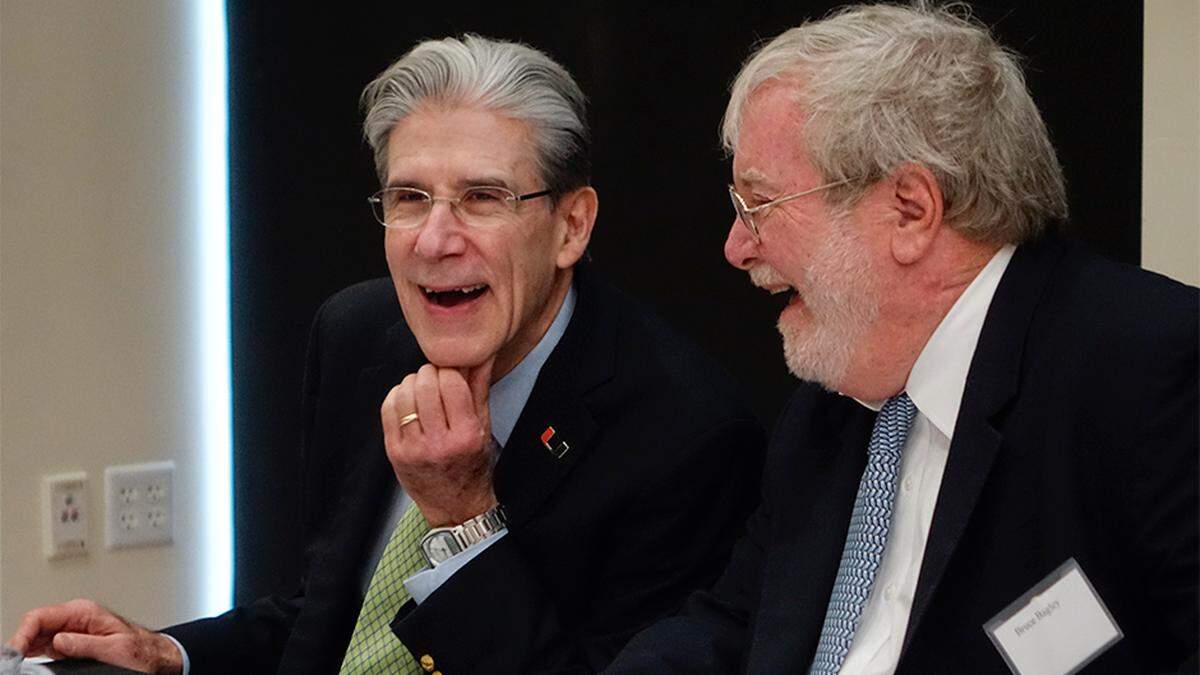
Three years ago, Bagley also organized a three-day conference at UM on climate change and energy security, an event that drew government leaders from across the world. Bagley was photographed, laughing, alongside UM President Julio Frenk.
But behind the scenes, federal prosecutors say, Bagley was raking in tens of thousands of dollars by helping wash corrupt cash. According to the indictment, Bagley used his bank accounts to collect $3 million in purported dirty money, keeping close to $300,000 for himself while turning over the rest to unnamed people.
State records show he had operated “Bagley Consultants,” along with his wife, Annette Bagley.
According to a federal indictment, Bagley in November 2016 opened up an account at a bank in Weston in the company name. State corporate records show the company was dissolved some time in the following year.
But the account remained open, going little used until about November 2017, when he began receiving monthly deposits of “hundreds of thousands of dollars from bank accounts located in Switzerland and the United Arab Emirates,” according to the indictment.
The deposits came from two companies not named in the indictment — one described as a purported food company and the other as a “wealth management firm.” Their accounts were controlled by someone described in court papers only as a “Colombian individual.”
The feds say Bagley got $200,000 from each deposit. He would then withdraw 90 percent of the funds in the form of a cashier’s check — payable to another unnamed “individual,” according to the indictment. The individual and the professor discussed they were moving the money on behalf of the Colombian and that “the funds represented the proceeds from foreign bribery and embezzlement stolen from the Venezuelan people.”
“Nevertheless, Bagley continued to receive and transfer money on behalf” of the Colombian, the indictment said.
Bagley entered into “sham contracts” to cover his tracks for the suspicious transactions, prosecutors said. Even after the account was shut down because of “suspicious activity” in October 2018, Bagley opened up a new account to launder the money, taking 10 percent as his cut, according to the indictment.
His cut was wired into his personal bank account, prosecutors said.
Bagley, of Coral Gables, was charged with one count of conspiracy to commit money laundering and two counts of money laundering. He faces up to 20 years in prison on each count.
He was charged in New York because some of the money allegedly passed through accounts in that state before it was deposited into Bagley’s company bank account.
This story was originally published November 18, 2019 at 3:18 PM.