
Miami’s top federal prosecutor makes rare appearance in court — for a minor traffic case
U.S. Attorney Ariana Fajardo Orshan, a former Miami-Dade judge, made a recent return to the state courthouse to watch a trial — involving a minor car crash.
Fajado appeared recently in support of her niece, who was the victim in a fender-bender accident in West Miami-Dade. Fajardo never identified herself on the record nor said she was the top federal prosecutor in South Florida.
But when the judge called the case, Fajardo did speak up, schooling the courtroom’s young prosecutors who appeared to be waffling on whether to proceed to trial against the woman who hit her niece’s car.
“Judge, may I address the court. We’re ready to go,” Fajardo said, according to the audio of the Oct. 22 hearing. “The issue is restitution. I told them you can reserve restitution, per statute, for 60 days to produce the deductible. They seem to think they can’t proceed forward. So I’m here on behalf of my niece, who has now missed school all day. I’m not understanding why we can’t go forward without restitution.”
Moments later, the state did agree to go to trial. Miami-Dade County Judge Jacquelyn Woodward ultimately found the driver who hit Samantha Fajardo’s car guilty of leaving the scene of the accident, but ordered no restitution because she said the law did not allow it.
The driver, Christina Marie Oliva, 47, was sentenced to pay court fines, complete 25 hours of community school and attend traffic school.
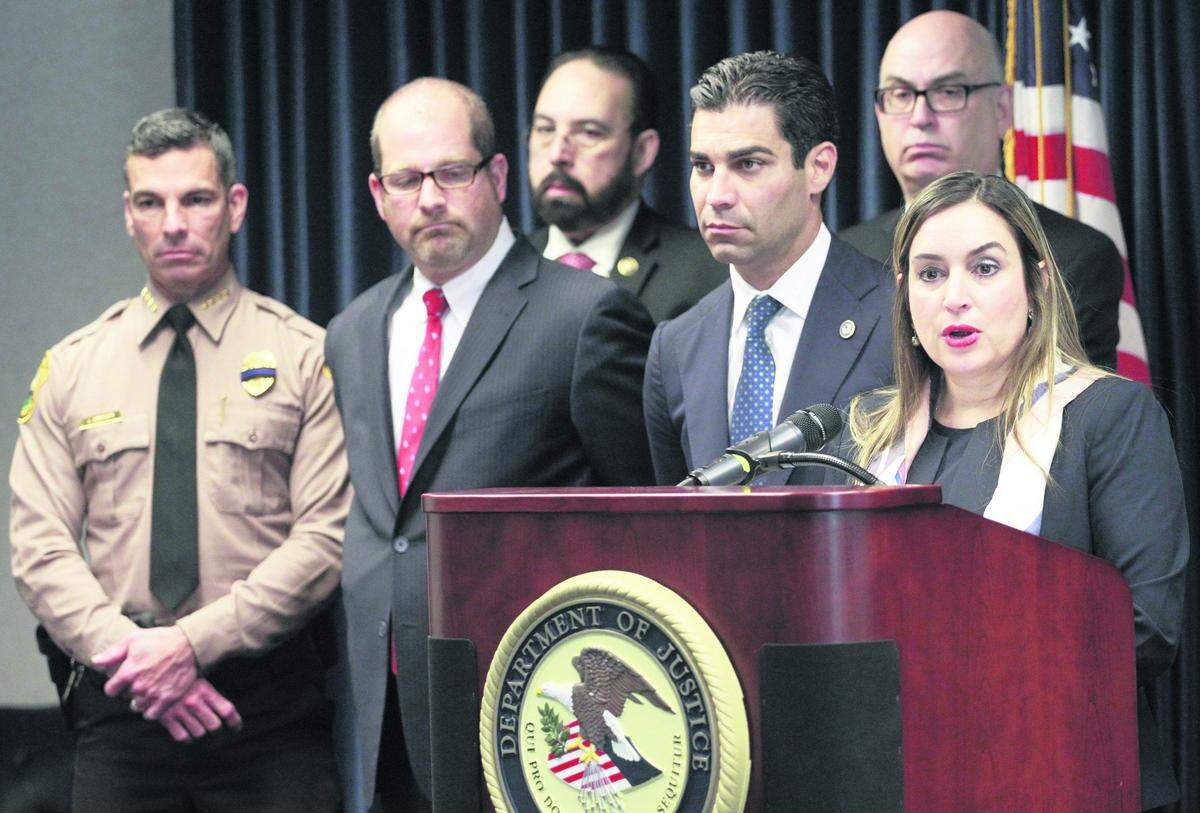
It’s unusual for U.S. attorneys to appear in court, let alone for a traffic case, and her appearance created a bit of a buzz in the courthouse. Several legal experts questioned Fajardo’s judgment for inserting herself into her niece’s case but said it doesn’t appear to violate any ethical rules governing lawyers.
Robert Jarvis, an ethics expert at Nova Southeastern University’s law school, said Fajardo had every right to represent her family at a hearing unconnected with her work as a federal prosecutor. But he said it was probably a “poor choice” because of the perception of using a powerful position to influence legal proceedings.
“The real question is: wasn’t there someone else who could go as an advocate on behalf of her niece?” Jarvis said.
Fajardo told the Miami Herald that she never intended on speaking and accompanied her 20-year-old niece, whom she raised as a daughter, strictly as a personal matter. She said she became concerned because Samantha Fajardo, a University of Miami student, was suffering from anxiety as the state considered whether to delay the trial.
“You don’t stop being a parent because of the title you have,” Fajardo told the Miami Herald
The Miami-Dade State Attorney’s Office said the prosecutor on the case didn’t know who Fajardo was. The judge didn’t ask Fajardo to identify herself when she spoke up. But she is well known in the Richard E. Gerstein Building, where she worked a state prosecutor and circuit judge before President Trump nominated her as South Florida’s U.S. Attorney in June 2018.
The U.S. Department of Justice guidelines state that employees must get permission to do outside legal work. Fajardo said those guidelines don’t apply to this case because she was there as a family member.
“I wasn’t representing her. I wasn’t acting as her lawyer,” Fajardo said.
This story was originally published November 12, 2019 at 6:00 AM.