
Miami-Dade’s new Tree Island Park preserves a wild chunk of the Everglades in suburbia
On a clear, cool weekday morning out in far west Miami-Dade, the turkey vultures circling overhead are getting a panoramic view of one of the county’s most remarkable sights: an expansive green rectangle containing a newly thriving, waterlogged piece of the Everglades, completely boxed in by row upon row of houses and townhomes.
Welcome to Tree Island Park, the newest gem in Miami-Dade’s far-reaching and diverse park system — and the draw for the buzzards scouring for prey below in the preserved marsh, near the edge of sprawling suburbia along the Tamiami Trail.
A work-in-progress 20 years in the making, Tree Island Park represents an unusual hybrid. It’s another step in the broadening scope and range of the county park system under an ambitious 50-year blueprint, approved in 2008, that aims in part to reconnect urban dwellers to nature.
The park’s nearly 115 acres include a newly opened community park serving a dense, growing suburban area starved for neighborhood recreational space, and it’s combined with a big remnant of unspoiled East Everglades ecosystem — or as unspoiled as several years of restoration work can make it.
The five-acre recreational park, the first of three planned phases, formally opened March 3. When the park is complete, facilities will include playing fields, tennis courts, a swimming pool and community center.
Tree Island’s natural bent is evident. Monarch butterflies and dragonflies abound, attracted by porterweed and bahia grass, respectively. Newly planted live oaks, gumbo limbos and wild tamarinds will in time provide a natural shade canopy over play areas, a fitness zone and the multi-use paved pathways that wind through the park. The drought-resistant plantings also reduce the need for watering once they become established. The kids’ playground uses natural materials, like stepping stones actually made of stone.
“It’s just an amazing place,” said Giovanni Lignarolo, whose Scapeshift was landscaping subcontractor for the park, as he led a crew watering and checking the still-fresh plantings. “I’m just in awe and privileged to be a part of this.”
The environmentally friendly emphasis extends to six electric-car charging stations and high-efficiency LED lighting.
The neighborhood park, at the corner of Southwest 11th Street and 147th Avenue, is already finding steady use from visitors of all ages, an indication of pent-up demand for its offerings. During a two-hour span on a recent Tuesday morning, there were joggers and power-walkers doing loops. Someone pushed a woman in a wheelchair around the paved walkways. People worked out on the fitness equipment, while kids and their parents enjoyed the playground. Dogs and their owners were in full frolic at the two bark parks.
“At any time, you’re almost guaranteed to see people using it. I’ve been here as early as 6 a.m. and seen people walking, running and exercising, and it’s all within a few minutes’ walk of your house,” said park manager Albert Alamina.
WET AND WILD
But the bulk of the park, around 70 acres, will remain wild and mostly wet.
The preserve encompasses a sampling of the full range of the imperiled Bird Drive Basin ecosystem, a 13-square-mile area of Everglades wetlands that functions as a key recharge for Miami-Dade’s underground aquifer water supply. That means mucky freshwater, marl prairie and 20 acres of the dry hardwood hammock habitats, commonly known as tree islands, that give the park its name.
The county park system’s natural areas management team is now in the middle of a five-year program of removal of invasive melaleuca trees and other exotic vegetation that had nearly overrun the property. The removal will allow the native trees and plants in the preserve to grow and thrive naturally, parks managers say. Once that’s done, the preserve will be managed by the county’s Environmentally Endangered Lands program, which oversees 24,000 acres across Miami-Dade.
There is no public access to the sensitive preserve yet, but parks administrators hope to eventually allow visitors in for guided tours and volunteer environmental work, Miami-Dade parks director Maria Nardi said.
“It allows a window into the ecological history of the area,” Nardi said. “As the community continues to get more urban, you can have respites that keep us all connected to nature.”
The importance of that connection was underscored by the COVID-19 pandemic, Nardi said. The county’s parks saw a sharp spike in visitors as residents sought outdoor spaces and trails for relief from lockdowns and crowded indoor places.
“People got to reconnect with their local parks,” she said. “We saw increased use and increased awareness of our parks.”
Tree Island is far from the only county park that blends nature with recreation. The agency, which bills itself as the third-largest parks system in the country, maintains some pure nature preserves, like the 112-acre Castellow Hammock Park and Nature Center in south Miami-Dade’s Redlandagricultural area. But the idea of combining play and wild places goes back to the department’s roots in the 1930s.
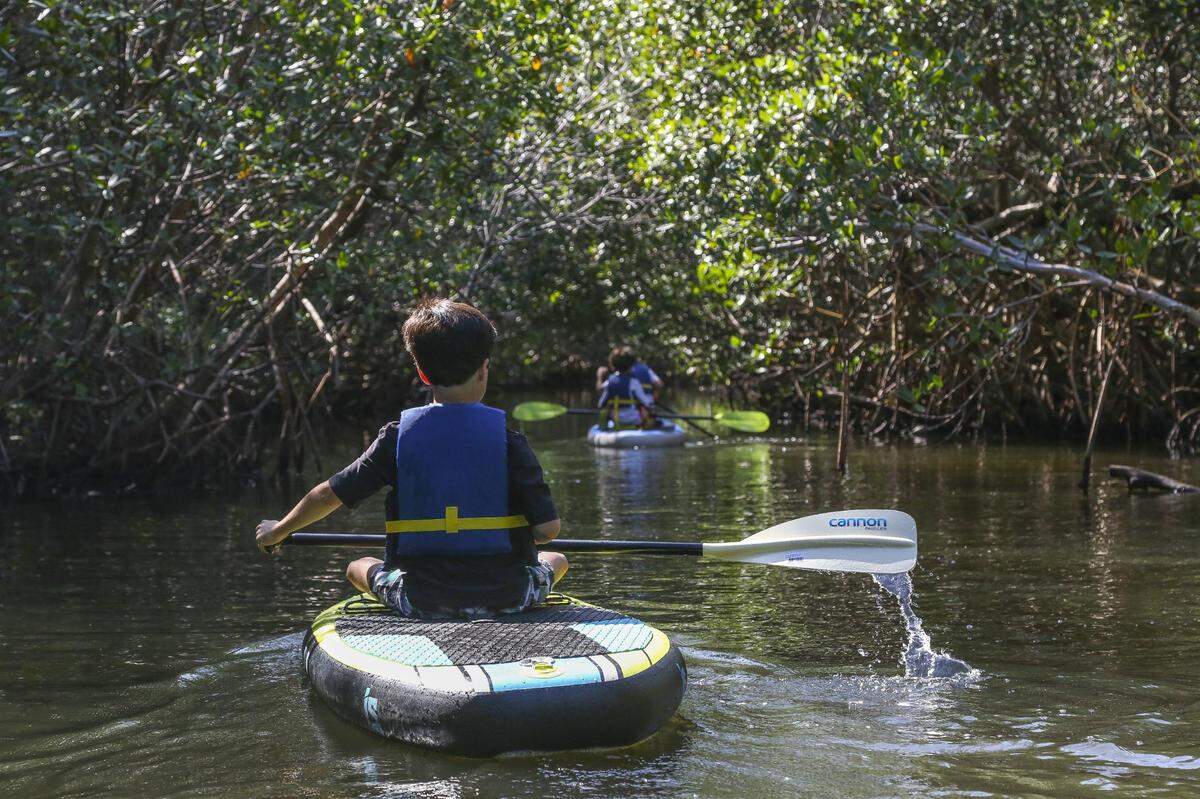
The county’s very first park, Greynolds Park in North Miami Beach, provides a nature-centered experience, with trails, hammocks, mangroves and a kayak and canoe launch, but its 250 acres also include a playground and a golf course.
The last big county park to open before Tree Island, the 164-acre West Kendall District Park, also lies at the edge of Miami-Dade’s urban development line, the invisible demarcation between city and natural and agricultural areas. A popular, nearly 9-acre dog park and limited walking trails opened in 2011; plans call for a sports complex and more trails on the remainder of the property, former farmland, as funding becomes available.
The park also sits on the unfinished Black Creek Trail, with an as-yet unpaved gravel section extending two miles west to the Krome Path, a separated, paved bikeway just finished by the Florida Department of Transportation as part of a roadway widening. The path runs along rural Krome Avenue for 20 miles from the Tamiami Trail to Southwest 312th street.
To the south of the West Kendall park, the Black Creek trail, which follows the canal of the same name, will eventually connect to the east to a wide and smooth, completed 8.7-mile segment that starts at Black Point Park and Marina on Biscayne Bay and now ends near the county’s Larry and Penny Thompson Memorial Park and Campground.
NATURE AND NEIGHBORHOODS
That network highlights another ambitious goal of the county parks master plan: Linking parks and natural areas to neighborhoods and one another via trails and paved greenways as much as possible, putting both nature and recreation within easy walking or cycling distance from any county resident’s home.
In the latest initiative, county parks planners have launched an effort to identify and designate “blueways,” bayfront areas and lake and canals that can provide convenient access to the water for paddlers and rowers. The blueways would also connect parks and neighborhoods.
The county department is also re-emphasizing nature as it retools some long-established parks in need of upgrades and restoration, including Matheson Hammock West and Chapman Field parks, both in Coral Gables — though the effort has come with some friction.
A $3.3 million project will restore Matheson West’s hardwood hammock and native habitats, add a boardwalk and create a fenced off-leash dog run in the 109-acre park — though a neighborhood gate that’s been the subject of a long-running dispute between park visitors and nearby wealthy residents will be closed permanently to all but pedestrians and cyclists.
At 48-year-old Chapman Field, where three in-demand baseball fields were closed six years ago after soil contamination was discovered, only one will be restored under a new $3.3 million plan. The other two will be turned into open green space for visitors to “walk, picnic, explore nature and contemplate,” parks planners said. Some neighbors have bitterly complained about the loss of the playing fields, but the department’s chief planner, Joe Cornely, citing the master plan, has said the Chapman Field project represents a better balance of passive and recreational uses for locals.
Tree Island Park, by contrast, was a natural, degraded remnant saved from bulldozing when the county bought it in 2011.
Permitting and platting issues that the parks department described as “very complex” delayed development of the community park, eventually paid for with nearly $6.3 million in general obligation bonds and development impact fees. The park was designed by Forbes Architects and Bell Landscape Architecture and built by HG Construction Development.
Ten blocks to the west of the park, along Southwest 157th Avenue, urban development ends abruptly. There the East Everglades wetlands begin, and, farther west along the Trail are Everglades National Park and the Big Cypress National Preserve.
But nothing beats having a bit of the Everglades so close to home, parks director Nardi said.
“The parks master plan is really a health plan for the environment and the community,” she said. “Parks play a critical role in health, recreation and resiliency.
“I don’t say this lightly, but parks will help save the planet.”
This story was originally published March 31, 2021 at 7:00 AM.